36,38
-1
1560
30
Briefs: Manufacturing & Prototyping
Sometimes referred to as “solid smoke,” aerogels are the world’s lightest solid materials, composed of approximately 85% air by volume. Polyamide aerogels open up a whole new world of...

Briefs: Materials
Advanced Multilayer Environmental Barrier Coatings
Innovators at NASA’s Glenn Research Center have created exciting new developments in thermal barrier coatings, both in the chemical compositions of the coatings and in the process by which they are applied. NASA’s researchers have developed a revolutionary bond coat system that improves the...
Briefs: Manufacturing & Prototyping
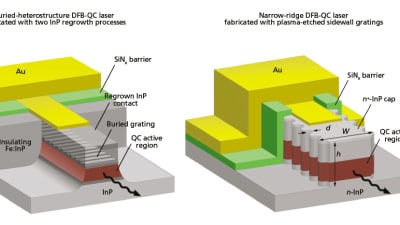
Quantum cascade (QC) lasers employ intersubband electronic transitions in semiconductor quantum well structures to generate emission at specific...
Briefs: Aerospace
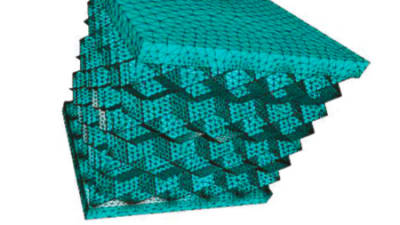
NASA has developed a versatile method and associated apparatus for constructing and using a conductive filament in various applications of 3D printing. It uses an attractive polymer formulation,...
Briefs: Manufacturing & Prototyping
NASA’s Langley Research Center has developed carbon fiber reinforced composites with self-healing properties. The initiation and propagation of damage to carbon...

Briefs: Manufacturing & Prototyping
Improved Impact Toughness and Heat Treatment for Cast Aluminum
NASA’s Marshall Space Flight Center researchers have developed a new, stronger aluminum alloy, ideal for cast aluminum products that have powder or paint-baked thermal coatings. With advanced mechanical properties, the NASA-427 alloy shows greater tensile strength and increased...
Briefs: Manufacturing & Prototyping
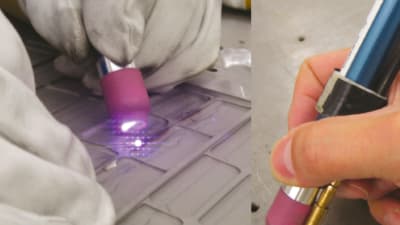
NASA’s Marshall Space Flight Center developed the handheld laser torch, designed for welding and brazing metals, to repair hard-to-reach Space Shuttle engine nozzles. It incorporates various manual...
Briefs: Materials
NASA seeks to license the Adaptive Thermal Management System (ATMS) for use in commercial applications. Developed at the John F. Kennedy Space Center, the ATMS provides a way to regulate heat transfer and...

Briefs: Materials
NASA’s Goddard Space Flight Center has developed a new method for bonding dissimilar materials using an elastic adhesive to permit the bond to withstand variations in temperature and pressure....

Briefs: Materials
The Johnson Space Center researched methods to coat aerogel insulation in order to make it better able to withstand vibration, mechanical compression and...

Briefs: Materials
Insulative Carbon Fiber Systems for Aerospace Applications
New insulative carbon-fiber composite systems have been developed for use in structural and thermal applications for the aerospace vehicle interface. The sandwich-type composite structure, including carbon fiber and aerogel blanket materials, is based on the previously disclosed family of...
Briefs: Materials
Methods and Systems for Non-Invasive Treatment of Tissue Using High-Intensity Focused Ultrasound Therapy
Minimally invasive and non-invasive therapeutic ultrasound treatments can be used to ablate, necrotize, and/or otherwise damage tissue. High-intensity focused ultrasound (HIFU), for example, is used to thermally or mechanically damage tissue....
Briefs: Materials
Future-generation materials for use on space transportation vehicles require substantial improvements in material properties leading to increased...

Briefs: Materials
Multi-Phase Ceramic System
Bearing surfaces are typically either metal-on-metal (MOM), ceramic-on-ceramic (COC), or metal-on-polyethylene (MOP). MOM and MOP couplings have the drawback that metallic or polyethylene particles can sometimes separate from the couplings, which can cause significant problems, particularly in a hip or joint replacement....
Briefs: Materials
Minimally Machined HoneySiC Panels and T300 HoneySiC
The primary purpose of this work is to develop and demonstrate technologies to manufacture ultra-low-cost precision optical systems for very large x-ray, UV/optical, or infrared telescopes.
Briefs: Materials
NASA’s Langley Research Center has developed composite elastic skins for covering shape-changing (morphable) structures. These skins are intended especially for use on advanced aircraft that change shapes in...

Briefs: Materials
Aeroplastic Composites
Aeroplastic refers to a family of polymeric composites with properties that provide a significant reduction in heat transfer. These composites reduce the thermal conductivity of the base polymer resin between 20%-50% without changing its mechanical properties or modifying the original techniques for processing those polymers....
Briefs: Materials
Shape memory alloys (SMAs), sometimes known as “smart metals,” provide a lightweight, solid-state alternative to conventional actuators and switches, such as...

Briefs: Materials
NASA has developed a class of low-density, flexible ablators that can be fabricated into heat-shields capable of being packaged, stowed, and deployed in space. The key characteristics of this new ablative...

Briefs: Materials
Resistive Heating Method for TPS Property Measurements
A unique ultrasonic-based technique has been developed to measure temperature profiles in materials used in thermal protection systems (TPS). The technology requires measurements of the thermal expansion coefficient and the ultrasonic velocity for these materials as a function of temperature in...
Briefs: Materials
Measuring Bond Site Concentration on the Intrinsic Aerogel Surface Through Chemisorption of Chlorosilanes
This work involves development of aerogel to be used as a passive absorption media — effectively a concentrator of trace organics — that can be detected by optical techniques. Such a trace organic detection scheme is very different from all...
Briefs: Materials
Toughened Uni-piece Fibrous Reinforced Oxidation-Resistant Composite (TUFROC)
The Toughened Uni-piece Fibrous Reinforced Oxidation-Resistant Composite (TUFROC) allows for much more affordable and sustainable operations involving Space Launch Services and other systems that utilize Earth re-entry vehicles. TUFROC has an exposed surface design and...
Briefs: Materials
Effects of Postcure and Associated Design Allowables for M55J/RS-3C Polycyanate Composite
M55J/RS-3C resin composite structures on the James Webb Space Telescope (JWST) sunshield will concurrently maintain loads and be exposed to temperature extremes throughout the life of the observatory. Increasing the glass transition temperature (Tg) is...
Briefs: Materials
NASA-developed polyimide aerogels are 500 times stronger than conventional silica aerogels. The innovative aerogels represent a revolutionary advance over fragile silica aerogels...

Briefs: Materials
Catalytic Oxidation of Organic Contaminants at Reduced Pressure
The current technology for catalytic oxidation of aqueous organic contaminants at elevated temperature and pressure works well at operating conditions of 265 °F and 70 psia with effluent TOCs (total organic carbon) of less than 0.5 ppm. However, it does not perform well at the reduced...
Briefs: Materials
Approach for Achieving Flame Retardancy While Retaining Physical Properties in a Compatible Polymer Matrix
NASA’s Kennedy Space Center (KSC) seeks to license its Advanced Fire Retardant Materials to industry. KSC’s scientists have developed processes and know-how to impart fire retardancy to common polymers such as nylons, polyesters, and...
Briefs: Materials
NASA’s Langley Research Center has developed a new technique to enable the preparation of metal/composite hybrid laminates, also known as fiber metal laminates (FML), by...

Briefs: Manufacturing & Prototyping
NASA’s Langley Research Center is developing a robotic arm with lightweight joints that provide a wide range of motion. The envisioned design provides users with a long reach and numerous...

Briefs: Manufacturing & Prototyping
Lattice Structures Coating Concept for Efficient Thermal Linking Beds
Conventional air revitalization technology for removal of CO2, moisture, and trace organic contaminants usually involves a packed bed of sorbent pellets that can be regenerated using a concept similar to that of pressure swing adsorption (PSA). Additional heat input for thermal...
Top Stories
 Blog: Lighting

A Stretchable OLED that Can Maintain Most of Its Luminescence
 Blog: Energy

Batteries that Can Withstand the Cold
 INSIDER: Energy

Advancing All-Solid-State Batteries
 Quiz: Energy

 Blog: Physical Sciences

 Blog: Materials

Webcasts
 Upcoming Webinars: Test & Measurement

From Spreadsheets to Insights: Fast Data Analysis Without Complex...
 Upcoming Webinars: Electronics & Computers

Cooling a New Generation of Aerospace and Defense Embedded...
 Upcoming Webinars: Test & Measurement

Beyond AI-Copy-Paste Engineering: Advanced AI-Integration Success...
 Upcoming Webinars: Automotive

Battery Abuse Testing: Pushing to Failure
 Upcoming Webinars: Internet of Things

A FREE Two-Day Event Dedicated to Connected Mobility
 Upcoming Webinars: Test & Measurement

Choosing the Right N-Port Strategy: Multiport VNAs vs. Switch...