36,38
-1
1740
30
Briefs: Software
A Model of Reduced Oxidation Kinetics Using Constituents and Species
Elementary-reaction chemical kinetics of hydrocarbon oxidation consists of hundreds to thousands of species and thousands of reactions. As such, it is impossible to use it in models and codes involving turbulence because computations are unfeasible due to lack of memory and...
Briefs: Materials
Determining Radiation Shielding Capability of the Earth’s Atmosphere from FAA Radiation Data
The FAA, using its CARI-6 program, provides galactic cosmic radiation dosage rates for any location on the Earth from ground up to 60,000 ft (≈18,300 m). One way to protect astronauts from galactic cosmic radiation (GCR) on a Mars mission is to use...
Briefs: Manufacturing & Prototyping
Advanced Composite Thrust Chambers for In-Space Propulsion
Radiation-cooled, bipropellant thrust chambers are being used for in-space propulsion. To increase the performance of radiation-cooled engines, improved chamber materials are needed that will allow higher operating conditions (pressure and temperature), better resistance to oxidation, and...
Briefs: Manufacturing & Prototyping
Integrally Woven Fiber Architecture for Composite Turbine Blades
Composite turbine blades are currently fabricated by laying up multiple layers of fibers in the form of either unidirectional prepregs or thin woven cloth. Composites formed in this manner have poor through-thickness strength. It is also difficult, if not impossible, to form trailing...
Briefs: Manufacturing & Prototyping
Assembly and Packaging to Mass-Produce Carbon Nanotube Vacuum Microdevices and Circuits
Field-emission electron sources using carbon nanotubes (CNTs) are being targeted for low-power vacuum microelectronic applications for harsh-environment operation (high temperature, pressure, and corrosive atmosphere). While CNTs have demonstrated excellent...
Briefs: Materials
High-Efficiency, Easy-to-Manufacture Engineered Nanomaterials for Thermoelectric Applications
Stated generally, reducing the dimensionality of bulk-scale thermoelectric (TE) materials is theoretically and practically understood to be a viable route for maintaining/increasing phonon scattering, and maintaining/increasing electrical conductivity —...
Briefs: Materials
Refractory Open-Cell Foam Fuel Matrix for High-Efficiency Nuclear Thermal Propulsion
A tricarbide foam fuel material has been developed that can operate at temperatures near 3,000 °C, without substantial hydrogen erosion, while providing highly efficient heat transfer to the coolant or propellant. A tricarbide foam fuel matrix of zirconium carbide...
Briefs: Materials
Hydrazine Absorbent/Detoxification Pad
A new chemistry was developed for existing hydrazine absorbent/detoxification pads. Enhancements include faster reaction rates, weight reduction, a color change that indicates spill occurrence, and another color change that indicates successful hydrazine degradation. The previous spill control pad, using...
Briefs: Materials
Nanotechnology Approach to Lightweight, Multifunctional Polyethylene Composite Materials
Of several ideas being pursued by NASA for the reduction of radiation dosage to astronauts, the use of ultra-high-molecular-weight polyethylene (UHMWPE)-based composite materials for both radiation shielding and micrometeorite shielding appears to be...
Briefs: Materials
Electrostrictive Polymers
A new class of electroactive polymeric blend materials has been created that offers both sensing and actuation dual functionality. The blend is comprised of two components where one has sensing capability, and the other has actuating capability. These innovative materials provide significant field-induced strain, high...
Briefs: Manufacturing & Prototyping
Full-Cell Evaluation/Screening Technique for New Battery Chemistries
A quick and cost-effective evaluation/screening technique for new battery chemistries was developed that integrates the individual advanced cell component in a full-cell format to identify the critical issues, such as cell component interaction and compatibility before proceeding...
Briefs: Manufacturing & Prototyping
Growth Method for Chalcongenide Phase-Change Nanostructures
Recently, one-dimensional (1-D) nanostructures, such as nanowires and nanotubes, have become the focal point of research in nanotechnology due to their fascinating properties. These properties are intrinsically associated with low dimensionality and small diameters, which may lead to...
Briefs: Manufacturing & Prototyping
ELID Grinding of Large Aspheres
This work focused on a manufacturing process to produce silicon carbide optical surfaces with low mid-spatial surface errors. Mid-spatial frequency (MSF) and high-spatial frequency (HSF) surface errors in the grinding of fast aspheres are amplified in hard ceramics like silicon carbide due to cyclic tool wear rates,...
Briefs: Manufacturing & Prototyping
Highly Aligned Electrospun Fibers and Mats
A modified electrospinning apparatus has been created for spinning highly aligned polymer fibers. Fiber placement, orientation, and porosity are difficult to control using conventional electrospinning apparatus. Conventional electrospinning creates randomly oriented fibers that are well suited to nonwoven...
Briefs: Manufacturing & Prototyping
Solar Panel and System Design to Reduce Heating and Optimize Corridors for Lower-Risk Planetary Aerobraking
This innovation presents a spacecraft aerobraking approach that reduces heating and optimizes corridors, which reduces overall risk. This is accomplished by combining solar panel aspect ratio and edge features with simple spacecraft packaging...
Briefs: Manufacturing & Prototyping
Low-Cost, Very Large Diamond-Turned Metal Mirror
This innovation is a method for fabricating a low-cost, lightweight, large-aperture mirror by constructing only the mirror substrate by electroforming on a master form machined from plastic foam. Electroformed tubes of the same NiP alloy are installed in the foam mirror substrate master. Installing...
Briefs: Manufacturing & Prototyping
Very-High-Load-Capacity Air Bearing Spindle for Large Diamond Turning Machines
Large-load-capacity oil hydrostatic bearings generate prohibitive amounts of heat in large sizes when run at speeds useful for diamond turning of optical components. The viscosity of air is more than three orders of magnitude less than the thinnest oil; therefore, the...
Briefs: Materials
Elevated-Temperature, Highly Emissive Coating for Energy Dissipation of Large Surfaces
This coating demonstrates high emittance above 80% or better at broad wavelengths within the infrared spectrum. It has shown to have an extremely stable emittance at lower wavelengths within the infrared (IR) spectrum, where energy dissipation is critical at...
Briefs: Materials
Catalyst for Treatment and Control of Post-Combustion Emissions
Emissions from fossil-fuel combustion contribute significantly to smog, acid rain, and global warming problems, and are subject to stringent environmental regulations. These regulations are expected to become more stringent as state and regional authorities become more involved in...
Briefs: Materials
Thermally Activated Crack Healing Mechanism for Metallic Materials
A thermally activated healing mechanism is proposed and experimentally validated to mitigate crack propagation damage in metallic materials. The protected structure is coated with a thin metallic film of a low-melting-temperature healing agent. To heal or mitigate crack damage, the...
Briefs: Materials
Subsurface Imaging of Nanocomposites
A nondestructive method that is based on modified atomic force ultrasonic microscopy (AFUM) methods has been developed for characterizing nanomaterials. The technology allows imaging and quantifying of material properties at the surface and subsurface levels. The technology reveals the orientation of nanotubes...
Briefs: Materials
Self-Healing Glass Sealants for Solid Oxide Fuel Cells and Electrolyzer Cells
A solid oxide fuel cell (SOFC) is an electrochemical device that converts chemical energy into electrical power. A solid oxide electrolyzer cell (SOEC) operates in a reverse mode of SOFC, and produces O2 and H2 gases. SOFCs are being developed for a broad range of...
Briefs: Materials
Micromachined Thermopile Arrays with Novel Thermo-electric Materials
Future missions to outer planets will have stringent limits on payload mass. Thermal imaging instruments to map planetary surfaces will be part of those payloads, and, consequently, will have to be compact and low mass. For thermal instruments, another key requirement will be...
Briefs: Materials
Low-Cost, High-Performance MMOD Shielding
High-performance micro-meteoroid and orbital debris (MMOD) shielding can be constructed from low-cost, off-the-shelf materials. The advantage in using this innovation is in achieving considerable reduction in both cost and mass of the shielding necessary to protect spacecraft from hypervelocity MMOD...
Briefs: Manufacturing & Prototyping
Tailored 3D Fiber Architecture to Improve CVI Processing
An improvement has been made to the infiltration of 3D woven and 3D braided preforms that will lead to the manufacture of CMC (ceramic matrix composite) and C–C (carbon-carbon) composites based on 3D fiber architectures that have low residual porosity and smaller void sizes. Tailoring the...
Briefs: Manufacturing & Prototyping
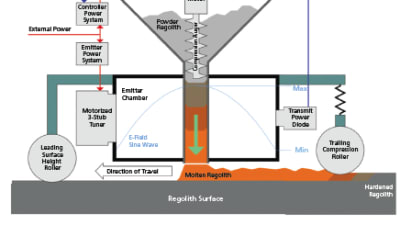
There is a need to develop an efficient method for processing lunar regolith in support of future missions to colonize the Moon. A system for heating lunar regolith (“moon soil”) using...
Briefs: Manufacturing & Prototyping
Novel Chemistry for Deposition of MgF2 Thin Films
Magnesium fluoride (MgF2) thin films are useful for many different optics applications. In particular, they are useful for ultraviolet anti-reflective and protective coatings. However, in the far UV, one needs a very small, controllable amount of material to get the best optical performance. That is...
Briefs: Materials
ITO is a doped metal oxide semiconductor that combines two properties that usually are mutually exclusive in most materials: optical transparency and electrical conductivity. It is...

Briefs: Materials
Electride Mediated Surface Enhanced Raman Spectroscopy
A new sensor substrate supports Surface Enhanced Raman Spectroscopy. A ceramic electride is demonstrated to provide surface enhanced Raman scattering. This provides a sensitive method for monitoring the chemistry and electronic environment at the electride surface. The electride, an ionic...
Top Stories
 Blog: Lighting

A Stretchable OLED that Can Maintain Most of Its Luminescence
 Blog: Energy

Batteries that Can Withstand the Cold
 INSIDER: Energy

Advancing All-Solid-State Batteries
 Quiz: Energy

 Blog: Physical Sciences

 Blog: Materials

Webcasts
 Upcoming Webinars: Test & Measurement

From Spreadsheets to Insights: Fast Data Analysis Without Complex...
 Upcoming Webinars: Electronics & Computers

Cooling a New Generation of Aerospace and Defense Embedded...
 Upcoming Webinars: Test & Measurement

Beyond AI-Copy-Paste Engineering: Advanced AI-Integration Success...
 Upcoming Webinars: Automotive

Battery Abuse Testing: Pushing to Failure
 Upcoming Webinars: Internet of Things

A FREE Two-Day Event Dedicated to Connected Mobility
 Upcoming Webinars: Test & Measurement

Choosing the Right N-Port Strategy: Multiport VNAs vs. Switch...