51
-1
390
30
Briefs: Mechanical & Fluid Systems
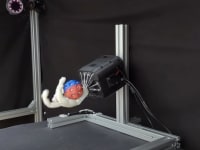
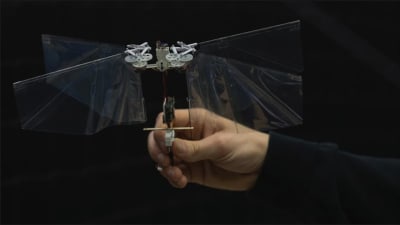
Flying animals both power and control flight by flapping their wings. This enables small natural flyers such as insects to hover close to a flower but also to rapidly escape danger. Animal flight has...
Briefs: Materials
Researchers have developed a fiber that combines the elasticity of rubber with the strength of a metal, resulting in a tougher material. The fibers consist of a gallium metal core surrounded...

Briefs: Sensors/Data Acquisition
Smart Electronic Skin for Robots and Prosthetics
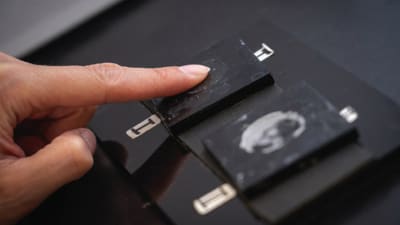
Humans use the sense of touch to accomplish almost every daily task such as picking up a cup of coffee or shaking someone’s hand. Without it, humans can even lose their sense of balance when walking. Similarly, robots need to have a sense of touch in order to interact better with humans but robots...
Briefs: Medical
Researchers have developed a formula that enables them to recreate different levels of perceived softness. Based on the results from their experiments, they created equations that can calculate how soft...
Briefs: Robotics, Automation & Control
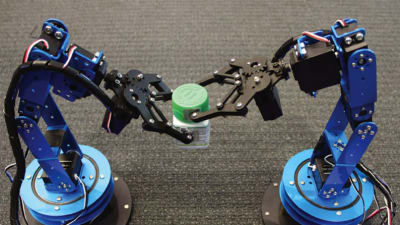
A system was developed that uses radio-frequency identification (RFID) tags to help robots target moving objects with unprecedented speed and accuracy. The system could enable greater...
Briefs: Photonics/Optics
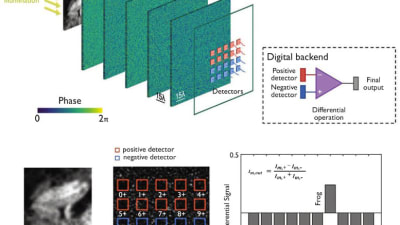
UCLA engineers have made major improvements on their design of an optical neural network — a device inspired by how the human brain works — that can identify objects or process...
Briefs: Manufacturing & Prototyping
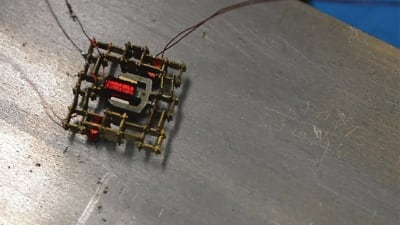
A set of five tiny fundamental parts can be assembled into a wide variety of functional devices including a tiny “walking” motor that can move back and forth across a surface or...
Briefs: Sensors/Data Acquisition
Between walking and running, human gaits can cover a wide range of speeds; for example, at low speeds, the metabolic rate of walking is lower than that of running in a slow jog. The...

Briefs: Manufacturing & Prototyping
A radically new kind of airplane wing, assembled from hundreds of tiny identical pieces, can change shape to control the plane’s flight, and could provide a significant boost in aircraft...

Briefs: Communications
Technique Locates Robots and Humans in GPS-Challenged Environments
An algorithm enables localization of humans and robots in areas where GPS is unavailable. The Army needs to be able to localize agents operating in physically complex, unknown, and infrastructure-poor environments. This capability is critical to help find dismounted soldiers and for...
Briefs: Manufacturing & Prototyping
Researchers have 3D-printed an all-liquid device that, with the click of a button, can be repeatedly reconfigured on demand to serve a wide range of applications from making battery materials to screening drug...
Briefs: Manufacturing & Prototyping
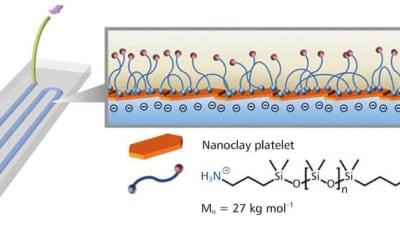
A smartphone app was developed that allows a user to easily program any robot to perform a mundane activity such as picking up parts from one area and delivering them to another. The app, called VRa, uses...

Briefs: Automotive
A high-sensitivity and low-noise MEMS accelerometer was developed using multi-layer metal structures composed of multiple metal layers. The accelerometer achieves 1 μG level resolution that has...

Briefs: Internet of Things
Soft robots have a distinct advantage over rigid robots: they can adapt to complex environments, handle fragile objects, and interact safely with humans. Made from silicone, rubber, or other stretchable polymers, they...

Briefs: Mechanical & Fluid Systems
An automated system designs and 3D-prints complex robotic parts that are optimized according to an enormous number of specifications. The system fabricates actuators — devices that mechanically control...

Briefs: AR/AI
Robotics has traditionally focused on industrial applications in which robots require strength and precision to carry out repetitive tasks. These robots flourish in highly...

Briefs: Mechanical & Fluid Systems
While different approaches have been used to create artificial muscles — including hydraulic systems, servomotors, shape-memory metals, and polymers that respond to stimuli — they all have limitations such as...

Briefs: Motion Control
The Advanced Explosive Ordnance Disposal Robotic System (AEODRS) features a modular open systems architecture that enables the robot to be self-righting after a fall. The self-righting...

Briefs: Manufacturing & Prototyping
In the future, soft, animal-inspired robots may be safely deployed in difficult-to-access environments in which rigid robots cannot currently be used such as inside the human body or in spaces that are too...

Briefs: Materials
Microrobots that can deliver drugs to specific spots inside the body while being monitored and controlled from outside the body have been developed that also can treat tumors in the...

Briefs: Materials
Researchers have created 3D-printed flexible mesh structures that can be controlled with applied magnetic fields while floating on water. The structures can grab small objects and carry water droplets, giving them...

Briefs: Photonics/Optics
The production of precision products depends on robot control systems knowing the location of the adhesive bonding head or welding head to the nearest millimeter at all times. This means the robot...
Briefs: Photonics/Optics
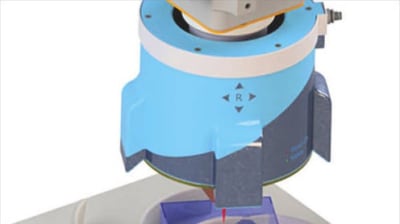
A new MIT-developed technique enables robots to quickly identify objects hidden in a three-dimensional cloud of data, reminiscent of how some people can make sense of a densely patterned “Magic Eye” image if...

Briefs: Robotics, Automation & Control
There is great potential in using both drones and ground-based robots for situations like disaster response, but generally these platforms either fly or creep along the ground. The flying...

Briefs: Sensors/Data Acquisition
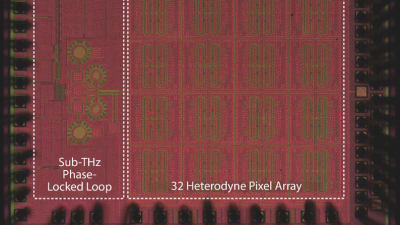
Autonomous vehicles relying on light-based image sensors often struggle to see through blinding conditions such as fog. Sub-terahertz wavelengths, which are between microwave and...
Briefs: Materials
NASA's Langley Research Center offers a novel lifting and precision positioning device with hybrid functional characteristics of both crane-type lifting devices and robotic manipulators. The design of the Lunar...

Briefs: Mechanical & Fluid Systems
Deployable Emergency Shutoff Device Blocks High-Velocity Fluid Flows
NASA's Marshall Space Flight Center has developed a device and method for blocking the flow of fluid from an open pipe. The device plugs, controls, and meters the flow of gases and liquids. Anchored with friction fittings, spikes, or explosively activated fasteners, the device is...
Briefs: Sensors/Data Acquisition
Researchers have created wearable technology to convert mechanical energy into electrical energy. It presents a step toward the practical realization of self-powered, human-integrated technologies.

Briefs: Imaging
A robot is being developed that tracks facial movements to perform human tasks. The robot resembles large, squiggly arms holding tiny cameras. Sitting in a rolling office chair across from one of the arms, the robot's...

Top Stories
 Blog: Power

My Opinion: We Need More Power Soon — Is Nuclear the Answer?
 Blog: AR/AI

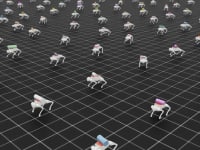
Aerial Microrobots That Can Match a Bumblebee's Speed
 News: Energy

 Blog: Electronics & Computers

Turning Edible Fungi into Organic Memristors
 Blog: Robotics, Automation & Control

Microscopic Swimming Machines that Can Sense, Respond to Surroundings
 INSIDER: Sensors/Data Acquisition
Webcasts
 Upcoming Webinars: Energy

Hydrogen Engines Are Heating Up for Heavy Duty
 Upcoming Webinars: Transportation

Advantages of Smart Power Distribution Unit Design for Automotive...
 Upcoming Webinars: Automotive

Quiet, Please: NVH Improvement Opportunities in the Early Design...
 Upcoming Webinars: Test & Measurement

From Spreadsheets to Insights: Fast Data Analysis Without Complex...
 Upcoming Webinars: Power

Battery Abuse Testing: Pushing to Failure
 Upcoming Webinars: Internet of Things