51
-1
510
30
Briefs: Robotics, Automation & Control
A group of researchers at Osaka University, Kobe University, Tohoku University, The University of Tokyo, and Tokyo Institute of Technology developed construction robots for disaster relief that solve the...

Briefs: Motion Control
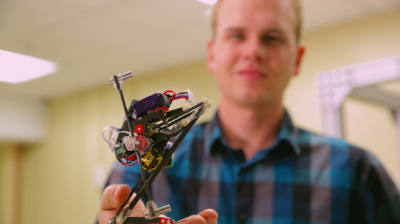
Roboticists at the University of California, Berkeley, have designed a small robot that can leap into the air and then spring off a wall, or perform multiple vertical jumps in a row, resulting in...
Briefs: Robotics, Automation & Control
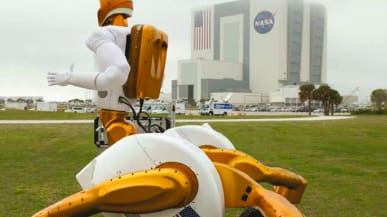
Researchers at NASA’s Johnson Space Center (JSC), in collaboration with General Motors and Oceaneering, have designed a state-of-the-art, highly dexterous, humanoid robot: Robonaut 2 (R2). R2...
Briefs: Motion Control
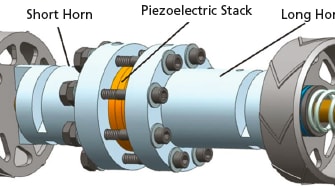
Actuators are a critical driver of all the mechanisms used in space, and improvements of their operation mechanism enhance...
Briefs: Robotics, Automation & Control
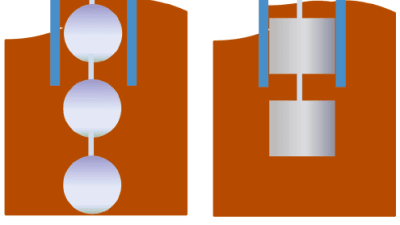
The Mars 2020 coring drill will generate a significant amount of dust and debris (known as fines) due to the volume of milled material displaced by the corer’s annulus. These cuttings must be removed to ensure...
Briefs: Robotics, Automation & Control
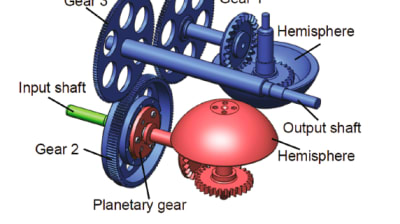
Inspecting the condition of dykes and other sea defense structures is typically a task for a team of robots. They consume a lot of energy to move across the dykes, perform tests, and communicate the...
Briefs: Motion Control
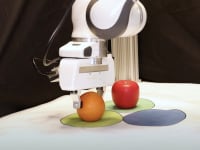
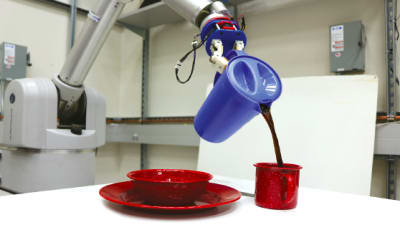
The Yale-CMU-Berkeley (YCB) Object and Model Set provides universal benchmarks for labs specializing in robotic manipulation and prosthetics. About two years ago, Aaron Dollar, an associate professor of...
Briefs: Robotics, Automation & Control
Lunar Regolith Simulant Sample Collection Mechanism for Remote Operation in a Thermal Vacuum Chamber
The Sample Capture Mechanism (SCM) is a remotely actuated, spring-driven mechanism designed to remotely capture and seal a 15-mL sample in less than 1 second. It was used to capture a 10-g sample of simulated regolith dispensed from a drill in a...
Briefs: Test & Measurement
NASA’s Johnson Space Center innovators have designed a Robotic Inspection System that is capable of surveying deep sea structures such as oil platform storage cells/tanks and pipelines in order to determine the...
Briefs: Robotics, Automation & Control
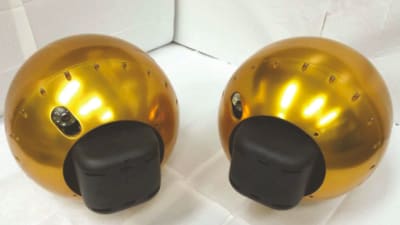
Researchers at the NASA Johnson Space Center (JSC), in collaboration with General Motors (GM) and Oceaneering, have designed a state-of-the-art, highly dexterous, humanoid robot: Robonaut 2 (R2). R2’s...

Briefs: Robotics, Automation & Control
Vessel Sealing Device for Robotic Devices
Invasive surgical procedures are essential for addressing various medical conditions. When possible, minimally invasive procedures are preferred, but these technologies are often limited in scope and complexity. These limitations are due in part to mobility restrictions from the use of rigid tools in small...
Briefs: Robotics, Automation & Control
Residual Mode Filters
NASA has developed a unique control algorithm and synthesis method that uses a system’s output to modify control inputs to cause the system to track a reference model or a fixed value in the presence of unmodeled system dynamics, varying operating environments, and unpredictable disturbances. The unique feature of this...
Briefs: Robotics, Automation & Control
Probabilistic Surface Characterization for Safe Landing Hazard Detection and Avoidance (HDA)
NASA’s Jet Propulsion Laboratory (JPL) has developed a probabilistic algorithm for hazard detection and avoidance (HDA) that robustly handles sensor noise. Conventional surface characterization methods use fixed hazard thresholds to determine hazardous...
Briefs: Robotics, Automation & Control
Robot for Controlled Deposition of Multilayer Thin Film Structures
During deposition of thin film layers using shadow masking techniques, thin film layer structure morphology changes with respect to the position of the thin film layer and the shadow of the mask. Morphology changes in the thin film result in refractive index and density changes that...
Briefs: Robotics, Automation & Control
In smooth terrain, the most efficient motion to traverse the terrain is rolling. However, when a wheeled vehicle encounters obstacles, it must circumvent them if possible or choose an alternate path. Legged vehicles can...

Briefs: Robotics, Automation & Control
Researchers at the NASA Johnson Space Center (JSC), in collaboration with General Motors (GM), have designed and developed Robo-Glove, a wearable human grasp assist device, to help reduce the grasping...

Briefs: Robotics, Automation & Control
Electromagnetic Monitoring and Control of a Plurality of Nanosatellites
NASA has developed an innovative combination of a Magnetometer, low-powered ElectroMagnets, and Res onant Inductive Coupling (MEMRIC) to create and control relative positioning of nanosatellites within a cluster. This is a game-changing approach to enable distributed...
Briefs: Robotics, Automation & Control
Elimination of Yaw Component of Gyroscope Propagation Error During Arm Activity in MSL
When updating attitude during arm motion, gyroscope propagation error soon becomes greater than the tilt being monitored. The solution is to add an accelerometer-only mode that can update attitude without using gyroscopes, and to add the ability to monitor pitch...
Briefs: Robotics, Automation & Control
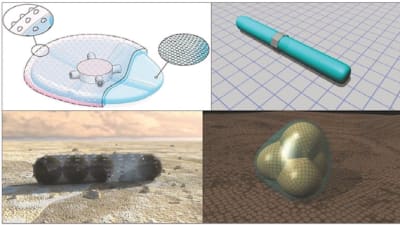
NASA’s Langley Research Center has developed multiple ways for amorphous robots to autonomously move across a surface without needing conventional wheels or legs. Amorphous robots are useful in dusty and...
Briefs: Robotics, Automation & Control
Self-Latching Piezocomposite Actuator
NASA’s Langley Research Center has developed a self-latching piezocomposite actuator. The self-latching nature of this invention allows for piezo actuators that do not require constant power draw. Among other applications, the invention is well suited for use in aerodynamic control surfaces and engine inlets....
Briefs: Mechanical & Fluid Systems
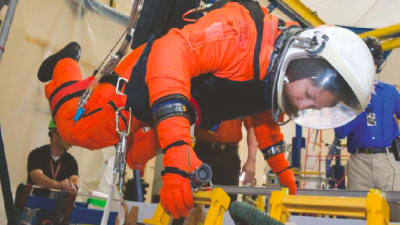
To train astronauts to live and work in the weightless environment on the International Space Station, NASA employs a number of techniques and facilities that simulate microgravity. Engineers at the...
Briefs: Robotics, Automation & Control
NASA Marshall Space Flight Center’s Fluid Structure Coupling (FSC) technology is a highly efficient and passive method to control the way fluids and structures communicate and dictate the behavior of a system. This...

Briefs: Mechanical & Fluid Systems
Variable-Aperture Reciprocating Reed Valve
NASA’s Marshall Space Flight Center engineers have developed a new reed valve for controlling fluid flow back and forth between two chambers. The VARR valve provides two-way flow that is proportional to flow demand. As the pressure gradient builds on one side, the reed valve responds by opening an amount...
Briefs: Robotics, Automation & Control
Passive, Integrated, Sublimator-Driven Coldplate
Spacecraft thermal control systems typically perform three key functions — heat acquisition, heat transport, and heat rejection — in addition to those of insulation, heat generation, and heat storage. In a typical pumped fluid-loop spacecraft thermal control system, heat is acquired from...
Briefs: Robotics, Automation & Control
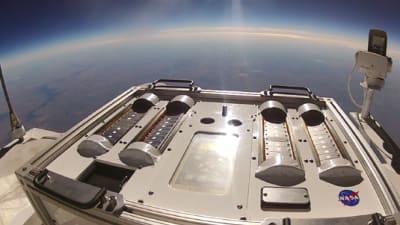
Experiments in space can be expensive and infrequent, but Earth’s upper atmosphere is accessible via large scientific balloons, and can be used to address many of the same fundamental questions. Scientific balloons are made of a thin...
Briefs: Robotics, Automation & Control
Human operation in space over long time periods causes bone and muscle deterioration, so there is a need for countermeasures in the form of physical exercises consisting of working against controlled...

Briefs: Mechanical & Fluid Systems
NASA’s Kennedy Space Center has developed a novel ruggedized housing for an electrical or fluid umbilical connector that prevents intrusion of dust, sand, dirt, mud, and moisture during field use under harsh...

Briefs: Robotics, Automation & Control
Systems, Methods, and Apparatus of a Low-Conductance Silicon Micro-Leak for Mass Spectrometer Inlet
Mass spectrometers on atmospheric entry probes require a method for introducing gas from high-pressure ambient regions to the vacuum of the mass spectrometer interior.
Briefs: Mechanical & Fluid Systems
NASA’s Langley Research Center has developed three techniques and systems to calibrate and validate...
Top Stories
 Blog: Power

My Opinion: We Need More Power Soon — Is Nuclear the Answer?
 Blog: AR/AI

Aerial Microrobots That Can Match a Bumblebee's Speed
 News: Energy

 Blog: Electronics & Computers

Turning Edible Fungi into Organic Memristors
 Blog: Robotics, Automation & Control

Microscopic Swimming Machines that Can Sense, Respond to Surroundings
 INSIDER: Sensors/Data Acquisition
Webcasts
 Upcoming Webinars: Energy

Hydrogen Engines Are Heating Up for Heavy Duty
 Upcoming Webinars: Transportation

Advantages of Smart Power Distribution Unit Design for Automotive...
 Upcoming Webinars: Automotive

Quiet, Please: NVH Improvement Opportunities in the Early Design...
 Upcoming Webinars: Test & Measurement

From Spreadsheets to Insights: Fast Data Analysis Without Complex...
 Upcoming Webinars: Power

Battery Abuse Testing: Pushing to Failure
 Upcoming Webinars: Internet of Things