40,51
-1
60
30
Briefs: Software
High-performance servo motion is now more affordable and accessible than ever due to integrated controllers, making the technology viable even for applications, which could not formerly support the cost or complexity of traditional implementations. Read on to learn more.

Briefs: Robotics, Automation & Control
For the first time, researchers at The University of Texas at Austin’s Applied Research Laboratories and NASA’s Goddard Space Flight Center have formed a radio interferometer between a GPS antenna and receiver and a large radio telescope. Read on to learn more about the new technique.

Briefs: Imaging
Southwest Research Institute has developed off-road autonomous driving tools with a focus on stealth for the military and agility for space and agriculture clients. The vision-based system pairs stereo cameras with novel algorithms, eliminating the need for LiDAR and active sensors. Read on to learn more.

Briefs: Robotics, Automation & Control
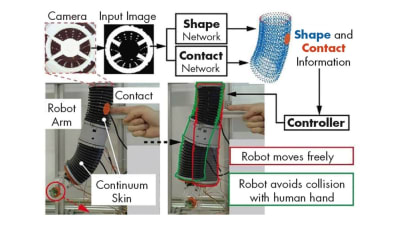
The sensing and control principles used in this framework could lead to new tactile sensors that can be attached to any existing robotics system, offering new sensing and control paradigms for safe human-robot interaction without altering the robot’s original design. Read on to learn more.
Briefs: Imaging
The camera mimics the involuntary movements of the human eye to create sharper, more accurate images for robots, smartphones, and other image-capturing devices. Read on to learn more about it.

Briefs: Medical
A research team created a noninvasive electroencephalogram (EEG) sensor that was installed in a Meta VR headset that can be worn comfortably for long periods. The EEG measures the brain’s electrical activity during the immersive VR interactions. Read on to learn more.

Briefs: Communications
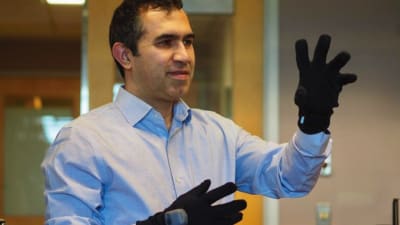
A new groundbreaking “smart glove” is capable of tracking the hand and finger movements of stroke victims during rehabilitation exercises. The glove incorporates a sophisticated network of highly sensitive sensor yarns and pressure sensors that are woven into a comfortable stretchy fabric. Read on to learn more about the smart glove.
Briefs: Medical
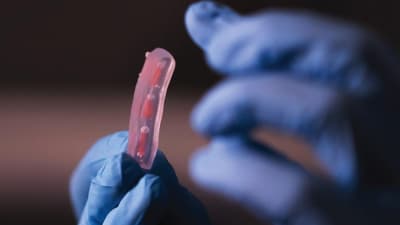
Eva Baur, a Ph.D. student, used 3D-printed double network granular elastomers (DNGEs) to print a prototype ‘finger,’ complete with rigid ‘bones’ surrounded by flexible ‘flesh.’ The finger was printed to deform in a pre-defined way, demonstrating the technology’s potential to manufacture devices that are sufficiently supple to bend and stretch, while remaining firm enough to manipulate objects. Read on to learn more.
Briefs: AR/AI
Because they can go where humans can’t, robots are especially suited for safely working with hazardous nuclear waste. Now, scientists at the U.S. Department of Energy’s (DOE) Argonne National Laboratory have designed and tested a remote-controlled, dual-arm telerobotics system with human-like capabilities that has the potential to revolutionize hazardous waste clean-up and holds potential for broader applications.

Briefs: Robotics, Automation & Control
Getting 800 robots in a warehouse to and from their destinations efficiently while keeping them from crashing into each other is no easy task. So, a group of MIT researchers who use AI to mitigate traffic congestion applied ideas from that domain to tackle this problem. Read on to learn what they built.

Briefs: Electronics & Computers
A team of researchers at Delft University of Technology has developed a drone that flies autonomously using neuromorphic image processing and control based on the workings of animal brains.

Briefs: Robotics, Automation & Control
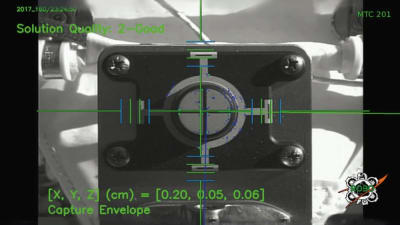
Innovators at NASA’s Johnson Space Center (JSC) have developed computer vision software that derives target posture determinations quickly and then instructs an operator how to properly align a robotic end-effector with a target that they are trying to grapple.
Briefs: Robotics, Automation & Control
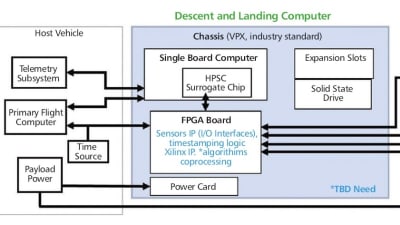
Innovators at NASA Johnson Space Center have developed and successfully flight tested a high-performance computing platform, known as the Descent and Landing Computer (DLC), to suit the demands of safe, autonomous, extraterrestrial spacecraft landings for robotic and human exploration missions.
Briefs: Research Lab
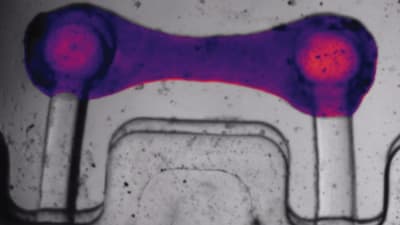
A promising way to study disease and test new drugs is to use cellular and engineered tissue models in a dish, but existing methods to study heart cell contraction and calcium handling require a good deal of manual work, are prone to errors, and need expensive specialized equipment. Researchers at Columbia Engineering unveiled a groundbreaking new tool today that addresses these challenges head-on: BeatProfiler.
Briefs: AR/AI
Researchers from Tsinghua University worked to break through the difficulties of robotic recognition of various common, yet complex, items. Read on to learn more.

Briefs: Mechanical & Fluid Systems
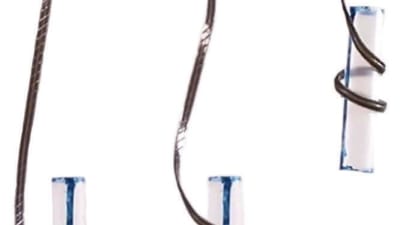
Researchers from NC State University have demonstrated mini soft hydraulic actuators that can be used to control the deformation and motion of soft robots that are less than a millimeter thick. The researchers also demonstrated that this technique works with shape memory materials.
Briefs: Robotics, Automation & Control
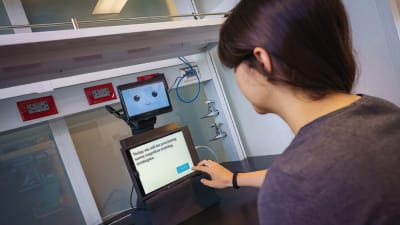
Engineers at the University of California San Diego in collaboration with clinicians, people with MCI, and their care partners have developed CARMEN, short for Cognitively Assistive Robot for Motivation and Neurorehabilitation — a small, tabletop robot designed to help people with mild cognitive impairment (MCI) learn skills to improve memory, attention, and executive functioning at home.
Briefs: Materials
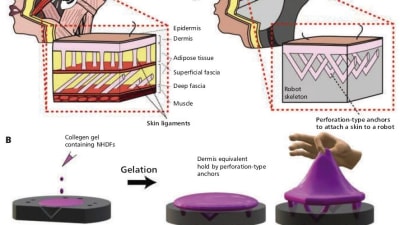
Researchers have found a way to bind engineered skin tissue to the complex forms of humanoid robots. This brings with it potential benefits to robotic platforms such as increased mobility, self-healing abilities, embedded sensing capabilities and an increasingly lifelike appearance.
Briefs: AR/AI
ANYmal has for some time had no problem coping with the stony terrain of Swiss hiking trails. Now researchers at ETH Zurich have taught this quadrupedal robot some new skills: it is proving rather adept at parkour. ANYmal is also proficient at dealing with the tricky terrain commonly found on building sites or in disaster areas. Read on to learn more.

Briefs: Unmanned Systems
Professor Angela Schoellig from the Technical University of Munich uses ChatGPT to develop choreographies for swarms of drones to perform along to music. An additional safety filter prevents mid-air collisions. Read on to learn more.
Briefs: Manufacturing & Prototyping
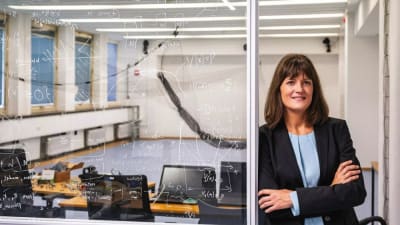
In bringing bio-inspired robots to life, scientists must first create soft matter counterparts that match the softness and functionality of biological tissue. University of Nebraska–Lincoln engineer Eric Markvicka is at the forefront of these efforts. Read on to learn more.

Briefs: Robotics, Automation & Control
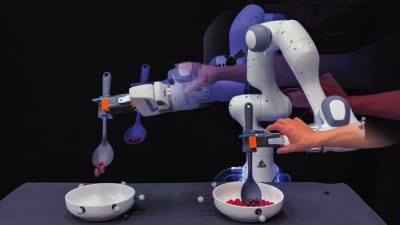
MIT engineers are aiming to give robots a bit of common sense when faced with situations that push them off their trained path. They’ve developed a method that connects robot motion data with the “common sense knowledge” of large language models, or LLMs.
Briefs: Design
A new robotic suction cup which can grasp rough, curved, and heavy stone, has been developed by scientists at the University of Bristol. The team, based at Bristol Robotics Laboratory, studied the structures of octopus biological suckers, which have superb adaptive suction abilities enabling them to anchor to rock.

Briefs: Robotics, Automation & Control
Researchers from Japan have developed DPPFA–Net, an innovative network that overcomes challenges related to occlusion and noise introduced by adverse weather.

Briefs: Aerospace
Innovators at the NASA Glenn Research Center have developed the PLGRM system, which allows an installed antenna to be characterized in an aircraft hangar. All PLGRM components can be packed onto pallets, shipped, and easily operated.

Briefs: Manufacturing & Prototyping
A research paper by scientists at the University of Coimbra proposed a soft robotic hand comprising soft actuator cores and an exoskeleton, featuring a multimaterial design aided by finite element analysis to define the hand geometry and promote finger’s bendability.

Briefs: Robotics, Automation & Control
Humans are generally good at whole-body manipulation, but robots struggle with such tasks. Now, MIT researchers have found a way to simplify this process, known as contact-rich manipulation planning.

Briefs: Sensors/Data Acquisition
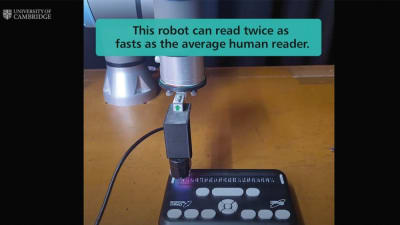
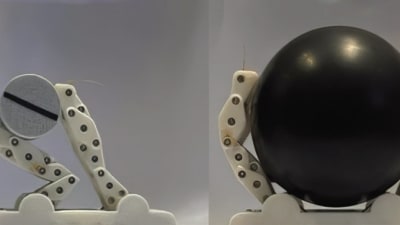
Although the robot braille reader was not developed as an assistive technology, the researchers say the high sensitivity required to read braille makes it an ideal test in the development of robot hands or prosthetics with comparable sensitivity to human fingertips.
Briefs: Mechanical & Fluid Systems
Led by Purdue University, the Resilient ExtraTerrestrial Habitats institute's goal is to “design and operate resilient deep space habitats that can adapt, absorb and rapidly recover from expected and unexpected disruptions.”
Top Stories
 Blog: Lighting

A Stretchable OLED that Can Maintain Most of Its Luminescence
 Blog: Energy

Batteries that Can Withstand the Cold
 INSIDER: Energy

Advancing All-Solid-State Batteries
 Quiz: Energy

 Blog: Physical Sciences

 Blog: Materials

Webcasts
 Upcoming Webinars: Sensors/Data Acquisition

From Spreadsheets to Insights: Fast Data Analysis Without Complex...
 Upcoming Webinars: Electronics & Computers

Cooling a New Generation of Aerospace and Defense Embedded...
 Upcoming Webinars: Sensors/Data Acquisition

Beyond AI-Copy-Paste Engineering: Advanced AI-Integration Success...
 Upcoming Webinars: Power

Battery Abuse Testing: Pushing to Failure
 Upcoming Webinars: Connectivity

A FREE Two-Day Event Dedicated to Connected Mobility
 Upcoming Webinars: Test & Measurement

Choosing the Right N-Port Strategy: Multiport VNAs vs. Switch...