40,51
-1
30
30
Briefs: Robotics, Automation & Control
Researchers have developed a tiny magnetic robot that can take 3D scans from deep within the body and could revolutionize early cancer detection. The team, led by engineers from the University of Leeds, said this is the first time high-resolution 3D ultrasound images taken from a probe deep inside the gastrointestinal tract, or gut, have been generated. Read on to learn more.

Briefs: Sensors/Data Acquisition
These materials can detect when they are damaged, take the necessary steps to temporarily heal themselves, and then resume work.

Briefs: Motion Control
A team of MIT engineers has developed a training method for multiagent systems that can guarantee their safe operation in crowded environments. Read on to learn more about it.
Briefs: Manufacturing & Prototyping
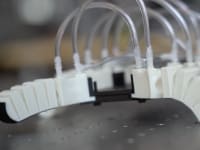
Researchers at Universidad Carlos III de Madrid have developed a new soft joint model for robots with an asymmetrical triangular structure and an extremely thin central column. This breakthrough, recently patented, allows for versatility of movement, adaptability and safety, and will have a major impact in the field of robotics. Read on to learn more.

Briefs: Robotics, Automation & Control
A new study, published in the journal Results in Engineering, introduced a meticulously designed dataset aimed at enhancing the performance of 6D pose estimation algorithms. Read on to learn more.

Briefs: Robotics, Automation & Control
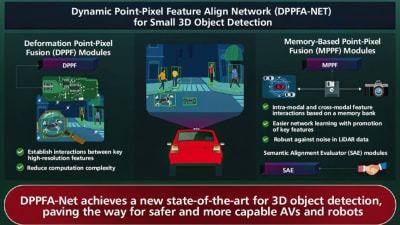
Scientists have developed multi-modal 3D object detection methods that combine 3D LiDAR data with 2D RGB images taken by standard cameras. While the fusion of 2D images and 3D LiDAR data leads to more accurate 3D detection results, it still faces its own set of challenges, with accurate detection of small objects remaining difficult. Read on to learn more about it.
Briefs: Sensors/Data Acquisition
Jamie Paik and colleagues in the Reconfigurable Robotics Lab in EPFL’s School of Engineering have developed a sensor that can perceive combinations of bending, stretching, compression, and temperature changes, all using a robust system that boils down to a simple concept: color. Read on to learn more about it.

Briefs: Motion Control
In a recent study published in the journal eLife, an international research group has studied the relationship between electrical stimulation in stick insects’ leg muscles and the resultant torque (the twisting force that makes the leg move). Read on to learn what they found.

Briefs: Mechanical & Fluid Systems
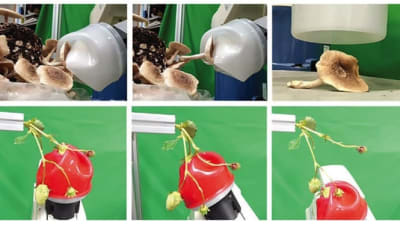
In creating a pair of new robots, Cornell researchers cultivated an unlikely component: fungal mycelia. By harnessing mycelia’s innate electrical signals, the researchers discovered a new way of controlling “biohybrid” robots that can potentially react to their environment better than their purely synthetic counterparts. Read on to learn more.
Briefs: Robotics, Automation & Control
A new study led by Flinders University and French researchers has used a novel bio-inspired computing artificial intelligence solution to improve the potential of UUVs and other adaptive control systems to operate more reliability in rough seas and other unpredictable conditions. Read on to learn more.

Briefs: Robotics, Automation & Control
A team has programmed a robotic spacecraft simulator with what it calls s-FEAST: Safe Fault Estimation via Active Sensing Tree Search. Read on to learn more.

Briefs: Electronics & Computers
A recent study demonstrates that soft skin pads doubling as sensors made from thermoplastic urethane can be efficiently manufactured using 3D printers. Read on to learn more.
Briefs: Motion Control
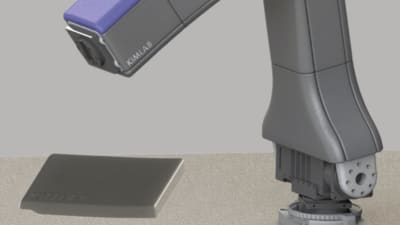
Innovators at the NASA Johnson Space Center have developed a novel foot-pedal-operated system and device to control movement of an object in 3D space. The Foot Pedal Controller system enables operators to control movement of spacecraft, aircraft, and watercraft using only foot pedals. Read on to learn more.

Briefs: Robotics, Automation & Control
A team led by University of Maryland computer scientists invented a camera mechanism that improves how robots see and react to the world around them. Inspired by how the human eye works, their innovative camera system mimics the tiny involuntary movements used by the eye to maintain clear and stable vision over time. Read on to learn more.

Briefs: Robotics, Automation & Control
MIT engineers are designing a pair of wearable robotic limbs that can physically support an astronaut and lift them back on their feet after a fall. The system, which the researchers have dubbed Supernumerary Robotic Limbs or “SuperLimbs,” is designed to extend from a backpack. Read on to learn more.

Briefs: Green Design & Manufacturing
Inspired by a small and slow snail, scientists have developed a robot prototype that may one day scoop up microplastics from the surfaces of oceans, seas, and lakes.
Briefs: Electronics & Computers
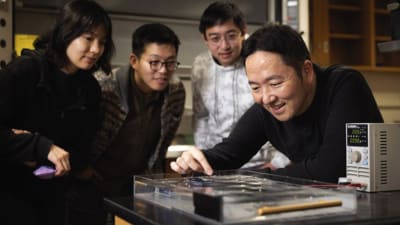
Researchers have developed a new soft robot design that engages in three simultaneous behaviors: rolling forward, spinning like a record, and following a path that orbits around a central point. The device, which operates without human or computer control, holds promise for developing soft robotic technologies that can be used to navigate and map unknown environments. The new soft robots are called twisted ringbots. Read on to learn more about them.

Briefs: Robotics, Automation & Control
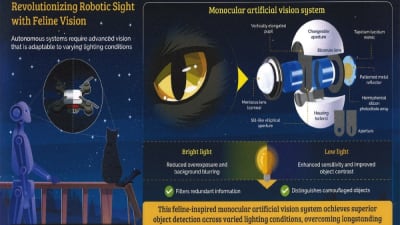
Researchers led by Professor Young Min Song from the Gwangju Institute of Science and Technology have unveiled a vision system inspired by feline eyes to enhance object detection in various lighting conditions. Featuring a unique shape and reflective surface, the system reduces glare in bright environments and boosts sensitivity in low-light scenarios. Read on to learn more.
Briefs: Software
Penn Engineers have developed a new algorithm that allows robots to react to complex physical contact in real time, making it possible for autonomous robots to succeed at previously impossible tasks, like controlling the motion of a sliding object. Read on to learn more.

Briefs: Robotics, Automation & Control
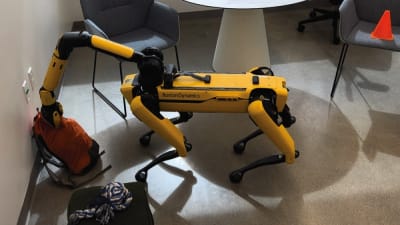
MIT engineers have developed a method that enables robots to make similarly intuitive, task-relevant decisions. The team’s new approach, named Clio, enables a robot to identify the parts of a scene that matter, given the tasks at hand. Read on to learn more about Clio.
Briefs: Robotics, Automation & Control
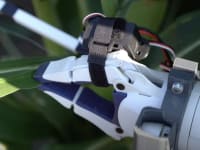
A team of researchers has developed an innovative soft robotic gripper named ROtation-based Squeezing grippEr or ROSE. Read on to learn more about it.
Briefs: Software
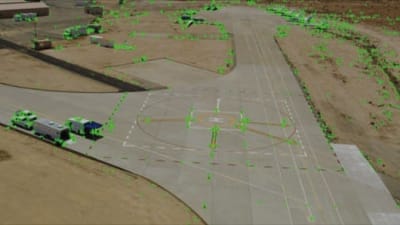
Incorporating a vision-based navigation method, NASA Ames has developed a novel Alternative Position, Navigation, and Timing (APNT) solution for AAM aircraft in environments where GPS is not available. Read on to learn more about it.
Briefs: AR/AI
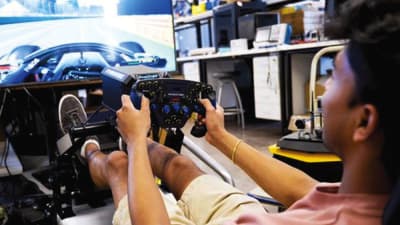
Yen-Ling Kuo at the University of Virginia School of Engineering and Applied Science is collaborating with a team at the Toyota Research Institute to build language representations of driving behavior that enable a robot to associate the meaning of words with what it sees by watching how humans interact with the environment or by its own interactions with the environment. Read on to learn more.
Briefs: Robotics, Automation & Control
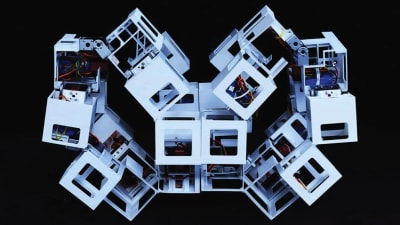
Inspired by the paper-folding art of origami, North Carolina State University engineers have discovered a way to make a single plastic cubed structure transform into more than 1,000 configurations using only three active motors. The findings could pave the way for shape-shifting artificial systems that can take on multiple functions and even carry a load. Read on to learn more.
Briefs: Medical
Read on to learn about CARMEN — Cognitively Assistive Robot for Motivation and Neurorehabilitation — a small, tabletop robot designed to help people with mild cognitive impairment learn skills to improve memory, attention, and executive functioning at home.

Briefs: Robotics, Automation & Control
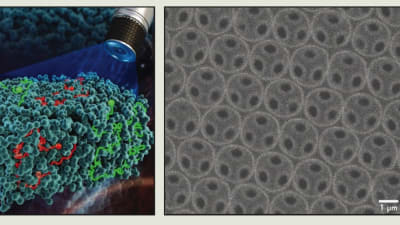
The “nanoswimmers” could be used to remediate contaminated soil, improve water filtration, or even deliver drugs to targeted areas of the body.
Briefs: Software
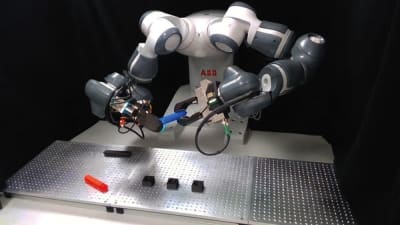
A new paper explores pick-and-place solutions with more precision. In precise pick-and-place, also known as kitting, the robot transforms an unstructured arrangement of objects into an organized arrangement. The approach, dubbed SimPLE (Simulation to Pick Localize and placE), learns to pick, regrasp and place objects using the object’s computer-aided design model. Read on to learn more.
Briefs: Robotics, Automation & Control
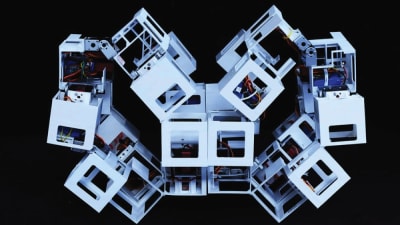
Inspired by the paper-folding art of origami, North Carolina State University engineers have discovered a way to make a single plastic cubed structure transform into more than 1,000 configurations using only three active motors. Read on to learn more.
Briefs: Robotics, Automation & Control
Researchers have successfully developed a DNA-based molecular controller that autonomously directs the assembly and disassembly of molecular robots. This pioneering technology marks a significant step toward advanced autonomous molecular systems with potential applications in medicine and nanotechnology.

Top Stories
 Blog: Lighting

A Stretchable OLED that Can Maintain Most of Its Luminescence
 Blog: Energy

Batteries that Can Withstand the Cold
 INSIDER: Energy

Advancing All-Solid-State Batteries
 Quiz: Energy

 Blog: Physical Sciences

 Blog: Materials

Webcasts
 Upcoming Webinars: Sensors/Data Acquisition

From Spreadsheets to Insights: Fast Data Analysis Without Complex...
 Upcoming Webinars: Electronics & Computers

Cooling a New Generation of Aerospace and Defense Embedded...
 Upcoming Webinars: Sensors/Data Acquisition

Beyond AI-Copy-Paste Engineering: Advanced AI-Integration Success...
 Upcoming Webinars: Power

Battery Abuse Testing: Pushing to Failure
 Upcoming Webinars: Connectivity

A FREE Two-Day Event Dedicated to Connected Mobility
 Upcoming Webinars: Test & Measurement

Choosing the Right N-Port Strategy: Multiport VNAs vs. Switch...