-1
1680
30
Briefs: Manufacturing & Prototyping
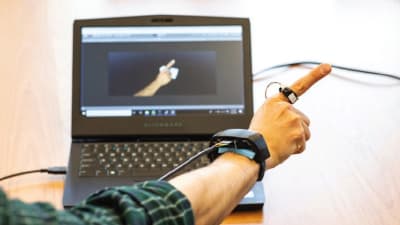
The technology, which could be added to smart watches, could detect the onset of Parkinson’s disease or help with stroke rehabilitation.
Briefs: Motion Control
The Tentacle Bot can grip, move, and manipulate a wide range of objects.

Briefs: Energy
An environmentally friendly method upcycles carbon dioxide emissions into polymers and other materials.

Briefs: Imaging
VR/AR devices can simulate some of the key difficulties experienced due to glaucoma.

Briefs: Robotics, Automation & Control
This form of thermal management can help enable untethered, high-powered robots to operate for long periods of time without overheating.
Briefs: Semiconductors & ICs
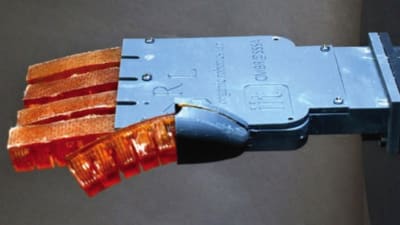
Tests show magnetoelectric power is a viable option for clinical-grade implants.

Briefs: Photonics/Optics
With low-cost materials called perovskites, stable, continuous lasing is achieved at room temperature for over an hour.

Briefs: Automotive
See how tantalum disulfide is supporting new kinds of optics, and potentially new kinds of application for VR and self-driving cars.

Briefs: Data Acquisition
MIT engineers are envisioning robots more like home helpers.

Briefs: AR/AI
A NIST method employs a neural network to detect patterns like geometric objects in imaging data.

Briefs: Electronics & Computers
The response time of kinetic inductance bolometers can be greatly enhanced by electrothermal feedback for devices that are both sensitive and speedy.

Briefs: Electronics & Computers
A nanostructure design lends extraordinary strength to a promising storage ingredient.
Briefs: Manufacturing & Prototyping
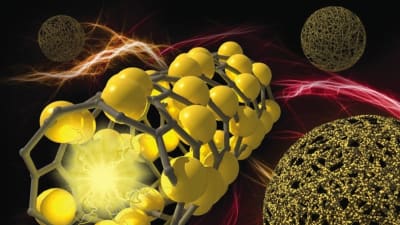
A metal-organic framework does not contain cost-intensive raw materials and can be produced in bulk.

Briefs: Photonics/Optics
This technology can work with multiple wavelengths of light simultaneously.
Briefs: Imaging
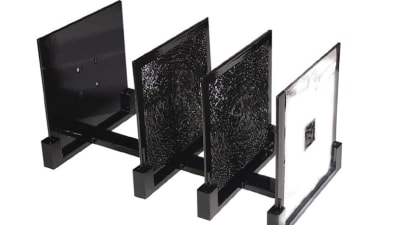
Applications include low-light conditions such as on orbital satellites and VR applications where the lens needs to be larger than a pupil.
Briefs: Electronics & Computers
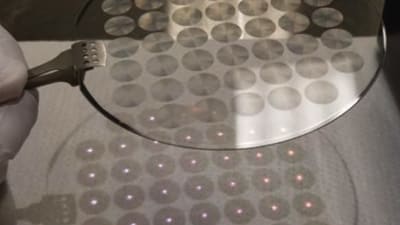
This method could benefit next-generation electronics.
Briefs: Materials
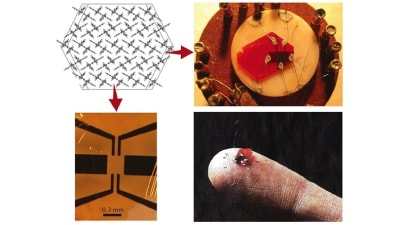
The new battery technology could improve electric vertical takeoff and landing aircraft and supercharge safe, long-range electric cars.

Briefs: Electronics & Computers
These non-reciprocal devices on a compact chip pave the way for applications from two-way wireless to quantum computing.

Briefs: Wearables
Fully integrated flexible electronics made of magnetic sensors and organic circuits open the path towards the development of electronic skin.

Briefs: Sensors/Data Acquisition
This technique may enable speedy, on-demand design of softer, safer neural devices.
Briefs: Software
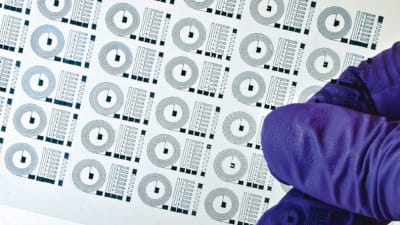
A higher-order network could be built that looks for subtle changes in data that point to suspicious activity.

Briefs: Motion Control
This system has a capacity of more than 1,500 times the volume of a typical testing facility.
Briefs: Materials
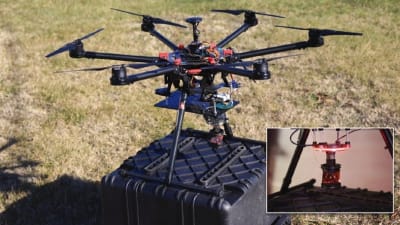
This technology makes it possible to save extensive data in objects such as shirt buttons, water bottles, or the lenses of glasses and then retrieve it years later.

Briefs: Materials
The technique could enable the printing of circuit boards, electromechanical components, and robots.

Briefs: Robotics, Automation & Control
The learning approach allows swarms of unmanned vehicles to optimally accomplish their mission while minimizing performance uncertainty.

Briefs: Imaging
Tiny aircraft that weigh as much as a fruit fly could serve as Martian atmospheric probes.

Briefs: Medical
This method integrates 3D plasmonic nanoarrays onto stickers that adhere to any surface.
Briefs: Automotive
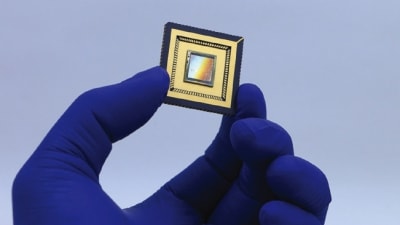
Applications include rapid prototyping, medical, aerospace, and automotive.
Briefs: Sensors/Data Acquisition
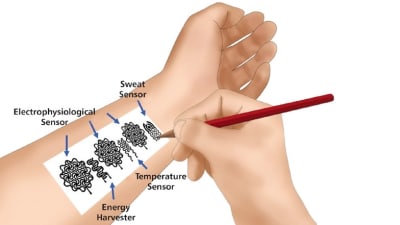
People could monitor their own health conditions by picking up a pencil and drawing a bioelectronic device on their skin.
Top Stories
 Blog: Design

A Stretchable OLED that Can Maintain Most of Its Luminescence
 INSIDER: Energy

Advancing All-Solid-State Batteries
 Blog: Power

My Opinion: We Need More Power Soon — Is Nuclear the Answer?
 Blog: Energy

Batteries that Can Withstand the Cold
 Quiz: Power

 Blog: Communications

Microscopic Swimming Machines that Can Sense, Respond to Surroundings
Webcasts
 On-Demand Webinars: Semiconductors & ICs

Advantages of Smart Power Distribution Unit Design for Automotive &...
 Upcoming Webinars: Transportation

Quiet, Please: NVH Improvement Opportunities in the Early Design...
 Upcoming Webinars: Sensors/Data Acquisition

From Spreadsheets to Insights: Fast Data Analysis Without Complex...
 Upcoming Webinars: Aerospace

Cooling a New Generation of Aerospace and Defense Embedded...
 Upcoming Webinars: Test & Measurement

Beyond AI-Copy-Paste Engineering: Advanced AI-Integration Success...
 Upcoming Webinars: Energy