

A report presents a computational study of the subcritical and supercritical behaviors of a drop of heptane surrounded by nitrogen. The subject matter is basically same as that of the report described in the preceding article, except that the Lewis-number issue is not addressed in detail; however, this article presents the full set of equations which lack in the former. As in the preceding case, the results of the computations are compared with data from microgravity experiments on drops of heptane evaporating in nitrogen at temperatures and pressures in the sub- and supercritical regimes, and conclusions are drawn regarding the accuracy of (1) the mathematical model used in the present study and (2) the limitation on accuracy of a traditional model (known as the d2 law) at supercritical pressures. The conclusions stated in the report are essentially a subset of the conclusions stated in the report described in the preceding article.
This work was done by Josette Bellan and Kenneth Harstad of Caltech for NASA's Jet Propulsion Laboratory. To obtain a copy of the report, "Validation of an All-Pressure Fluid Drop Model: Heptane Fluid Drops in Nitrogen," access the Technical Support Package (TSP) free on-line at www.nasatech.com/tsp under the Physical Sciences category.
NPO-20707
This Brief includes a Technical Support Package (TSP).
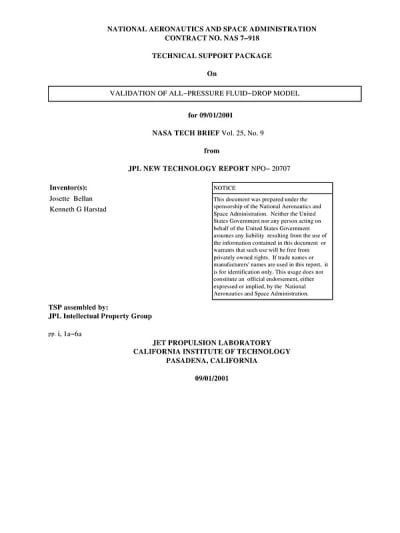
Validation of All-Pressure Fluid-Drop Model
(reference NPO-20707) is currently available for download from the TSP library.
Don't have an account?
Overview
The document is a Technical Support Package prepared under the sponsorship of the National Aeronautics and Space Administration (NASA), specifically focusing on the validation of an all-pressure fluid-drop model. Authored by Josette Bellan and Kenneth G. Harstad from the Jet Propulsion Laboratory (JPL) at the California Institute of Technology, the report is identified as NASA Tech Brief Vol. 25, No. 9, and is dated September 1, 2001.
The primary focus of the report is a computational study examining the behaviors of heptane drops surrounded by nitrogen, particularly in subcritical and supercritical conditions. The study aims to validate a mathematical model that describes the dynamics of fluid drops under varying pressure scenarios. The authors compare their computational results with data obtained from microgravity experiments involving heptane evaporation in nitrogen, which provides a practical context for their theoretical findings.
The report highlights the limitations of traditional models, specifically the d² law, when applied to supercritical pressures. It emphasizes the importance of accurately modeling fluid behavior in these conditions, as it has significant implications for various applications in aerospace and other fields. The conclusions drawn from the study indicate that while the mathematical model used in the research shows promise, there are inherent limitations that need to be addressed for improved accuracy.
Additionally, the document includes a disclaimer stating that references to specific commercial products or manufacturers do not imply endorsement by the U.S. Government or JPL. It also clarifies that the work was conducted under a contract with NASA, ensuring that the research aligns with governmental standards and objectives.
Overall, this Technical Support Package serves as a valuable resource for understanding the complexities of fluid dynamics in varying pressure environments, particularly for applications in space exploration and related fields. The findings contribute to the ongoing development of more accurate models for predicting fluid behavior, which is crucial for the design and operation of aerospace systems.











