

-1
870
30
Briefs: Mechanical & Fluid Systems
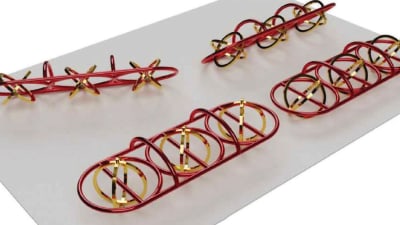
A technique enables manufacturing of minuscule robots by interlocking multiple materials in a complex way.
Briefs: Medical
A first-of-its-kind robotic glove is lending a “hand” and providing hope to piano players who have suffered a disabling stroke. Developed by researchers from Florida Atlantic University’s College of Engineering and Computer Science, the soft robotic hand exoskeleton uses artificial intelligence to improve hand dexterity.

Briefs: Aerospace
Innovators at NASA’s Johnson Space Center have designed a circumferential scissor spring mechanism, that when incorporated into a hand controller, improves the restorative force to a control stick’s neutral position. The design also provides for operation on a more linear portion of the spring’s force deflection curve, yielding better feedback to the user.

Briefs: Communications
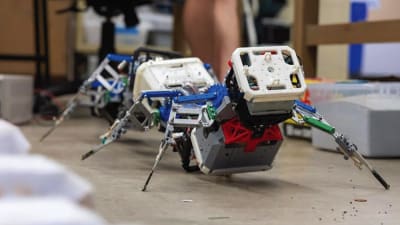
Intrigued to see if many limbs could be helpful for locomotion in this world, a team at the Georgia Institute of Technology is using a centipede's style of movement to its advantage. They developed a new theory of multilegged locomotion and created many-legged robotic models.
Briefs: AR/AI
MIT researchers developed a machine-learning technique called Diffusion-CCSP. Diffusion models learn to generate new data samples that resemble samples in a training dataset by iteratively refining their output.

Briefs: Materials
Inventors at the NASA Langley Research Center have developed a novel method to model and ingest point-wise process data to evaluate an additive manufacturing build and its file for issues by highlighting potential anomalies or other areas where the build may have issues with fusion of the material.

Briefs: Imaging
By using artificial intelligence, researchers are developing a system that can automatically identify buildings after disasters and make an initial determination of whether they are damaged and how serious that damage might be.

Briefs: Software
Researchers from MIT, the MIT-IBM Watson AI Lab, and elsewhere have developed a technique that enables deep-learning models to efficiently adapt to new sensor data directly on an edge device. Their on-device training method, Pock-Engine, determines which parts of a huge machine-learning model need to be updated to improve accuracy, and only stores and computes with those specific pieces.

Products: Information Technology
See what's new on the market, including igus' two- and four-hole fixed flange bearings; FixtureBuilder 3D fixture-modelling software from Renishaw; XENON Corporation's X-1100/2x Pulsed Light Research System; Rad Source NDT's NDT 1000 X-ray Inspection System; and more.

Products: Photonics/Optics
See the product of the month: 2Pi Optics' high-resolution fisheye sensor based on optical metalens technology.

Products: Electronics & Computers
See the products of the year: The Talaria TWO Module Ultra-Low Power Wi-Fi optimized solution for cloud-connected IP video IoT devices by InnoPhase IoT; Hexagon's Elements, simulation software to better understand the increasingly complex behavior of systems in modern products; and Nexa3D's highest throughput additive production system, the QLS 820.

Application Briefs: Manufacturing & Prototyping
Insaco manufactured custom tooling to meet the unique part specifications for NASA’s DISSIPATION mission, which will enable better understanding of how the energy imparted by solar winds into the atmosphere is dispersed.

Q&A: Design
Distinguished Professor of Mechanical Engineering Ron Miles and his team at Binghamton University, New York, have developed an entirely new microphone technology based on research into how spiders hear.

NASA Spinoff: Photonics/Optics
A ruggedized video camera designed to withstand the shock, vibration, and extreme temperatures of space is now ready for extreme conditions on Earth.

5 Ws: Design
A smart modular yardwork robot that can blow leaves and plow snow as well as achieve reductions in carbon emissions at the same time.

Articles: Electronics & Computers
What are the opportunities and risks AI offers in manufacturing? How can manufacturers successfully implement AI and prepare their workforce to integrate it into their processes? What’s its future outlook? Tech Briefs asked four industry experts in this roundtable.

Articles: Test & Measurement
NASA’s Artemis program consists of a series of missions designed to land humans on the Moon and establish a sustainable, continuing presence. A long-term foothold on the Moon’s surface enables invaluable research and testing opportunities that will set the stage for future groundbreaking missions, including the first human mission to Mars.

Briefs: Materials
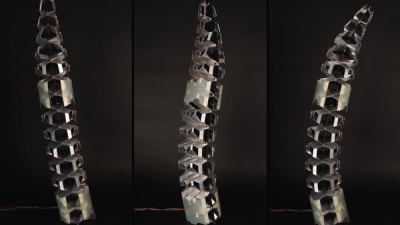
Using kirigami, the ancient Japanese art of folding and cutting paper, MIT researchers have now manufactured a type of high-performance architected material known as a plate lattice, on a much larger scale than scientists have previously been able to achieve by additive fabrication.
Briefs: Manufacturing & Prototyping
Recent experiments by a team from the West Virginia University focused on how a weightless microgravity environment affects 3D printing using titania foam, a material with potential applications ranging from UV blocking to water purification. ACS Applied Materials and Interfaces published their findings.

Briefs: Manufacturing & Prototyping
A new method for metal 3D printing aims to make more efficient use of resources by allowing structural modifications to be “programmed” into metal alloys during 3D printing, fine-tuning their properties without the “heating and beating” process that’s been in use for thousands of years.

Briefs: Electronics & Computers
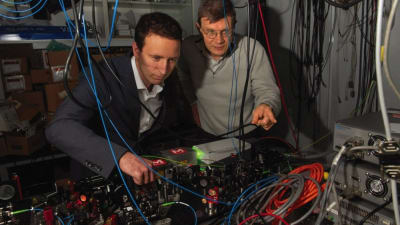
Harvard researchers have realized a key milestone in the quest for stable, scalable quantum computing, an ultra-high-speed technology that will enable game-changing advances in a variety of fields, including medicine, science, and finance.
Briefs: Materials
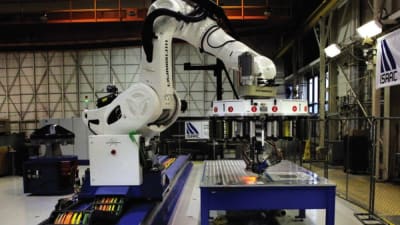
NASA’s Langley Research Center has developed a simplified, tool-less automated tow/tape placement (ATP) system. This invention enables several benefits that mitigate limitations associated with conventional ATP systems. Read on to learn more.
Briefs: Nanotechnology
Scientists at the Columbia University, University of Connecticut, and the U.S. Department of Energy’s (DOE) Brookhaven National Laboratory were able to fabricate a pure form of glass and coat specialized pieces of DNA with it to create a material that was not only stronger than steel, but incredibly lightweight.

Briefs: Materials
A series of buzzing “loop-currents” could explain a recently discovered, never-before-seen phenomenon in a type of quantum material. The quantum material is known by the chemical formula Mn 3Si2Te6, but it’s safe to call it “honeycomb.” Read on to learn more.

Briefs: Manufacturing & Prototyping
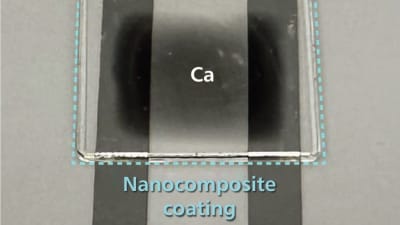
Developed by a team led by Lawrence Berkeley National Laboratory, a self-assembling nanosheet could significantly extend the shelf life of consumer products. And because the new material is recyclable, it could also enable a sustainable manufacturing approach that keeps single-use packaging and electronics out of landfills.
Briefs: Semiconductors & ICs
Researchers have unveiled a remarkable new material with potential to impact the world of material science: amorphous silicon carbide (a-SiC). Beyond its exceptional strength, this material demonstrates mechanical properties crucial for vibration isolation on a microchip. It is therefore particularly suitable for making ultra-sensitive microchip sensors.

Briefs: Electronics & Computers
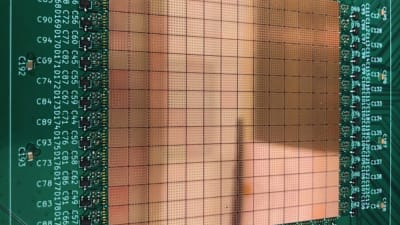
The NIST camera is made up of grids of ultrathin electrical wires, cooled to near absolute zero, in which current moves with no resistance until a wire is struck by a photon. In these superconducting-nanowire cameras, the energy imparted by even a single photon can be detected because it shuts down the superconductivity at a particular location (pixel) on the grid. Combining all the locations and intensities of all the photons makes up an image.

Briefs: Photonics/Optics
An international team of researchers reports on a compact high-brightness mid-IR-driven source combining a gas-filled anti-resonant-ring photonic crystal fiber with a novel nonlinear-crystal. The tabletop source provides a seven-octave coherent spectrum from 340 nm–40,000 nm with spectral brightness 2–5 orders of magnitude higher than one of the brightest synchrotron facilities.

Briefs: Communications
Researchers have created a device that enables them to electronically steer and focus a beam of terahertz electromagnetic energy with extreme precision. This opens the door to high-resolution, real-time imaging devices that are hundredths the size of other radar systems and more robust than other optical systems.
Top Stories
 Blog: Lighting

A Stretchable OLED that Can Maintain Most of Its Luminescence
 Blog: Energy

Batteries that Can Withstand the Cold
 INSIDER: Energy

Advancing All-Solid-State Batteries
 Quiz: Energy

 Blog: Physical Sciences

 Blog: Materials

Webcasts
 Upcoming Webinars: Test & Measurement

From Spreadsheets to Insights: Fast Data Analysis Without Complex...
 Upcoming Webinars: Electronics & Computers

Cooling a New Generation of Aerospace and Defense Embedded...
 Upcoming Webinars: Test & Measurement

Beyond AI-Copy-Paste Engineering: Advanced AI-Integration Success...
 Upcoming Webinars: Automotive

Battery Abuse Testing: Pushing to Failure
 Upcoming Webinars: Internet of Things

A FREE Two-Day Event Dedicated to Connected Mobility
 Upcoming Webinars: Test & Measurement

Choosing the Right N-Port Strategy: Multiport VNAs vs. Switch...