
-1
60
30
Blog: Medical
One promising strategy to counter cognitive decline is through olfactory stimulation — engaging the sense of smell. Read on to learn how a team developed VR tech to do just that.

Blog: Design
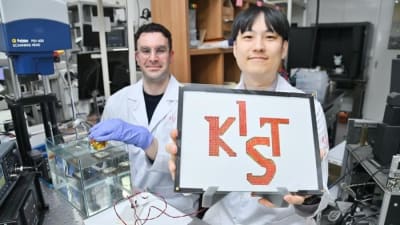
A research team has developed a biocompatible ultrasonic receiver that maintains its performance even when bent. Read on to learn more about it.
Blog: Robotics, Automation & Control
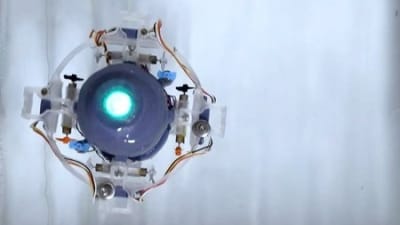
The work shows how a soft robot can use suction flow not just to stick to things, but also to sense its environment and control its own actions — just like an octopus.

Blog: Green Design & Manufacturing
Researchers at the FAMU-FSU College of Engineering have engineered a practical liquid hydrogen storage and delivery system that brings zero-emission aviation significantly closer to reality.

Blog: Sensors/Data Acquisition
Researchers were brainstorming ways that underwater vehicles could use turbulent water currents for propulsion and wondered if, instead of them being a problem, they could be an advantage.
Blog: Design
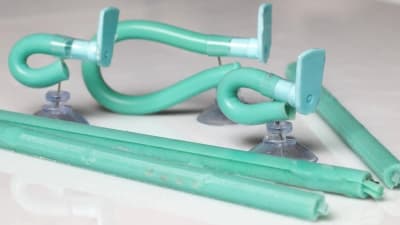
Inspired by the movements of a tiny parasitic worm, Georgia Tech engineers have created a five-inch soft robot that can jump as high as a basketball hoop.
Blog: Design
Our current battery industry needs to be re-energized. The decades-old technology isn’t always the ideal match for some of our recent advancements, like EVs, or for more extreme environments. Fortunately, some companies are charging up potentially ground-breaking ideas. Read on to learn more.

Blog: Materials
In a breakthrough that blends ancient design with modern materials science, researchers at the University of Houston have developed a new class of ceramic structures that can bend under pressure — without breaking.

Blog: Design
My Opinion: The Institute for Connected Sensor-Systems (IConS) at North Carolina State University is exploring new ways to combine sensor development and application-driven solutions.

Blog: Manufacturing & Prototyping
While AI-driven robotics is driving greater efficiency and productivity, the manufacturing sector still faces several challenges that need to be addressed. How can manufacturers prepare for this new era of automation? Ujjwal Kumar, Group President, Teradyne Robotics, one of the keynote speakers at Automate 2025, shares his insights about the future of automation.
Blog: Materials
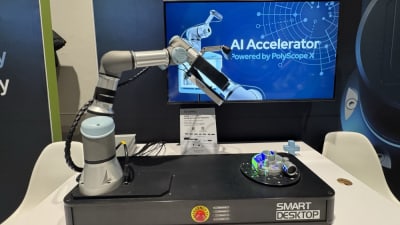
MIT engineers have found a way to fabricate a metamaterial that is both strong and stretchy. The base material is typically highly rigid and brittle, but it is printed in precise, intricate patterns that form a structure that is both strong and flexible.

Blog: Robotics, Automation & Control
Engineers have created a type of material that can expand, assume new shapes, move, and follow electromagnetic commands like a remotely controlled robot even though it lacks any motor or internal gears.
Blog: Sensors/Data Acquisition
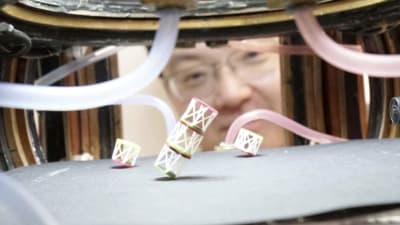
A tiny, soft, flexible robot that can crawl through earthquake rubble or travel inside the human body may seem like science fiction, but a team is pioneering such adaptable robots by integrating flexible electronics with magnetically controlled motion.
Blog: Wearables
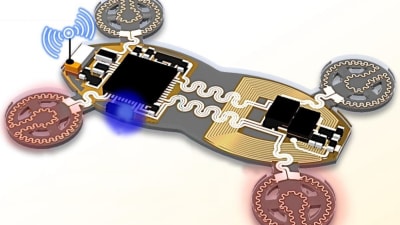
A research team has developed an electronic skin that detects and precisely tracks magnetic fields with a single global sensor. Read on to learn more.

Blog: Manufacturing & Prototyping
How can competitors both win when working together? Read on to find out SAE Media Group's Ed Brown's opinion on the matter.

Blog: Robotics, Automation & Control
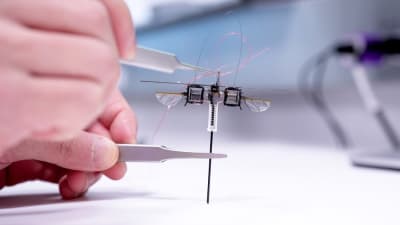
The hopping robot, which is smaller than a human thumb and weighs less than a paperclip, has a springy leg that propels it off the ground and four flapping-wing modules that give it lift and control its orientation.
Blog: Design
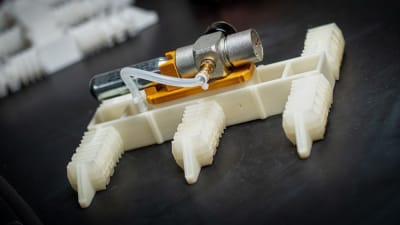
Imagine a robot that can walk, without electronics, and only with the addition of a cartridge of compressed gas, right off the 3D-printer. It can also be printed in one go, from one material. That is exactly what roboticists have achieved in robots developed at the University of California San Diego.
Blog: Photonics/Optics
The work addresses the outfielder problem, which refers to the baseball player who stands in the outfield to catch the ball after it is hit. It is a classic challenge in physics and the neuroscience of movement, used to explore how humans and animals predict movements in a dynamic environment and how automated systems can be designed to mimic them.

Blog: Medical
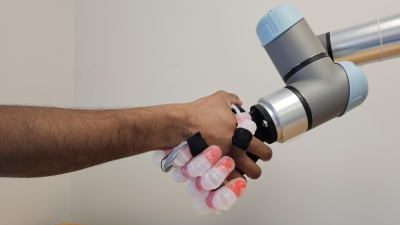
Johns Hopkins University engineers have developed a pioneering prosthetic hand that can grip plush toys, water bottles, and other everyday objects like a human, carefully conforming and adjusting its grasp to avoid damaging or mishandling whatever it holds.
Blog: Materials
An interdisciplinary team of researchers has introduced a new way to improve textile-based filters by coating them with a type of two-dimensional nanomaterial called MXene.

Blog: Materials
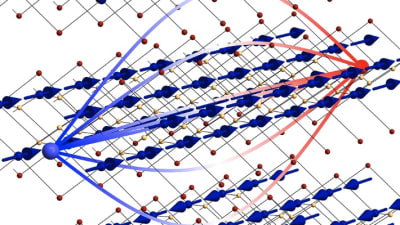
An international team has developed a novel approach to maintain special quantum characteristics, even in 3D materials.
Blog: Design
A research team has recently developed a neuromorphic exposure control system that revolutionizes machine vision under extreme lighting variations.

Blog: Manufacturing & Prototyping
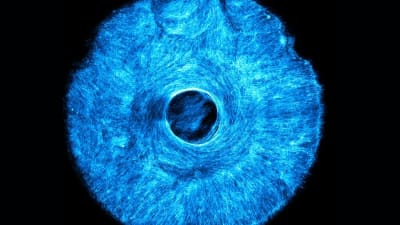
A team has developed a method to grow artificial muscle tissue that twitches and flexes in multiple coordinated directions. As a demonstration, they grew an artificial, muscle-powered structure that pulls both concentrically and radially.
Blog: AR/AI
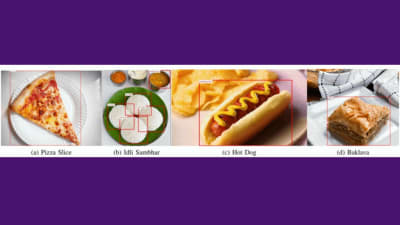
An AI system developed by NYU Tandon School of Engineering researchers promises a new tool for the millions of people who want to manage their weight, diabetes, and other diet-related health conditions.
Blog: Energy
A cathode material put forward by the Dincă Group, a layered organic solid called bis-tetraaminobenzoquinone (TAQ), outperforms traditional lithium-ion cathodes in both energy and power densities in a technology that is truly scalable.

Blog: Green Design & Manufacturing
This device works to suppress flames using the power of conductive aerosols, small particles that can direct electricity.

Blog: Design
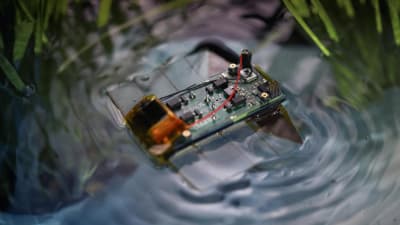
Researchers at EPFL and the Max Planck Institute for Intelligent Systems have developed a compact and versatile robot that can maneuver through tight spaces and transport payloads much heavier than itself.
Blog: Energy
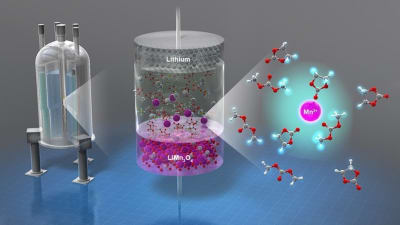
Researchers have been working on a method to detect and investigate the dissolution of the metal ion in a cathode. Using nuclear MRI, they were able to directly observe the dissolution in real time. Read on to learn more.
Blog: Data Acquisition
Researchers have developed a new AI algorithm, called Torque Clustering, that is much closer to natural intelligence than current methods. It significantly improves how AI systems learn and uncover patterns in data independently, without human guidance.

Top Stories
 Blog: Design

Aerial Microrobots That Can Match a Bumblebee's Speed
 Blog: Energy

My Opinion: We Need More Power Soon — Is Nuclear the Answer?
 Blog: Electronics & Computers

Turning Edible Fungi into Organic Memristors
 Blog: Semiconductors & ICs

Revolutionizing the Production of Semiconductor Chips
 Blog: Robotics, Automation & Control

Microscopic Swimming Machines that Can Sense, Respond to Surroundings
 Quiz: Energy

Webcasts
 Upcoming Webinars: Power

Hydrogen Engines Are Heating Up for Heavy Duty
 Upcoming Webinars: Transportation

Advantages of Smart Power Distribution Unit Design for Automotive...
 Upcoming Webinars: Unmanned Systems

Quiet, Please: NVH Improvement Opportunities in the Early Design...
 Upcoming Webinars: Power

A FREE Two-Day Event Dedicated to Connected Mobility
 On-Demand Webinars: Automotive

E/E Architecture Redefined: Building Smarter, Safer, and Scalable Vehicles
 Podcasts: Unmanned Systems

How Sift's Unified Observability Platform Accelerates Drone Innovation