38
-1
30
30
Briefs: Materials
MIT researchers have used 3D printing to produce self-heating microfluidic devices, demonstrating a technique which could someday be used to rapidly create cheap, yet accurate, tools to detect a host of diseases. Read on to learn more.

Briefs: Materials
Researchers have developed an on-chip twisted moiré photonic crystal sensor that uses MEMS technology to control the gap and angle between the crystal layers in real time. The sensor can detect and collect detailed polarization and wavelength information simultaneously. Read on to learn more.

Briefs: Sensors/Data Acquisition
Engineers at NASA Langley Research Center have developed a cutting-edge thermal inspection technology that enhances defect detection on low-emissivity surfaces by eliminating false readings caused by infrared reflections. Read on to learn more.

Briefs: Sensors/Data Acquisition
Innovators at NASA Johnson Space Center have developed a thin film sensor that measures temperatures up to 1200 °F, and whose prototype successor may achieve measurements up to ~3000 °F — which was the surface temperature of the Space Shuttle during its atmospheric reentry. Read on to learn more.

Briefs: Aerospace
Solar cells account for approximately six percent of the electricity used on Earth; however, in space, they play a significantly larger role, with nearly all satellites relying on advanced solar cells for their power. That’s why Georgia Tech researchers will soon be sending 18 photovoltaic cells to the International Space Station (ISS) for a study of how space conditions affect the devices’ operation over time. Read on to learn more.

Briefs: Energy
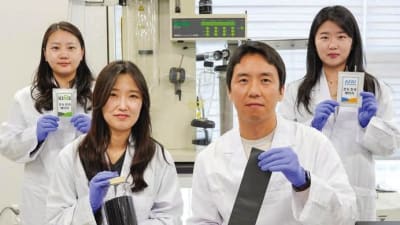
The Korea Electrotechnology Research Institute (KERI) and the Korea Institute of Materials Science have jointly developed spray drying technology-based high-performance dry electrode manufacturing technology for the realization of high-capacity secondary batteries. Read on to learn more.
Briefs: Energy
A team of chemists led by Feng Lin and Louis Madsen found a way to see into battery interfaces, which are tight, tricky spots buried deep inside the cell. Read on to learn what this means.

Briefs: Materials
Researchers at the U.S. Department of Energy (DOE)’s Oak Ridge National Laboratory (ORNL) have developed an innovative new technique using carbon nanofibers to enhance binding in carbon fiber and other fiber-reinforced polymer composites — an advance likely to improve structural materials for automobiles, airplanes and other applications that require lightweight and strong materials.

Briefs: Photonics/Optics
With this groundbreaking discovery of time-dependent changes in networked nanodomains, developers are on the path to building adaptive networks for information storage and processing. Read on to learn more.

Briefs: Energy
Using a new technology, Juan-Pablo Correa-Baena's lab has found a way to stabilize perovskite solar cells, which are built like a battery. Read on to learn more.

Briefs: Materials
Engineers from Australia and China have invented a sponge-like device that captures water from thin air and then releases it in a cup using the sun’s energy, even in low humidity where other technologies such as fog harvesting and radiative cooling have struggled. Read on to learn more.

Briefs: Energy
This research has far-reaching implications, offering a path to safer, more efficient batteries that can support the growing demand for electric vehicles. As the world moves towards cleaner energy solutions, these advancements are crucial for making EVs more viable and attractive for consumers. Read on to learn more.

Briefs: Energy
In the race to meet the growing global demand for lithium, a team of researchers from Rice University’s Elimelech lab has developed a breakthrough lithium extraction method that could reshape the industry. Read on to learn more about it.

Briefs: Materials
A team led by Kelsey Hatzell, Associate Professor of Mechanical and Aerospace Engineering and the Andlinger Center for Energy and the Environment, has uncovered insights that could help power a new type of battery, called an anode-free solid-state battery, past lithium-ion’s limitations.

Briefs: Energy
Aqueous zinc-ion batteries have attracted extensive attention due to their high safety, abundant reserves, and environmental friendliness. However, the low electrical conductivity of iodine hinders the redox conversion for an efficient energy storage process with zinc. Read on to learn how a research team addressed the existing issues in Zn-I2 batteries.
Briefs: Materials
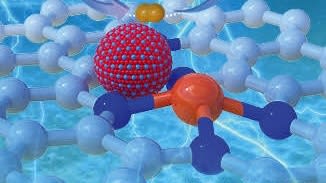
To create the new batteries needed for EVs, mobile devices, and renewable energy storage, researchers have explored new materials, new designs, new configurations, and new chemistry. But one aspect — the texture of the metals used — has been historically overlooked. Read on to learn more.

Briefs: Sensors/Data Acquisition
Researchers have developed a new type of sensor platform using a gold nanoparticle array. The sensor is made up of a series of gold disk-shaped nanoparticles on a glass slide. When an infrared laser is pointed at a precise arrangement of the particles, they start to emit unusual amounts of ultraviolet light. Read on to learn more.

Briefs: Electronics & Computers
This technology has potential as a portable power supply in several applications, including electric vehicles, cellphones, and wearable technology.
Briefs: Robotics, Automation & Control
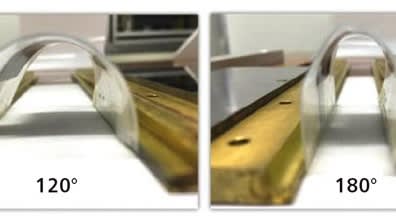
These materials can detect when they are damaged, take the necessary steps to temporarily heal themselves, and then resume work.

Briefs: Manufacturing & Prototyping
Innovators at the NASA Glenn Research Center have developed a toughened hybrid reinforcement material made from carbon fiber and carbon nanotube (CNT) yarn for use in polymer matrix composites (PMCs). The new material improves toughness and damping properties of PMCs, enhancing impact resistance, fatigue life, as well as structural longevity. Read on to learn more.

Briefs: Materials
In a new study, researchers from the University of Illinois Urbana-Champaign reported that automated high-resolution electron imaging can capture the nanoscale deformation events that lead to metal failure and breakage at the origin of metal failure. Read on to learn more.

Briefs: Materials
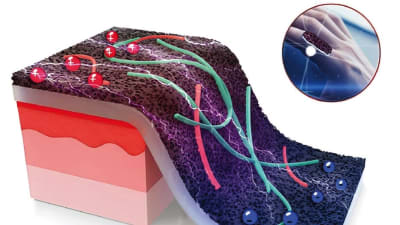
A major challenge in self-powered wearable sensors for health care monitoring is distinguishing different signals when they occur at the same time. Researchers addressed this issue by uncovering a new property of a sensor material, enabling the team to develop a new type of flexible sensor that can accurately measure both temperature and physical strain simultaneously but separately to more precisely pinpoint various signals. Read on to learn more.
Briefs: Sensors/Data Acquisition
Researchers have developed a groundbreaking near-infrared fluorescent nanosensor capable of simultaneously detecting and differentiating between iron forms — Fe(II) and Fe(III) — in living plants. Read on to learn more about it.

Briefs: AR/AI
Magnets generate invisible fields that attract certain materials. Far more important to our everyday lives, magnets also can store data in computers. Exploiting the direction of the magnetic field, microscopic bar magnets each can store one bit of memory as a zero or a one — the language of computers.

Briefs: Materials
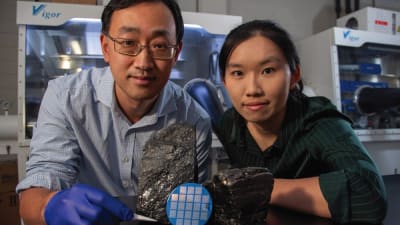
A joint research effort led by the University of Illinois Urbana-Champaign has shown how coal can play a vital role in next-generation electronic devices. Read on to learn more about it.
Briefs: Electronics & Computers
Researchers have designed and synthesized a unique material with controllable capabilities that make it promising for future electronics including cellphones and computers. Read on to learn more.

Briefs: Energy
A research team led by Dr. Daeho Kim and Dr. Jong Hwan Park at the Nano Hybrid Technology Research Center of the Korea Electrotechnology Research Institute has developed a groundbreaking process technology that enables ultrafast, 30-second preparation of hard carbon anodes for sodium-ion batteries, using microwave induction heating. Read on to learn more.
Briefs: Materials
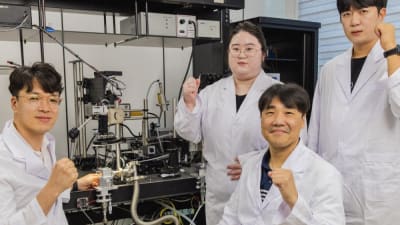
The triple-layer solid electrolyte features a robust middle layer that boosts the battery’s mechanical strength, while its soft outer surface ensures an excellent electrode contact, facilitating an easy movement of lithium ions. Read on to learn more.

Briefs: Materials
Purdue University material engineers have created a patent-pending process to develop ultrahigh-strength aluminum alloys that are suitable for additive manufacturing because of their plastic deformability. Read on to learn more.

Top Stories
 Blog: Lighting

A Stretchable OLED that Can Maintain Most of Its Luminescence
 Blog: Energy

Batteries that Can Withstand the Cold
 INSIDER: Energy

Advancing All-Solid-State Batteries
 Quiz: Energy

 Blog: Physical Sciences

 Blog: Materials

Webcasts
 Upcoming Webinars: Sensors/Data Acquisition

From Spreadsheets to Insights: Fast Data Analysis Without Complex...
 Upcoming Webinars: Electronics & Computers

Cooling a New Generation of Aerospace and Defense Embedded...
 Upcoming Webinars: Sensors/Data Acquisition

Beyond AI-Copy-Paste Engineering: Advanced AI-Integration Success...
 Upcoming Webinars: Power

Battery Abuse Testing: Pushing to Failure
 Upcoming Webinars: Connectivity

A FREE Two-Day Event Dedicated to Connected Mobility
 Upcoming Webinars: Test & Measurement

Choosing the Right N-Port Strategy: Multiport VNAs vs. Switch...