38
-1
60
30
Briefs: Materials
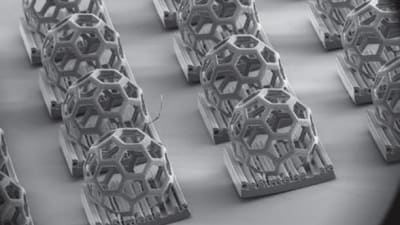
Researchers at Stanford University have introduced a more efficient processing technique that can print up to 1 million highly detailed and customizable microscale particles a day. Read on to learn more about it.
Briefs: Materials
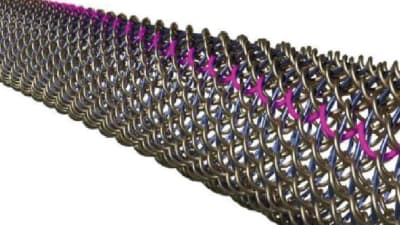
A Duke University team's approach takes a metallic nanotube, which always lets current through, and transforms it into a semiconducting form that can be switched on and off. Read on to learn more.

Briefs: Materials
A PNNL research team used a simple mixed-salt water-based solution and their knowledge of metal properties to separate valuable minerals in continuously flowing reaction chambers. Read on to learn more.

Briefs: Energy
Researchers have developed a strategy to design luminescent polymers with high light-emitting efficiencies from the start that are both biodegradable and recyclable. Read on to learn more.

Briefs: Materials
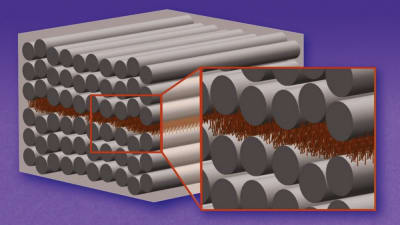
MIT engineers have shown they can prevent cracks from spreading between composite’s layers, using an approach they developed called “nanostitching,” in which they deposit chemically grown microscopic forests of carbon nanotubes between composite layers. Read on to learn more about it.
Briefs: Materials
A future quantum network may become less of a stretch thanks to researchers at the Argonne National Laboratory, the University of Chicago, and Cambridge University. By “stretching” thin films of diamond, they created quantum bits that can operate with significantly reduced equipment and expense. Read on to learn more.

Briefs: Electronics & Computers
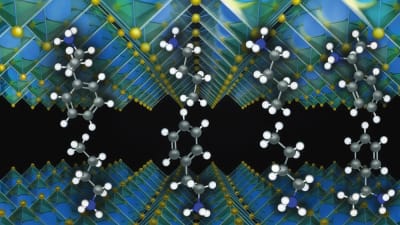
Researchers have demonstrated the ability to engineer materials that are both stiff and capable of insulating against heat. This combination of properties is extremely unusual and holds promise for a range of applications, such as the development of new thermal insulation coatings for electronic devices. Read on to learn more.
Briefs: Green Design & Manufacturing
Worldwide, glass manufacturing produces at least 86 million tons of carbon dioxide every year. A new type of glass aims to cut this carbon footprint in half. Read on to learn more about the invention: LionGlass, engineered at Penn State.

Briefs: Materials
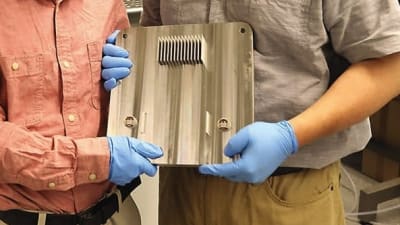
A research team led by Associate Professor Tao Sun has made new discoveries that can expand additive manufacturing in aerospace and other industries that rely on strong metal parts. Read on to learn more.
Briefs: Materials
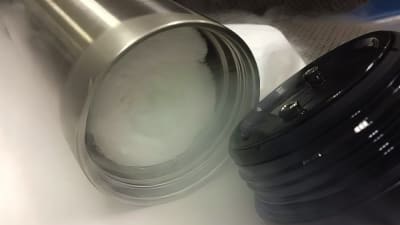
NASA’s Cryogenic Flux Capacitor capitalizes on the energy storage capacity of liquefied gases. By exploiting a unique attribute of nano-porous materials, aerogel in this case, fluid commodities such as oxygen, hydrogen, methane, etc. can be stored in a molecular surface-adsorbed state. Read on to learn more.
Briefs: Materials
NASA Kennedy Space Center engineers developed a Cryogenic Oxygen Storage Module to store oxygen in solid-state form and deliver it as a gas to an end-use environmental control and/or life support system. Read on to learn more about it.
Briefs: Software
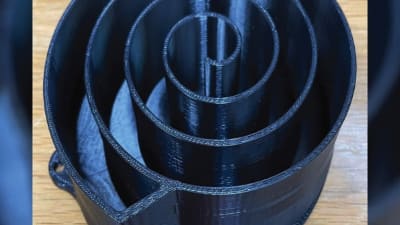
A team at MIT has moved beyond traditional trial-and-error methods to create materials with extraordinary performance through computational design. Their new system integrates physical experiments, physics-based simulations, and neural networks to navigate the discrepancies often found between theoretical models and practical results. Read on to learn more.
Briefs: Electronics & Computers
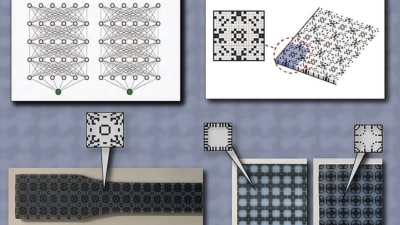
Researchers from MIT and elsewhere have developed a new technique to integrate 2D materials into devices in a single step while keeping the surfaces of the materials and the resulting interfaces pristine and free from defects. Read on to learn more.

Briefs: Physical Sciences
Researchers have fabricated the world’s highest-performing HTS wire segment while making the price-performance metric significantly more favorable. Read on to learn more.

Briefs: Green Design & Manufacturing
Inspired by a small and slow snail, scientists have developed a robot prototype that may one day scoop up microplastics from the surfaces of oceans, seas, and lakes.
Briefs: Electronics & Computers
A PNNL research team used a simple mixed-salt water-based solution and their knowledge of metal properties to separate valuable minerals in continuously flowing reaction chambers. Read on to learn more.

Briefs: Materials
Using transmission electron microscopes, Researchers at Graz University of Technology were able to systematically track lithium ions as they traveled through battery material, map their arrangement in the crystal lattice of an iron phosphate cathode with unprecedented resolution, and precisely quantify their distribution in the crystal. Read on to learn more.

Briefs: Manufacturing & Prototyping
Biomedical engineers have developed a “bio-ink” for 3D-printed materials that could serve as scaffolds for growing human tissues to repair or replace damaged ones in the body. Read on to learn more.

Briefs: Materials
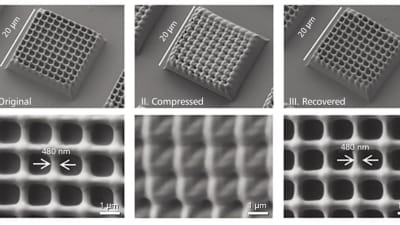
Researchers have successfully demonstrated the 4D printing of shape memory polymers in submicron dimensions that are comparable to the wavelength of visible light. Read on to learn more.
Briefs: Wearables
A silicone membrane for wearable devices is more comfortable and breathable thanks to better-sized pores made with the help of citric acid crystals. The new preparation technique fabricates thin, silicone-based patches that rapidly wick water away from the skin. The technique could reduce the redness and itching caused by wearable biosensors that trap sweat beneath them. Read on to learn more.

Briefs: Connectivity
Purdue University engineers have developed a method to transform existing cloth items into battery-free wearables resistant to laundering. These smart clothes are powered wirelessly through a flexible, silk-based coil sewn on the textile. Read on to learn more.

Briefs: Materials
Potential Solvents for Building on Moon and Mars
Researchers have taken the first steps toward finding liquid solvents that may someday help extract critical building materials from lunar and Martian rock dust, an important piece in making long-term space travel possible. Read on to learn more.
Briefs: Photonics/Optics
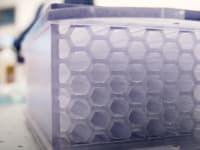
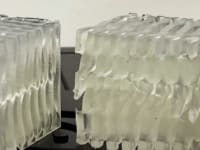
Imagine if physicians could capture 3D projections of medical scans, suspending them inside an acrylic cube to create a hand-held reproduction of a patient’s heart, brain, kidneys, or other organs. Then, when the visit is done, a quick blast of heat erases the projection, and the cube is ready for the next scan. A new report by researchers at Dartmouth and Southern Methodist University outlines a technical breakthrough that could enable such scenarios, and others, with widespread utility. Read on to learn more.

Briefs: Energy
Researchers have developed better rechargeable batteries by applying silicon to the batteries’ cathodes. Read on to learn more about it.
Briefs: Manufacturing & Prototyping
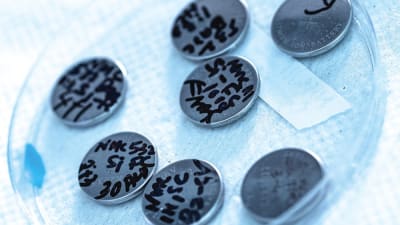
A flexible and stretchable cell has been developed for wearable electronic devices that require a reliable and efficient energy source that can easily be integrated into the human body. Read on to learn more about it.
Briefs: Energy
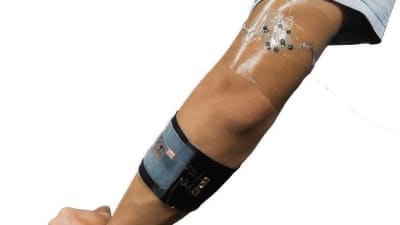
It's time to rethink battery technology. Compared to other existing or developing technologies, a new lithium metal-based solid-state battery brings some significant advantages: It can be charged and discharged within one minute, lasts about 10 times as long as a Li-ion battery, and is insensitive to temperature fluctuations. Read on to learn more about it.
Briefs: Software
Leveraging Machine Learning and AI to Automate Wearable Tech Design
Defying engineering challenges in record time, researchers at the University of Maryland developed a machine learning model that eliminates hassles in materials design to yield green technologies used in wearable heaters. Read on to learn more.
Briefs: Energy
The novel solar concentrators can be applied to textile fibers without the textile becoming brittle and susceptible to cracking or accumulating water vapor in the form of sweat. Read on to learn more.
Briefs: Manufacturing & Prototyping
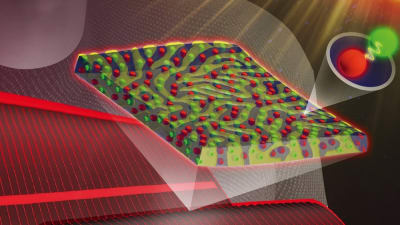
Applications include vehicle and aircraft tires, sports helmets, military equipment, and seals and couplings. Read on to learn more.
Top Stories
 Blog: Lighting

A Stretchable OLED that Can Maintain Most of Its Luminescence
 Blog: Energy

Batteries that Can Withstand the Cold
 INSIDER: Energy

Advancing All-Solid-State Batteries
 Quiz: Energy

 Blog: Physical Sciences

 Blog: Materials

Webcasts
 Upcoming Webinars: Sensors/Data Acquisition

From Spreadsheets to Insights: Fast Data Analysis Without Complex...
 Upcoming Webinars: Electronics & Computers

Cooling a New Generation of Aerospace and Defense Embedded...
 Upcoming Webinars: Sensors/Data Acquisition

Beyond AI-Copy-Paste Engineering: Advanced AI-Integration Success...
 Upcoming Webinars: Power

Battery Abuse Testing: Pushing to Failure
 Upcoming Webinars: Connectivity

A FREE Two-Day Event Dedicated to Connected Mobility
 Upcoming Webinars: Test & Measurement

Choosing the Right N-Port Strategy: Multiport VNAs vs. Switch...