36,38
-1
1830
30
Briefs: Materials
Preparation of a Bimetal Using Mechanical Alloying for Environmental or Industrial Use
Following the 1976 Toxic Substances Control Act ban on their manufacture, PCBs remain an environmental threat. PCBs are known to bio-accumulate and concentrate in fatty tissues. Further complications arise from the potential for contamination of commercial...
Briefs: Materials
Phase Change Material for Temperature Control of Imager or Sounder on GOES Type Satellites in GEO
An imager or sounder on satellites, such as the Geostationary Operational Environmental Satellite (GOES), in geostationary orbit (GEO) has a scan mirror and motor in the scan cavity. The GEO orbit is 24 hours long. During part of the orbit, direct...
Briefs: Manufacturing & Prototyping
Advanced Materials and Fabrication Techniques for the Orion Attitude Control Motor
Rhenium, with its high melting temperature, excellent elevated temperature properties, and lack of a ductile-to-brittle transition temperature (DBTT), is ideally suited for the hot gas components of the ACM (Attitude Control Motor), and other hightemperature...
Briefs: Manufacturing & Prototyping
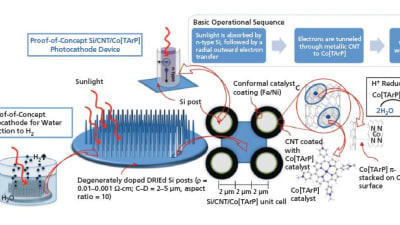
A proof-of-concept device is being developed (see figure) for hydrogen gas production based on water-splitting redox reactions facilitated by cobalt tetra-aryl porphyrins (Co[TArP])...
Briefs: Materials
Self-Healing Nanocomposites for Reusable Composite Cryotanks
Composite cryotanks, or composite overwrapped pressure vessels (COPVs), offer advantages over currently used aluminum- lithium cryotanks, particularly with respect to weight savings. Future NASA missions are expected to use COPVs in spaceflight propellant tanks to store fuels, oxidizers,...
Briefs: Materials
Ceramic Adhesive and Methods for On-Orbit Repair of Re-Entry Vehicles
This adhesive is capable of repairing damaged leading edge components of re-entry vehicles while in space, and is novel with regard to its ability to be applied in the vacuum of space, and in a microgravity environment. Once applied, the adhesive provides thermal and oxidation...
Briefs: Materials
Aerogel-Based Multilayer Insulation With Micrometeoroid Protection
Ultra-low-density, highly hydrophobic, fiber-reinforced aerogel material integrated with MLI (aluminized Mylar reflectors and B4A Dacron separators) offers a highly effective insulation package by providing unsurpassed thermal performance and significant robustness, delivering...
Briefs: Materials
Pt-Ni and Pt-Co Catalyst Synthesis Route for Fuel Cell Applications
Oxygen reduction reactions (ORRs) at the cathode are the rate-limiting step in fuel cell performance. The ORR is 100 times slower than the corresponding hydrogen oxidation at the anode. Speeding up the reaction at the cathode will improve fuel cell efficiency.
Briefs: Materials
Multi-scale CNT-Based Reinforcing Polymer Matrix Composites for Lightweight Structures
Reinforcing critical areas in carbon polymer matrix composites (PMCs), also known as fiber reinforced composites (FRCs), is advantageous for structural durability. Since carbon nanotubes (CNTs) have extremely high tensile strength, they can be used as a...
Briefs: Materials
Manufacturing of Nanocomposite Carbon Fibers and Composite Cylinders
Pitch-based nanocomposite carbon fibers were prepared with various percentages of carbon nanofibers (CNFs), and the fibers were used for manufacturing composite structures. Experimental results show that these nanocomposite carbon fibers exhibit improved structural and electrical...
Briefs: Materials
Polymer-Reinforced, Non-Brittle, Lightweight Cryogenic Insulation
The primary application for cryogenic insulating foams will be fuel tank applications for fueling systems. It is crucial for this insulation to be incorporated into systems that survive vacuum and terrestrial environments. It is hypothesized that by forming an open-cell...
Briefs: Materials
Sprayable Aerogel Bead Compositions With High Shear Flow Resistance and High Thermal Insulation Value
A sprayable aerogel insulation has been developed that has good mechanical integrity and lower thermal conductivity than incumbent polyurethane spray-on foam insulation, at similar or lower areal densities, to prevent insulation cracking and...
Briefs: Materials
Controlled, Site-Specific Functionalization of Carbon Nanotubes With Diazonium Salts
This work uses existing technologies to prepare a crossbar architecture of nanotubes, wherein one nanotube is fixed to a substrate, and a second nanotube is suspended a finite distance above. Both nanotubes can be individually addressed electrically. Application of...
Briefs: Materials
A Nanostructured Composites Thermal Switch Controls Internal and External Short Circuit in Lithium Ion Batteries
A document discusses a thin layer of composite material, made from nano scale particles of nickel and Teflon, placed within a battery cell as a layer within the anode and/or the cathode. There it conducts electrons at room temperature,...
Briefs: Manufacturing & Prototyping
Circularly Polarized Microwave Antenna Element With Very Low Off-Axis Cross-Polarization
The goal of this work was to improve offaxis cross-polarization performance and ease of assembly of a circularly polarized microwave antenna element. To ease assembly, the initial design requirement of Hexweb support for the internal circuit part, as well as...
Briefs: Manufacturing & Prototyping
Flash Cracking Reactor for Waste Plastic Processing
Conversion of waste plastic to energy is a growing problem that is especially acute in space exploration applications. Moreover, utilization of heavy hydrocarbon resources (wastes, waxes, etc.) as fuels and chemicals will be a growing need in the future. Existing technologies require a trade-off...
Briefs: Manufacturing & Prototyping
Ultra-Low Heat- Leak, High- Temperature Superconducting Current Leads for Space Applications
NASA Goddard Space Flight Center has a need for current leads used in an adiabatic demagnetization refrigerator (ADR) for space applications. These leads must comply with stringent requirements such as a heat leak of approximately 100 μW or less while...
Briefs: Materials
Regenerable Sorbent for CO2 Removal
A durable, high-capacity regenerable sorbent can remove CO2 from the breathing loop under a Martian atmosphere. The system design allows nearambient temperature operation, needs only a small temperature swing, and sorbent regeneration takes place at or above 8 torr, eliminating the potential for Martian...
Briefs: Materials
Li-Ion Electrolytes With Improved Safety and Tolerance to High-Voltage Systems
Given that lithium-ion (Li-ion) technology is the most viable rechargeable energy storage device for near-term applications, effort has been devoted to improving the safety characteristics of this system. Therefore, extensive effort has been devoted to developing...
Briefs: Materials
Composite Aerogel Multifoil Protective Shielding
New technologies are needed to survive the temperatures, radiation, and hypervelocity particles that exploration spacecraft encounter. Multilayer insulations (MLIs) have been used on many spacecraft as thermal insulation. Other materials and composites have been used as micrometeorite shielding or...
Briefs: Materials
Soft-Bake Purification of SWCNTs Produced by Pulsed Laser Vaporization
The “soft-bake” method is a simple and reliable initial purification step first proposed by researchers at Rice University for single-walled carbon nanotubes (SWCNT) produced by high-pressure carbon mon - oxide disproportionation (HiPco). Softbaking consists of annealing...
Briefs: Materials
Improved Wide Operating Temperature Range of Li-Ion Cells
Future NASA missions aimed at exploring the Moon, Mars, and the outer planets require rechargeable batteries that can operate over a wide temperature range (–60 to +60 ºC) to satisfy the requirements of various applications including landers, rovers, penetrators, CEV, CLV, etc. This work...
Briefs: Manufacturing & Prototyping
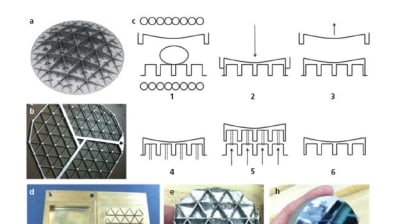
The use of mirror assemblies is commonplace in the aerospace industry, as most satellites and spacecraft contain optics. The fabrication of these mirrors is extremely complex due to the...
Briefs: Materials
Non-Toxic, Non-Flammable, –80 ºC Phase Change Materials
The objective of this effort was to develop a non-toxic, non-flammable, –80 °C phase change material (PCM) to be used in NASA’s ICEPAC capsules for biological sample preservation in flight to and from Earth orbit. A temperature of about –68 °C or lower is a critical temperature for...
Briefs: Manufacturing & Prototyping
The NASA Deep Space Network (DSN) uses commercial waveguide windows on the output waveguide of Ka-band (32 GHz) low-noise amplifiers. Mechanical failure of these windows resulted in an...

Briefs: Manufacturing & Prototyping
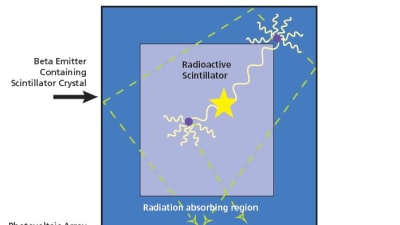
Technology has been developed for a class of self-contained, long-duration power sources called beta batteries, which harvest the energy contained in the...
Briefs: Manufacturing & Prototyping
Magnetic Shield for Adiabatic Demagnetization Refrigerators (ADR)
A new method was developed for creating a less expensive shield for ADRs using 1018 carbon steel. This shield has been designed to have similar performance to the expensive vanadium permen dur shields, but the cost is 30 to 50% less. Also, these shields can be stocked in a variety of...
Briefs: Materials
High-Temperature, Lightweight, Self- Healing Ceramic Composites for Aircraft Engine Applications
The use of reliable, high-temperature, lightweight materials in the manufacture of aircraft engines is expected to result in lower fossil and biofuel consumption, thereby leading to cost savings and lower carbon emissions due to air travel. Although...
Briefs: Materials
Treatment to Control Adhesion of Silicone-Based Elastomers
Seals are used to facilitate the joining of two items, usually temporarily. At some point in the future, it is expected that the items will need to be separated. This innovation enables control of the adhesive properties of silicone-based elastomers. The innovation may also be effective on...
Top Stories
 Blog: Lighting

A Stretchable OLED that Can Maintain Most of Its Luminescence
 Blog: Energy

Batteries that Can Withstand the Cold
 INSIDER: Energy

Advancing All-Solid-State Batteries
 Quiz: Energy

 Blog: Physical Sciences

 Blog: Materials

Webcasts
 Upcoming Webinars: Test & Measurement

From Spreadsheets to Insights: Fast Data Analysis Without Complex...
 Upcoming Webinars: Electronics & Computers

Cooling a New Generation of Aerospace and Defense Embedded...
 Upcoming Webinars: Test & Measurement

Beyond AI-Copy-Paste Engineering: Advanced AI-Integration Success...
 Upcoming Webinars: Automotive

Battery Abuse Testing: Pushing to Failure
 Upcoming Webinars: Internet of Things

A FREE Two-Day Event Dedicated to Connected Mobility
 Upcoming Webinars: Test & Measurement

Choosing the Right N-Port Strategy: Multiport VNAs vs. Switch...