36,38
-1
1860
30
Briefs: Materials
Using Pre-Melted Phase Change Material to Keep Payloads in Space Warm for Hours Without Power
Adding phase change material (PCM) to a mission payload can maintain its temperature above the cold survival limit, without power, for several hours in space. For the International Space Station, PCM is melted by heaters just prior to the payload...
Briefs: Materials
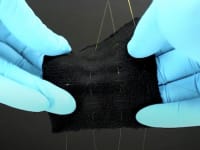
Fibrillar Adhesive for Climbing Robots
A climbing robot needs to use its adhesive patches over and over again as it scales a slope. Replacing the adhesive at each step is generally impractical. If the adhesive or attachment mechanism cannot be used repeatedly, then the robot must carry an extra load of this adhesive to apply a fresh layer with each...
Briefs: Materials
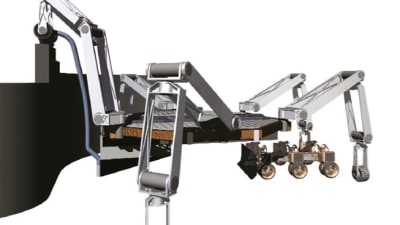
Transformers: Shape-Changing Space Systems Built With Robotic Textiles
Prior approaches to transformer-like robots had only very limited success. They suffer from lack of reliability, ability to integrate large surfaces, and very modest change in overall shape. Robots can now be built from two-dimensional (2D) layers of robotic fabric. This expands...
Briefs: Manufacturing & Prototyping
The harmful properties of lunar dust, such as small size, glass composition, abnormal surface area, and coatings of imbedded nanophase iron, lead to a unique coupling of the...
Briefs: Manufacturing & Prototyping
Development of a Centrifugal Technique for the Microbial Bioburden Analysis of Freon (CFC-11)
NASA Procedural Requirement 8020.12C entitled “Planetary Protection Provisions for Robotic Extraterrestrial Missions” states that the source-specific encapsulated microbial density for encapsulated organisms (div(0)) in nonmetallic materials ranges...
Briefs: Manufacturing & Prototyping
Advanced Materials and Manufacturing for Low-Cost, High-Performance Liquid Rocket Combustion Chambers
A document describes the low-cost manufacturing of C103 niobium alloy combustion chambers, and the use of a high-temperature, oxidation-resistant coating that is superior to the standard silicide coating. The manufacturing process involved...
Briefs: Manufacturing & Prototyping
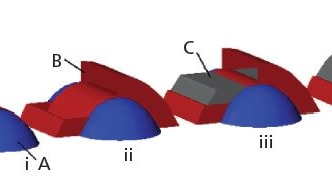
The environmental conditions of the Moon require mitigation if a long-term human presence is to be achieved for extended periods of time. Radiation, micrometeoroid impacts,...
Briefs: Manufacturing & Prototyping
Process for Patterning Indium for Bump Bonding
An innovation was created for the Cosmology Large Angular Scale Surveyor for integration of low-temperature detector chips with a silicon backshort and a silicon photonic choke through flip-chip bonding. Indium bumps are typically patterned using liftoff processes, which require thick resist. In some...
Briefs: Manufacturing & Prototyping
Composite With In Situ Plenums
A document describes a high-performance thermal distribution panel (TDP) concept using high-conductivity (>800 W/mK) macro composite skin with in situ heat pipes. The processing technologies proposed to build such a panel result in a one-piece, inseparable assembly with high conductance in both the X and Y planes....
Briefs: Manufacturing & Prototyping
Pneumatic System for Concentration of Micrometer-Size Lunar Soil
A report describes a size-sorting method to separate and concentrate micrometer-size dust from a broad size range of particles without using sieves, fluids, or other processes that may modify the composition or the surface properties of the dust.
Briefs: Manufacturing & Prototyping
Buckyball Nucleation of HiPco Tubes
The purpose of this innovation is to enhance nucleation of single-wall nanotubes (SWNTs) in the HiPco process, selectively producing 10,10 tubes, something which until now has not been thought possible.
Briefs: Manufacturing & Prototyping
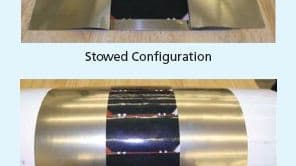
The Flexible Array Concentrator Technology (FACT) is a lightweight, high-performance reflective concentrator blanket assembly that can be used on flexible solar array blankets. The FACT concentrator replaces every...
Briefs: Materials
Adjusting Permittivity by Blending Varying Ratios of SWNTs
A new composite material of singlewalled carbon nanotubes (SWNTs) displays radio frequency (0 to 1 GHz) permittivity properties that can be adjusted based upon the nanotube composition. When varying ratios of raw to functionalized SWNTs are blended into the silicone elastomer matrix at a...
Briefs: Materials
Polyolefin-Based Aerogels
An organic polybutadiene (PB) rubber-based aerogel insulation material was developed that will provide superior thermal insulation and inherent radiation protection, exhibiting the flexibility, resiliency, toughness, and durability typical of the parent polymer, yet with the low density and superior insulation properties...
Briefs: Energy
An Integrated, Layered-Spinel Composite Cathode for Energy Storage Applications
At low operating temperatures, commercially available electrode materials for lithium-ion batteries do not fully meet the energy and power requirements for NASA’s exploration activities. The composite cathode under development is projected to provide the required...
Briefs: Materials
Engineered Multifunctional Surfaces for Fluid Handling
Designs incorporating variations in capillary geometry and hydrophilic and/or antibacterial surface properties have been developed that are capable of passive gas/liquid separation and passive water flow. These designs can incorporate capillary grooves and/or surfaces arranged to create linear...
Briefs: Manufacturing & Prototyping
Fabrication of Single Crystal MgO Capsules
A method has been developed for machining MgO crystal blocks into forms for containing metallic and silicate liquids at temperatures up to 2,400 ºC, and pressures up to at least 320 kilobars. Possible custom shapes include tubes, rods, insulators, capsules, and guides. Key differences in this innovative...
Briefs: Manufacturing & Prototyping
Mars Aqueous Processing System
The goal of the Mars Aqueous Processing System (MAPS) is to establish a flexible process that generates multiple products that are useful for human habitation. Selectively extracting useful components into an aqueous solution, and then sequentially recovering individual constituents, can obtain a suite of refined or...
Briefs: Manufacturing & Prototyping
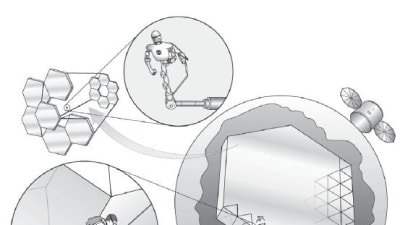
The NASA Human Space Flight program is interested in projects where humans, beyond low-Earth orbit (LEO), can make an important and unique contribution that cannot be reasonably...
Briefs: Materials
Bonding to aluminum can be a difficult task. Many engineers will search for a single and simple remedy in the form of a low-temperature adhesive for making structural joints without welding. A...

Briefs: Materials
Hybrid Filter Membrane
Cabin environmental control is an important issue for a successful Moon mission. Due to the unique environment of the Moon, lunar dust control is one of the main problems that significantly diminishes the air quality inside spacecraft cabins. Therefore, this innovation was motivated by NASA’s need to minimize the negative...
Briefs: Manufacturing & Prototyping
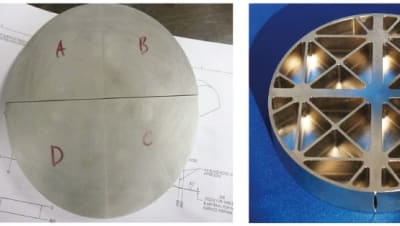
High-precision mirrors for space applications are traditionally manufactured from one piece of material, such as lightweight glass “sandwich” or...
Briefs: Manufacturing & Prototyping
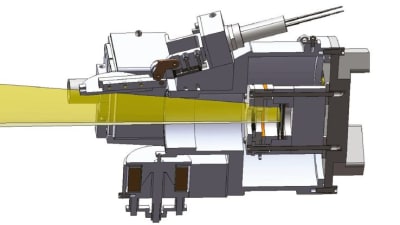
The sounding rocket experiment FIRE (Far-ultraviolet Imaging Rocket Experi ment) will improve the science community’s ability to image a spectral region hitherto unexplored...
Briefs: Materials
Ablative materials are required to protect a space vehicle from the extreme temperatures encountered during the most demanding (hyperbolic) atmospheric entry...

Briefs: Materials
A long-term space mission requires efficient air revitalization performance to sustain the crew. Prefilter and particulate air filter media are susceptible to rapid fouling that adversely affects their...

Briefs: Materials
Polyurea-Based Aerogel Monoliths and Composites
A flexible, organic polyurea-based aerogel insulation material was developed that will provide superior thermal insulation and inherent radiation protection for government and commercial applications. The rubbery polyurea-based aerogel exhibits little dustiness, good flexibility and toughness, and...
Briefs: Mechanical & Fluid Systems
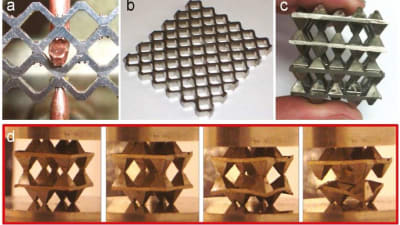
Bulk metallic glasses (BMGs), a class of amorphous metals defined as having a thickness greater than 1 mm, are being broadly investigated by NASA for use in...
Briefs: Materials
Imidazolium-Based Polymeric Materials as Alkaline Anion-Exchange Fuel Cell Membranes
Polymer electrolyte membranes that conduct hydroxide ions have potential use in fuel cells. A variety of polystyrenebased quaternary ammonium hydroxides have been reported as anion exchange fuel cell membranes. However, the hydrolytic stability and conductivity of...
Briefs: Materials
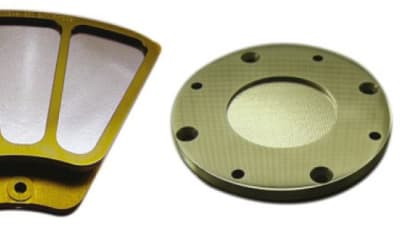
New and improved blocking filters (see figure) have been developed for microcalorimeters on several mission payloads, made of high-transmission polyimide support mesh, that...
Top Stories
 Blog: Lighting

A Stretchable OLED that Can Maintain Most of Its Luminescence
 Blog: Energy

Batteries that Can Withstand the Cold
 INSIDER: Energy

Advancing All-Solid-State Batteries
 Quiz: Energy

 Blog: Physical Sciences

 Blog: Materials

Webcasts
 Upcoming Webinars: Test & Measurement

From Spreadsheets to Insights: Fast Data Analysis Without Complex...
 Upcoming Webinars: Electronics & Computers

Cooling a New Generation of Aerospace and Defense Embedded...
 Upcoming Webinars: Test & Measurement

Beyond AI-Copy-Paste Engineering: Advanced AI-Integration Success...
 Upcoming Webinars: Automotive

Battery Abuse Testing: Pushing to Failure
 Upcoming Webinars: Internet of Things

A FREE Two-Day Event Dedicated to Connected Mobility
 Upcoming Webinars: Test & Measurement

Choosing the Right N-Port Strategy: Multiport VNAs vs. Switch...