36,38
-1
1890
30
Briefs: Materials
Electrospun Nanofiber Coating of Fiber Materials: A Composite Toughening Approach
Textile-based composites could significantly benefit from local toughening using nanofiber coatings. Nanofibers, thermoplastic or otherwise, can be applied to the surface of the fiber tow bundle, achieving toughening of the fiber tow contact surfaces, resulting in...
Briefs: Medical
Saliva Preservative for Diagnostic Purposes
Saliva is an important body fluid for diagnostic purposes. Glycoproteins, glucose, steroids, DNA, and other molecules of diagnostic value are found in saliva. It is easier to collect as compared to blood or urine. Un for tunately, saliva also contains large numbers of bacteria that can release enzymes,...
Briefs: Materials
Asymmetric Supercapacitor for Long-Duration Power Storage
A document discusses a project in which a series of novel hybrid positive electrode materials was developed and tested in asymmetric capacitors with carbon negative electrodes. The electrochemical performance of the hybrid capacitors was characterized by cyclic voltammetry and a DC...
Briefs: Manufacturing & Prototyping
Projects that utilize large volumes of nonmetallic materials of planetary protection concern pose a challenge to their bioburden budget, as the most...
Briefs: Manufacturing & Prototyping
Demonstration of Minimally Machined Honeycomb Silicon Carbide Mirrors
Honeycomb silicon carbide composite mirrors are made from a carbon fiber preform that is molded into a honeycomb shape using a rigid mold. The carbon fiber honeycomb is densified by using polymer infiltration pyrolysis, or through a reaction with liquid silicon. A chemical vapor...
Briefs: Materials
Nanoengineered Thermal Materials Based on Carbon Nanotube Array Composites
State-of-the-art integrated circuits (ICs) for microprocessors routinely dissipate power densities on the order of 50 W/cm2. This large power is due to the localized heating of ICs operating at high frequencies and must be managed for future highfrequency microelectronic...
Briefs: Materials
Polyimide Aerogel Thin Films
Polyimide aerogels have been cross-linked through multifunctional amines. This invention builds on “Polyimide Aerogels With Three-Dimensional Cross-Linked Structure,” (LEW-18486-1), NASA Tech Briefs, Vol. 34, No. 8 (August 2010), page 38, and may be considered as a continuation of that invention, which results in a...
Briefs: Materials
Composite Laminate With Coefficient of Thermal Expansion Matching D263 Glass
The International X-ray Observatory project seeks to make an X-ray telescope assembly with 14,000 flexible glass segments. The glass used is commercially available SCHOTT D263 glass. Thermal expansion causes the mirror to distort out of alignment. A housing material is...
Briefs: Manufacturing & Prototyping
Heat Shield Employing Cured Thermal Protection Material Blocks Bonded in a Large-Cell Honeycomb Matrix
A document describes a new way to integrate thermal protection materials on external surfaces of vehicles that experience the severe heating environments of atmospheric entry from space. Cured blocks of thermal protection materials are bonded into...
Briefs: Manufacturing & Prototyping
Single-Layer, All-Metal Patch Antenna Element With Wide Bandwidth
It is known that the impedance at the center of a patch antenna element is a short circuit, implying that a wire or post can be connected from the patch to the groundplane at this point without impacting radiation performance. In principle, this central post can be used to support...
Briefs: Manufacturing & Prototyping
Scanning Laser Infrared Molecular Spectrometer (SLIMS)
This prototype innovation is a novel design that achieves very long, effective laser path lengths that are able to yield ppb (parts per billion) and sub-ppb measurements of trace gases. SLIMS can also accommodate multiple laser channels covering a wide range of wavelengths, resulting in...
Briefs: Manufacturing & Prototyping
Next-Generation Microshutter Arrays for Large-Format Imaging and Spectroscopy
A next-generation microshutter array, LArge Microshutter Array (LAMA), was developed as a multi-object field selector. LAMA consists of small-scaled microshutter arrays that can be combined to form large-scale microshutter array mosaics. Microshutter actuation is...
Briefs: Materials
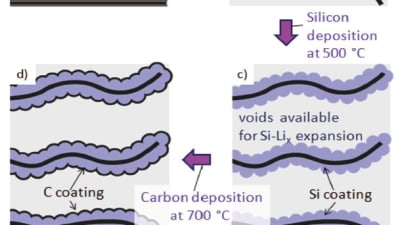
Building on previous knowledge acquired through research on thin-film batteries, three-dimensional (3D) porous macroscopic particles...
Briefs: Materials
Enhanced-Adhesion Multiwalled Carbon Nanotubes on Titanium Substrates for Stray Light Control
Carbon nanotubes previously grown on silicon have extremely low reflectance, making them a good candidate for stray light suppression. Silicon, however, is not a good structural material for stray light components such as tubes, stops, and baffles....
Briefs: Materials
Detection of Carbon Monoxide Using Polymer-Composite Films With a Porphyrin-Functionalized Polypyrrole
Post-fire air constituents that are of interest to NASA include CO and some acid gases (HCl and HCN). CO is an important analyte to be able to sense in human habitats since it is a marker for both pre-fire detection and post-fire cleanup.
Briefs: Materials
Ultra-Lightweight Nanocomposite Foams and Sandwich Structures for Space Structure Applications
Microcellular nanocomposite foams and sandwich structures have been created to have excellent electrical conductivity and radiation-resistant properties using a new method that does not involve or release any toxicity. The nanocomposite structures have...
Briefs: Materials
Over the past 30 years, significant technology gains in polymer engineering have greatly expanded the applications suited to adhesive bonding with epoxy resins. Advanced bonding...

Briefs: Materials
Electrochemical Ultracapacitors Using Graphitic Nanostacks
Electrochemical ultracapacitors (ECs) have been developed using graphitic nanostacks as the electrode material. The advantages of this technology will be the reduction of device size due to superior power densities and relative powers compared to traditional activated carbon electrodes....
Briefs: Manufacturing & Prototyping
Techniques for Solution-Assisted Optical Contacting
A document discusses a “solution-assisted contacting” technique for optical contacting. An optic of surface flatness Lambda/20 was successfully contacted with one of “moderate” surface quality, or Lambda/4. Optics used were both ultra-low expansion (ULE) glass (Lambda/4 and Lambda/20) and...
Briefs: Materials
Large-Strain Transparent Magnetoactive Polymer Nanocomposites
A document discusses polymer nanocomposite superparamagnetic actuators that were prepared by the addition of organically modified superparamagnetic nanoparticles to the polymer matrix. The nanocomposite films exhibited large deformations under a magnetostatic field with a low loading...
Briefs: Manufacturing & Prototyping
Graphene Transparent Conductive Electrodes for Next- Generation Microshutter Arrays
Graphene is a single atomic layer of graphite. It is optically transparent and has high electron mobility, and thus has great potential to make transparent conductive electrodes. This invention contributes towards the development of graphene transparent conductive...
Briefs: Manufacturing & Prototyping
Fabrication of a Cryogenic Terahertz Emitter for Bolometer Focal Plane Calibrations
A fabrication process is reported for prototype emitters of THz radiation, which operate cryogenically, and should provide a fast, stable blackbody source suitable for characterization of THz devices. The fabrication has been demonstrated and, at the time of this...
Briefs: Manufacturing & Prototyping
Fabrication of an Absorber-Coupled MKID Detector
Absorber-coupled microwave kinetic inductance detector (MKID) arrays were developed for submillimeter and farinfrared astronomy. These sensors comprise arrays of lambda/2 stepped microwave impedance resonators patterned on a 1.5-mm-thick silicon membrane, which is optimized for optical coupling. The...
Briefs: Manufacturing & Prototyping
Processing of Nanosensors Using a Sacrificial Template Approach
A new microsensor fabrication approach has been demonstrated based upon the use of nanostructures as templates. The fundamental idea is that existing nanostructures, such as carbon nanotubes or biological structures, have a material structure that can be used advantageously in order to...
Briefs: Manufacturing & Prototyping
Fabrication of a Cryogenic Bias Filter for Ultrasensitive Focal Plane
A fabrication process has been developed for cryogenic in-line filtering for the bias and readout of ultrasensitive cryogenic bolometers for millimeter and submillimeter wavelengths. The design is a microstripline filter that cuts out, or strongly attenuates, frequencies (10–50...
Briefs: Materials
High-Temperature Shape Memory Polymers
Shape memory materials undergo physical conformation changes when exposed to an external stimulus, such as a change in temperature. Such materials have a permanent shape, but can be reshaped above a critical temperature and fixed into a temporary shape when cooled under stress to below the critical...
Briefs: Materials
Non-Toxic, Low-Freezing, Drop-In Replacement Heat Transfer Fluids
A non-toxic, non-flammable, low-freezing heat transfer fluid is being developed for drop-in replacement within current and future heat transfer loops currently using water or alcohol-based coolants. Numerous water-soluble compounds were down-selected and screened for toxicological,...
Briefs: Materials
Modular Flooring System
The modular flooring system (MFS) was developed to provide a portable, modular, durable carpeting solution for NASA’s Robotics Alliance Project’s (RAP) outreach efforts. It was also designed to improve and replace a modular flooring system that was too heavy for safe use and transportation. The MFS was developed for use...
Briefs: Materials
Materials That Enhance Efficiency and Radiation Resistance of Solar Cells
A thin layer (≈10 microns) of a novel “transparent” fluorescent material is applied to existing solar cells or modules to effectively block and convert UV light, or other lower solar response waveband of solar radiation, to visible or IR light that can be more...
Top Stories
 Blog: Lighting

A Stretchable OLED that Can Maintain Most of Its Luminescence
 Blog: Energy

Batteries that Can Withstand the Cold
 INSIDER: Energy

Advancing All-Solid-State Batteries
 Quiz: Energy

 Blog: Physical Sciences

 Blog: Materials

Webcasts
 Upcoming Webinars: Test & Measurement

From Spreadsheets to Insights: Fast Data Analysis Without Complex...
 Upcoming Webinars: Electronics & Computers

Cooling a New Generation of Aerospace and Defense Embedded...
 Upcoming Webinars: Test & Measurement

Beyond AI-Copy-Paste Engineering: Advanced AI-Integration Success...
 Upcoming Webinars: Automotive

Battery Abuse Testing: Pushing to Failure
 Upcoming Webinars: Internet of Things

A FREE Two-Day Event Dedicated to Connected Mobility
 Upcoming Webinars: Test & Measurement

Choosing the Right N-Port Strategy: Multiport VNAs vs. Switch...