36,38
-1
2400
30
Briefs: Manufacturing & Prototyping
Automated Rapid Prototyping of 3D Ceramic Parts
An automated system of manufacturing equipment produces three-dimensional (3D) ceramic parts specified by computational models of the parts. The system implements an advanced, automated version of a generic rapid-prototyping process in which the fabrication of an object having a possibly complex 3D...
Briefs: Materials
Photocatalytic Coats in Glass Drinking-Water Bottles
According to a proposal, the insides of glass bottles used to store drinking water would be coated with films consisting of or containing TiO2. In the presence of ultraviolet light, these films would help to remove bacteria, viruses, and trace organic contaminants from the water.
Briefs: Materials
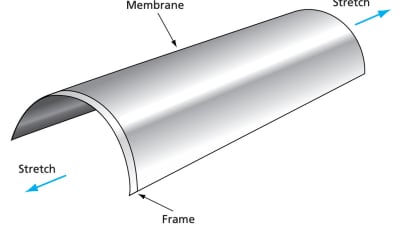
A new type of composite material has been proposed for membranes that would constitute the reflective surfaces of planned lightweight, single curvature (e.g., parabolic cylindrical)...
Briefs: Materials
Nickel-Tin Electrode Materials for Nonaqueous Li-Ion Cells
Experimental materials made from mixtures of nickel and tin powders have shown promise for use as the negative electrodes of rechargeable lithium-ion electrochemical power cells. During charging (or discharging) of a lithiumion cell, lithium ions are absorbed into (or desorbed from,...
Briefs: Materials
Patched Off-Axis Bending/Twisting Actuators for Thin Mirrors
Two documents present updates on thin-shell, adjustable, curved mirrors now being developed for use in spaceborne imaging systems. These mirrors at an earlier stage of development were reported in “Nanolaminate Mirrors With Integral Figure-Control Actuators” (NPO-30221), NASA Tech...
Briefs: Manufacturing & Prototyping
Fabrication of Spherical Reflectors in Outer Space
A process is proposed for fabrication of lightweight spherical reflectors in outer space for telescopes, radio antennas, and light collectors that would be operated there. The process would obviate the relatively massive substrates and frames needed to support such reflectors in normal Earth...
Briefs: Manufacturing & Prototyping
High-Temperature, High-Load-Capacity Radial Magnetic Bearing
A radial heteropolar magnetic bearing capable of operating at a temperature as high as 1,000°F (≈540°C) has been developed. This is a prototype of bearings for use in gas turbine engines operating at temperatures and speeds much higher than can be withstood by lubricated...
Briefs: Materials
These coatings show promise, but further development is needed. Conversion coatings that comprise mixtures of molybdates and several additives have been subjected to a variety of...

Briefs: Materials
A relatively economical method of chemical vapor deposition (CVD) has been developed for synthesizing diamond crystals and films. Unlike prior CVD methods for synthesizing diamond, this method does not...

Briefs: Materials
Modifying Silicates for Better Dispersion in Nanocomposites
An improved chemical modification has been developed to enhance the dispersion of layered silicate particles in the formulation of a polymer/silicate nanocomposite material. The modification involves, among other things, the co-exchange of an alkyl ammonium ion and a monoprotonated diamine...
Briefs: Materials
A class of end-cap compounds that increase the thermo-oxidative stability of polyimides of the polymerization of monomeric reactants (PMR) type has been extended. In addition, an...

Briefs: Materials
Dendrimeric reporter compounds have been invented for use in sensing and amplifying electrochemical signals from molecular recognition events that involve many chemical and biological entities. These...

Briefs: Materials
Precious-Metal Salt Coatings for Detecting Hydrazines
Substrates coated with a precious metal salt KAuCl4 have been found to be useful for detecting hydrazine vapors in air at and above a concentration of the order of 0.01 parts per million (ppm). Upon exposure to air containing a sufficient amount of hydrazine for a sufficient time, the coating...
Briefs: Materials
Nanocarpets — that is, carpets of carbon nanotubes — are undergoing development as means of trapping microscopic particles for scientific analysis. Examples of such particles include inorganic...

Briefs: Manufacturing & Prototyping
Resin-Transfer-Molding of a Tool Face
A resin-transfer-molding (RTM) process has been devised for fabricating a matrix/graphite-cloth composite panel that serves as tool face for manufacturing other composite panels. Heretofore, RTM has generally been confined to resins with viscosities low enough that they can readily flow through interstices of...
Briefs: Manufacturing & Prototyping
An improved process for the fabrication of random arrays of silicon nanotips has been demonstrated to be feasible. Relative to other such processes, this process offers advantages of low...

Briefs: Manufacturing & Prototyping
A process for making chemically pure, single-domain magnetite crystals substantially free of structural defects has been invented as a byproduct of research into the origin of globules in a...

Briefs: Manufacturing & Prototyping
Now more than ever, technological advancements drive the product design process.Increasingly powerful CAD programs allow more complex product designs, which in turn drive...

Briefs: Nanotechnology
Treated Carbon Nanofibers for Storing Energy in Aqueous KOH
A surface treatment has been found to enhance the performances of carbon nanofibers as electrode materials for electrochemical capacitors in which aqueous solutions of potassium hydroxide are used as the electrolytes. In the treatment, sulfonic acid groups are attached to edge plane sites...
Briefs: Materials
New Material for Surface-Enhanced Raman Spectroscopy
A chemical method of synthesis and application of coating materials that are especially suitable for surface-enhanced Raman spectroscopy (SERS)has been developed.The purpose of this development is to facilitate the utilization of the inherently high sensitivity of SERS to detect chemicals of...
Briefs: Manufacturing & Prototyping
Progress in Fabrication of Rocket Combustion Chambers by VPS
Several documents in a collection describe aspects of the development of advanced materials and fabrication processes intended to enable the manufacture of advanced rocket combustion chambers and nozzles at relatively low cost. One concept discussed in most of the documents is the...
Briefs: Materials
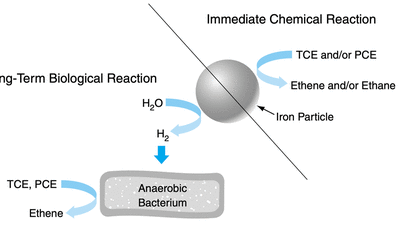
A method of in situ remediation of soil contaminated with chlorinated hydrocarbon solvents involves injection of nanometer-size iron particles. This method should not be confused with a...
Briefs: Photonics/Optics
Optoelectronic sensors and magnetic actuators have been developed as parts of a system for controlling the relative position and attitude of two massive optical tables that float on...

Briefs: Materials
Brazing SiC/SiC Composites to Metals
Experiments have shown that active brazing alloys (ABAs) can be used to join SiC/SiC composite materials to metals, with bond strengths sufficient for some structural applications. The SiC/SiC composite coupons used in the experiments were made from polymer-based SiC fiber preforms that were chemical-vapor-...
Briefs: Materials
Composite-Material Tanks With Chemically Resistant Liners
Lightweight composite-material tanks with chemically resistant liners have been developed for storage of chemically reactive and/or unstable fluids — especially hydrogen peroxide. These tanks are similar, in some respects, to the ones described in — Lightweight Composite-Material...
Briefs: Materials
Modifications of BN-based coatings that are used as interfacial layers between the fibers and matrices of SiC-fiber/SiC-matrix composite materials have been investigated to improve the...

Briefs: Manufacturing & Prototyping
In a proposed advance in friction stir welding, the torque exerted on the workpiece by the friction stir pin would be measured and controlled in an effort to measure and control the total...

Briefs: Manufacturing & Prototyping
Setup for Visual Observation of Carbon-Nanotube Arc Process
A simple optical setup has been devised to enable safe viewing of the arc and measurement of the interelectrode gap in a process in which carbon nanotubes are produced in an arc between a catalyst-filled carbon anode and a graphite cathode. This setup can be used for visually guided...
Briefs: Manufacturing & Prototyping
Manufacturing High-Quality Carbon Nanotubes at Lower Cost
A modified electric-arc welding process has been developed for manufacturing high-quality batches of carbon nanotubes at relatively low cost. Unlike in some other processes for making carbon nanotubes, metal catalysts are not used and, consequently, it is not necessary to perform extensive...
Top Stories
 Blog: Lighting

A Stretchable OLED that Can Maintain Most of Its Luminescence
 Blog: Energy

Batteries that Can Withstand the Cold
 INSIDER: Energy

Advancing All-Solid-State Batteries
 Quiz: Energy

 Blog: Physical Sciences

 Blog: Materials

Webcasts
 Upcoming Webinars: Test & Measurement

From Spreadsheets to Insights: Fast Data Analysis Without Complex...
 Upcoming Webinars: Electronics & Computers

Cooling a New Generation of Aerospace and Defense Embedded...
 Upcoming Webinars: Test & Measurement

Beyond AI-Copy-Paste Engineering: Advanced AI-Integration Success...
 Upcoming Webinars: Automotive

Battery Abuse Testing: Pushing to Failure
 Upcoming Webinars: Internet of Things

A FREE Two-Day Event Dedicated to Connected Mobility
 Upcoming Webinars: Test & Measurement

Choosing the Right N-Port Strategy: Multiport VNAs vs. Switch...