-1
510
30
Briefs: Communications
MIT researchers have demonstrated the first system for ultra-low-power underwater networking and communication, which can transmit signals across kilometer-scale distances. This technique uses about one-millionth the power that existing underwater communication methods use.

Briefs: Connectivity
Testing Smart Surfaces to Improve Wireless Communication
Researchers at UBC Okanagan are looking at ways to improve cell phone connectivity and localization abilities by examining “smart” surfaces that can bounce signals from a tower to customers to improve the link.
Briefs: Electronics & Computers
Exploiting Signals Broadcast by Multi-Constellation LEO Satellites
Researchers have developed an algorithm that can “eavesdrop” on any signal from a satellite and use it to locate any point on Earth, much like GPS. The study represents the first time an algorithm was able to exploit signals broadcast by multi-constellation low-Earth orbit satellites.
Briefs: Materials
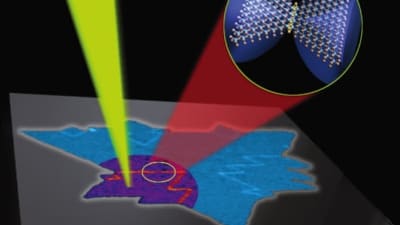
To further shrink electronic devices and to lower energy consumption, the semiconductor industry is interested in using 2D materials but manufacturers need a quick and accurate method for detecting defects in these materials to determine if the material is suitable for device manufacture.
Briefs: Imaging
Imagine being able to snap a picture of extremely fast events on the order of a picosecond.

Briefs: Test & Measurement
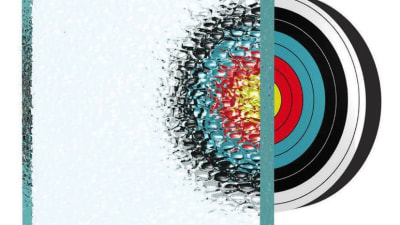
Researcher are finding ways to estimate a target location when light gets deflected by a disordered structure.
Briefs: Imaging
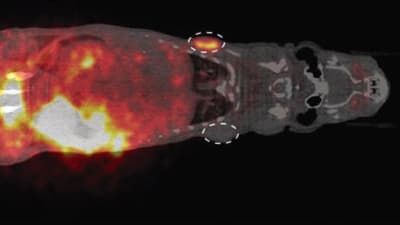
Processes and structures within the body that are normally hidden from the eye can be made visible through medical imaging. Scientists use imaging to investigate...
Briefs: Automotive
Researchers at The Ohio State University have developed new software to aid in the development, evaluation, and demonstration of safer autonomous, or driverless, vehicles. Called the Vehicle-in-Virtual-Environment (VVE) method, it allows the testing of driverless cars in a perfectly safe environment.

Briefs: Software
A Software Model Makes Transport Robots Smarter
Imagine a team of humans and robots working together to process online orders — real-life workers strategically positioned among their automated coworkers who are moving intelligently back and forth in a warehouse space. This could become a reality sooner than later, thanks to researchers at the University of Missouri.
Briefs: Power
Launched by Purdue University postgraduate students, Aerovy Mobility commercializes cloud-based software solutions to plan and operate infrastructure that charges electric aircraft with renewable energy.

Briefs: Electronics & Computers
New research in quantum computing at Sandia National Laboratories is moving science closer to being able to overcome supply-chain challenges and restore global security during future periods of unrest.

Briefs: Electronics & Computers
An ultra-small actuator has nanometer-scale precision.

Briefs: Nanotechnology
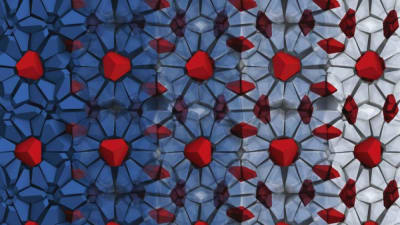
Cage structures made with nanoparticles could be a step toward making organized nanostructures with mixed materials, and researchers at the University of Michigan have shown how to achieve this through computer simulations.
Briefs: Materials
Researchers at the University of California San Diego have developed soft devices containing algae that glow in the dark when experiencing mechanical stress, such as being squished, stretched, twisted, or bent.

Briefs: Photonics/Optics
Researchers from Imperial College London and University College London have demonstrated the first spontaneously self-organizing laser device, which can reconfigure when conditions change.
Briefs: Materials
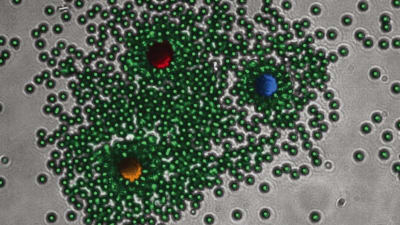
Researchers have developed a viable dust, water, and ice mitigation optical coating for space flight, aeronautical, and ground applications. The innovation of the LOTUS coating prevents contamination on sensitive surfaces.
Briefs: Photonics/Optics
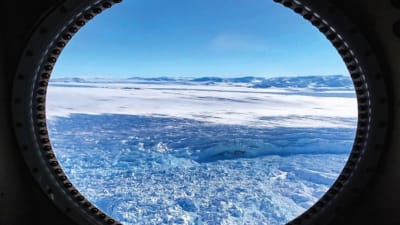
A team of researchers demonstrated the first light-emitting array with 49 different colors on a single chip. This novel optoelectronic device is built on metal-oxide semiconductor capacitors.
Briefs: Energy
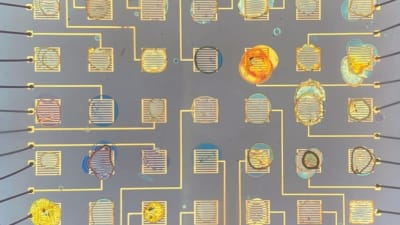
With a new microscopy technique that uses blue light to measure electrons in semiconductors and other nanoscale materials, a team of researchers is opening a new realm of possibilities in the study of these critical components, which can help power devices like mobile phones and laptops.
Briefs: Photonics/Optics
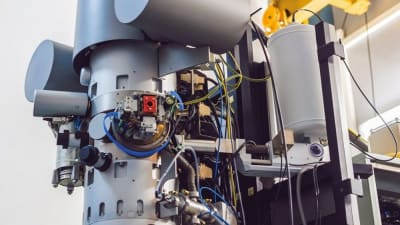
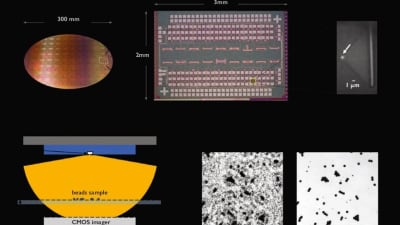
Researchers have developed the world’s smallest LED. It enables the conversion of existing mobile phone cameras into high-resolution microscopes. Smaller than the wavelength of light, the new LED was used to build the world’s smallest holographic microscope.
Briefs: Photonics/Optics
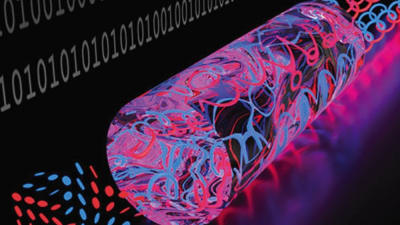
Researchers have outlined a new optical communication protocol that exploits spatial patterns of light for multi-dimensional encoding in a manner that does not require the patterns to be recognized, thus overcoming the prior limitation of modal distortion in noisy channels.
Briefs: Power
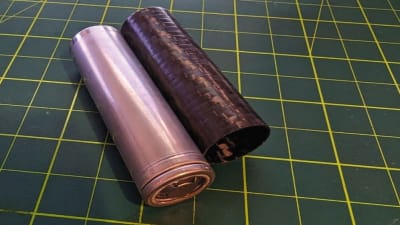
Innovators at NASA Johnson Space Center have developed a carbon fiber reinforced polymer (CFRP) sleeve, that, when fitted over a cylindrical Li-ion battery cell, can prevent cell-to-cell propagation by containing a thermal runaway (TR) event to the originating cell.
Briefs: Manufacturing & Prototyping
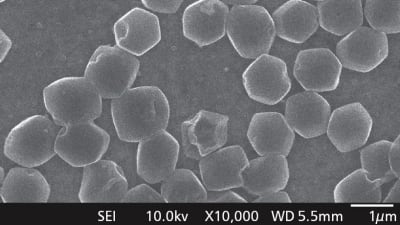
Engineers have made progress toward lithium-metal batteries that charge as fast as an hour. This fast charging is thanks to lithium metal crystals that can be seeded and grown — quickly and uniformly — on a surprising surface.
Briefs: Energy
Researchers continue to refine the process to improve electrochemical performance. The goal is to balance the benefits and drawbacks of the thicker electrode: It has the potential for higher energy loading and is easy to roll, but it may provide less power, since the ions have further to travel.

Briefs: Materials
Most space satellites are powered by photovoltaic cells that convert sunlight to electricity. Exposure to certain orbit radiation can damage the devices. Scientists have proposed a radiation-tolerant photovoltaic cell design that features an ultrathin layer of light-absorbing material.
Briefs: Robotics, Automation & Control
Research reveals that expertly timed lasers shined at an approaching LIDAR system can create a blind spot in front of the vehicle.

Briefs: Sensors/Data Acquisition
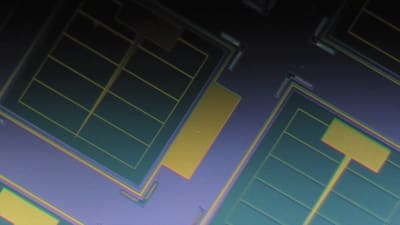
Study shows improvements to chemical sensing chip that aims to quickly and accurately identify drugs and other trace chemicals.

Briefs: Sensors/Data Acquisition
Engineers have demonstrated an ingestible sensor whose location can be monitored as it moves through the digestive tract, an advance that could help doctors more easily diagnose gastrointestinal motility disorders such as constipation, gastroesophageal reflux disease, and gastroparesis.

Briefs: Energy
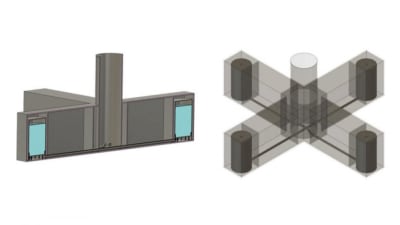
NASA engineers have developed a new approach to mitigating unwanted motion in floating structures. Ideally suited to applications including offshore wind energy platforms and barges, the innovation uses water ballast as a motion damping fluid.
Briefs: Design
The innovation can provide a wide range of damping forces, a linear damping function and/or an extended dynamic range of attenuation, providing broad flexibility in configuration size and functional applicability.

Top Stories
 Blog: Design

A Stretchable OLED that Can Maintain Most of Its Luminescence
 INSIDER: Design

Advancing All-Solid-State Batteries
 Blog: Power

My Opinion: We Need More Power Soon — Is Nuclear the Answer?
 Blog: Energy

Batteries that Can Withstand the Cold
 Quiz: Power

 Blog: Robotics, Automation & Control

Microscopic Swimming Machines that Can Sense, Respond to Surroundings
Webcasts
 On-Demand Webinars: Electronics & Computers

Advantages of Smart Power Distribution Unit Design for Automotive &...
 Upcoming Webinars: Unmanned Systems

Quiet, Please: NVH Improvement Opportunities in the Early Design...
 Upcoming Webinars: AR/AI

From Spreadsheets to Insights: Fast Data Analysis Without Complex...
 Upcoming Webinars: Defense

Cooling a New Generation of Aerospace and Defense Embedded...
 Upcoming Webinars: Software

Beyond AI-Copy-Paste Engineering: Advanced AI-Integration Success...
 Upcoming Webinars: Energy