-1
480
30
Briefs: Materials
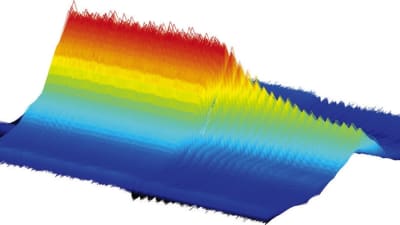
With this new capability, researchers can potentially use frequency combs to better understand the split-second intermediate steps in fast-moving processes ranging from the workings of hypersonic jet engines to the chemical reactions between enzymes that regulate cell growth.
Briefs: Test & Measurement
Scientists from the Institute of Geophysics at ETH Zurich, working together with the Swiss Federal Institute of Metrology (METAS), have found an inexpensive method that enables accurate earthquake measurements even on the ocean floor and in less developed countries.

Briefs: Photonics/Optics
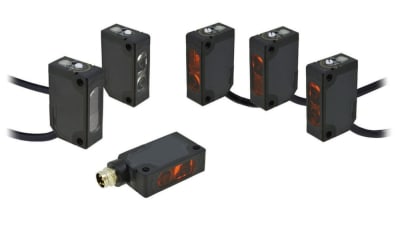
Photoelectric (PE) sensors represent a discrete sensor technology widely used throughout industry. They use the presence or absence of light to provide an on/off output to supervisory automation and monitoring systems, and are often the better choice for sensing manufacturing products.
Briefs: Lighting
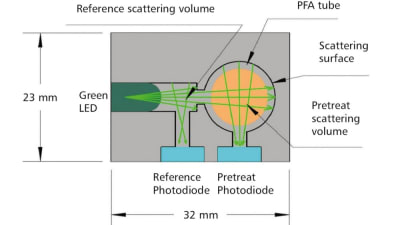
The optical concentration sensor has been demonstrated to effectively measure pretreat concentrations in both still and flowing liquid conditions and is resistant to contamination issues as necessitated by the UWMS.
Briefs: Sensors/Data Acquisition
Macquarie University engineers have developed a new technique to make the manufacturing of nanosensors far less carbon-intensive, much cheaper, more efficient, and more versatile — substantially improving a key process in this trillion-dollar global industry.

Briefs: Sensors/Data Acquisition
A Molecular-Sized, More Efficient Electronic Sensor
Australian researchers have developed a molecular-sized, more efficient version of a widely used electronic sensor, in a breakthrough that could bring widespread benefits.
Briefs: Robotics, Automation & Control
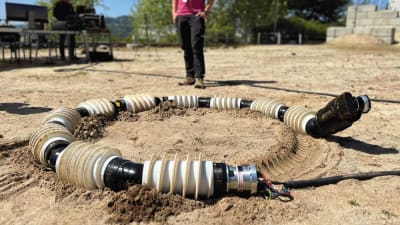
Called EELS (Exobiology Extant Life Surveyor), the self-propelled, autonomous robot was inspired by a desire to look for signs of life in the ocean hiding below the icy crust of Saturn's moon Enceladus by descending narrow vents in the surface that spew geysers into space.
Briefs: Materials
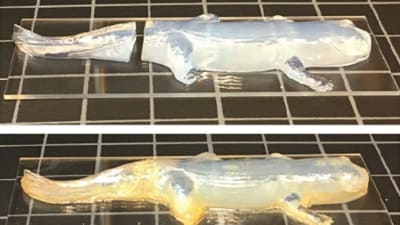
Using a new type of dual-polymer material capable of responding dynamically to its environment, researchers have developed a set of modular hydrogel components that could be useful in a variety of soft robotic and biomedical applications.
Briefs: Robotics, Automation & Control
A research team has developed a robotic system that can be unobtrusively built into the frame of a standard honeybee hive. Composed of an array of thermal sensors and actuators, the system measures and modulates honeybee behavior through localized temperature variations.

Briefs: Sensors/Data Acquisition
A team at ETH Zurich has developed an ultrasonically actuated glass needle that can be attached to a robotic arm. This lets them pump and mix minuscule amounts of liquid and trap particles.

Briefs: Materials
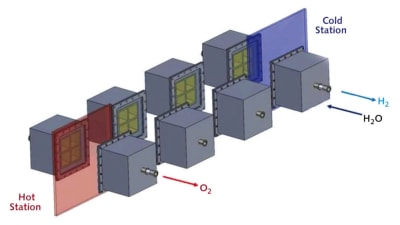
The system harnesses the sun's heat to directly split water and generate hydrogen — a clean fuel that can power long-distance trucks, ships, and planes, while in the process emitting no greenhouse gas emissions.
Briefs: Materials
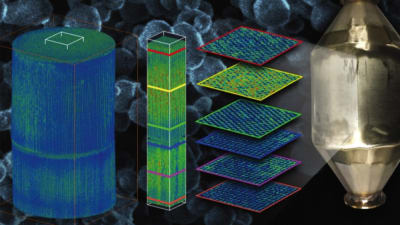
Scientists at the Department of Energy's Oak Ridge National Laboratory have developed an affordable add-on technology that removes more than 99.9 percent of acidic gases and other emissions to produce an ultraclean natural gas furnace.
Briefs: Green Design & Manufacturing
Recent discoveries by MIT engineers have revealed that introducing new materials into existing concrete manufacturing processes could significantly reduce their carbon footprint without altering concrete's bulk mechanical properties.

Briefs: Energy
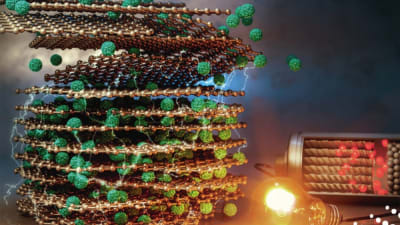
To improve battery performance and production, Penn State researchers and collaborators have developed a new fabrication approach that could make for more efficient batteries that maintain energy and power levels.
Briefs: Energy
Researchers at Chalmers University of Technology, Sweden, have created a new and efficient way to recycle metals from spent electric vehicle (EV) batteries. The method allows recovery of 100 percent of the aluminum and 98 percent of the lithium in EV batteries.

Briefs: Energy
A team developed a framework for designing solid-state batteries (SSBs) with mechanics in mind. Their paper, published in Science, reviewed how these factors change SSBs during their cycling.

Briefs: Energy
A collaborative research team has achieved a groundbreaking milestone in battery technology. Their remarkable achievement in developing a non-flammable gel polymer electrolyte is set to revolutionize the safety of Li-ion batteries by mitigating the risks of thermal runaway and fire incidents.

Briefs: Robotics, Automation & Control
Cornell researchers have combined soft microactuators with high-energy-density chemical fuel to create an insect-scale quadrupedal robot that is powered by combustion and can outrace, outlift, outflex, and outleap its electric-driven competitors.

Briefs: Imaging
MIT researchers have developed a camera-based touch sensor that is long, curved, and shaped like a human finger. Their device provides high-resolution tactile sensing over a large area. The sensor, called the GelSight Svelte, uses two mirrors to reflect and refract light.
Briefs: Robotics, Automation & Control
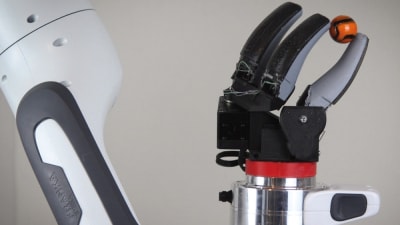
Dr. Song Kahye along with Professor Lee, Dae-Young have jointly developed a soft gripper with a woven structure that can grip objects weighing more than 100 kg with 130 g of material. To increase the loading capacity of the soft robot gripper, the team applied a new structure inspired by textiles.

Briefs: Sensors/Data Acquisition
A new soft sensor developed by UBC and Honda researchers opens the door to a wide range of applications in robotics and prosthetics. When applied to the surface of a prosthetic arm or a robotic limb, the sensor skin provides touch sensitivity and dexterity, enabling tasks that can be difficult for machines such as picking up a piece of soft fruit.

Briefs: Electronics & Computers
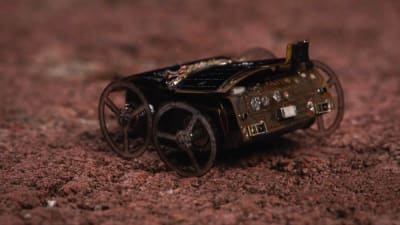
Moving robots demands a lot of energy, and batteries, the typical power source, limit lifetime and raise environmental concerns. Researchers at the University of Washington have now created MilliMobile, a tiny, self-driving robot powered only by surrounding light or radio waves.
Briefs: Robotics, Automation & Control
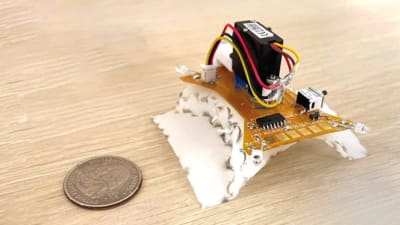
Centimeter-scale walking and crawling robots are in demand both for their ability to explore tight or cluttered environments and for their low fabrication costs. Pulling from origami-inspired construction, researchers have crafted a more simplified approach to the design and fabrication of these robots.
Briefs: Aerospace
A research team at the Illinois Institute of Technology has for the first time demonstrated the use of a novel control method in a tailless aircraft. The technology allows an aircraft to be as smooth and sleek as possible — making it safer to fly in dangerous areas where radar scans the sky for sharp edges.

Briefs: Manufacturing & Prototyping
A team of MIT engineers is creating a one-megawatt motor that could be a key stepping-stone toward electrifying larger aircraft. The team has designed and tested the major components of the motor.

Briefs: Aerospace
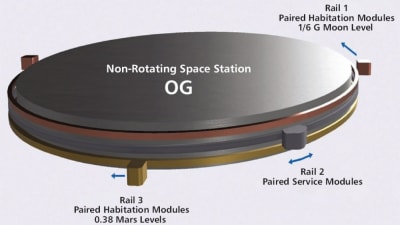
NASA Ames Research Center has developed a novel technology — a system and approach for creating artificial gravity using a non-rotating spacecraft with connected moving modules, which can be used for habitation and other purposes.
Briefs: Electronics & Computers
When multiple drones are working together in the same airspace, perhaps spraying pesticide over a field of corn, there’s a risk they might crash into each other. To help avoid these costly crashes, MIT researchers developed a system called MADER in 2020.

Briefs: Aerospace
Innovators at NASA Johnson Space Center have developed a coil-on-plug ignition system for integrated liquid oxygen/liquid methane thermal-vacuum environment propulsion systems operating in a thermal vacuum environment. The innovation will help quell corona discharge issues and reduce overall mass.

Briefs: Electronics & Computers
Making Satellite, Ground Communication More Effective
Rensselaer Polytechnic Institute’s Moussa N’Gom has devised a method to make communications between satellites and the ground more effective — regardless of the weather.
Top Stories
 Blog: Design

A Stretchable OLED that Can Maintain Most of Its Luminescence
 INSIDER: Design

Advancing All-Solid-State Batteries
 Blog: Power

My Opinion: We Need More Power Soon — Is Nuclear the Answer?
 Blog: Energy

Batteries that Can Withstand the Cold
 Quiz: Power

 Blog: Robotics, Automation & Control

Microscopic Swimming Machines that Can Sense, Respond to Surroundings
Webcasts
 On-Demand Webinars: Transportation

Advantages of Smart Power Distribution Unit Design for Automotive &...
 Upcoming Webinars: Unmanned Systems

Quiet, Please: NVH Improvement Opportunities in the Early Design...
 Upcoming Webinars: AR/AI

From Spreadsheets to Insights: Fast Data Analysis Without Complex...
 Upcoming Webinars: Electronics & Computers

Cooling a New Generation of Aerospace and Defense Embedded...
 Upcoming Webinars: AR/AI

Beyond AI-Copy-Paste Engineering: Advanced AI-Integration Success...
 Upcoming Webinars: Energy