-1
540
30
Briefs: Manufacturing & Prototyping
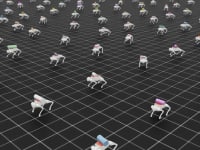
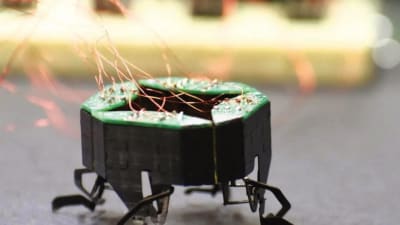
Engineers at CU Boulder have designed a robot called CLARI, which stands for Compliant Legged Articulated Robotic Insect, that has the potential to aid first responders after major disasters in an entirely new way.
Briefs: Medical
Research teams at University of Galway and MIT have detailed a new breakthrough in medical device technology that could lead to intelligent, long-lasting, tailored treatment for patients thanks to soft robotics and artificial intelligence.

Briefs: Unmanned Systems
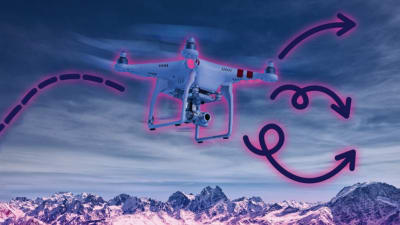
Researchers from MIT and Stanford University have devised a new machine-learning approach that could be used to control a robot, such as a drone or autonomous vehicle, more effectively and efficiently in dynamic environments where conditions can change rapidly.
Briefs: Sensors/Data Acquisition
Prompted by conversations regarding soft robotics, a research group has developed a design for a new sensor using 3D electrodes inspired by the folding patterns used in origami, able to measure a strain range of up to three times higher than a typical sensor.

Briefs: Robotics, Automation & Control
Sensor Enhances Robots’ Tactile Capabilities
Achieving human-level dexterity during manipulation and grasping has been a long-standing goal in robotics. To accomplish this, having a reliable sense of tactile information and force is essential for robots.
Briefs: Sensors/Data Acquisition
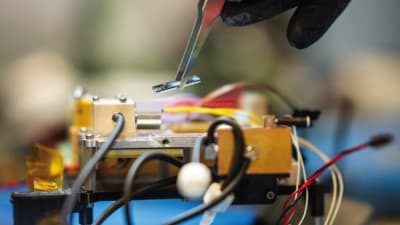
In people with epilepsy, seizure-alert dogs can smell small changes in body chemistry and warn of an impending seizure an hour or more before it occurs. Inspired by this feat of nature, a team of researchers has developed a way to replicate that ability with technology.
Briefs: AR/AI
Praneeth Namburi is a research scientist at the MIT.nano Immersion Lab. One project that bridges the physical and digital worlds uses VR simulations to train people to fabricate computer chips and semiconductors.

Briefs: Photonics/Optics
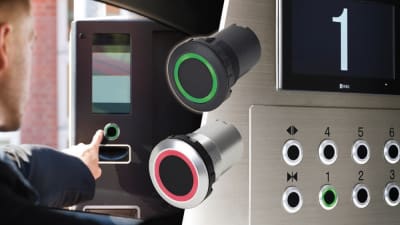
Touchless switches are an ideal solution for industries such as food, beverage, pharmaceuticals, medical, and chemicals where sanitary design is important. They are also useful for protecting the well-being of users in everyday commercial applications.
Briefs: Semiconductors & ICs
A Northwestern University research team has developed a revolutionary transistor that is expected be ideal for lightweight, flexible, high-performance bioelectronics. The electrochemical transistor is compatible with blood and water and can amplify important signals.
Briefs: Energy
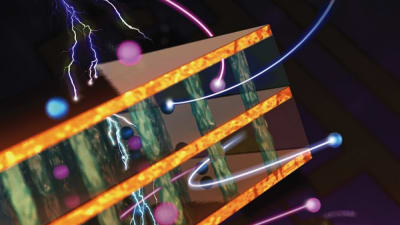
Thermoelectric Cooler Improves Cooling Power and Efficiency
A new thermoelectric cooler developed by Penn State scientists greatly improves the cooling power and efficiency compared to current commercial thermoelectric units and may help control heat in future high-power electronics, the researchers said.
Briefs: Lighting
Imagine a thin, digital display so flexible that you can wrap it around your wrist, fold it in any direction, or even curve it over your car’s steering wheel. Well, imagine no more — researchers at the Pritzker School of Molecular Engineering at the University of Chicago have designed such a material.

Briefs: Test & Measurement
NASA Ames has developed a new state-of-the-art method for measuring fluctuating aerodynamic-induced pressures on wind tunnel models using unsteady Pressure Sensitive Paint (uPSP).

Briefs: Manufacturing & Prototyping
The vibrating device uses bone-conducted sounds to achieve better results.

Briefs: Test & Measurement
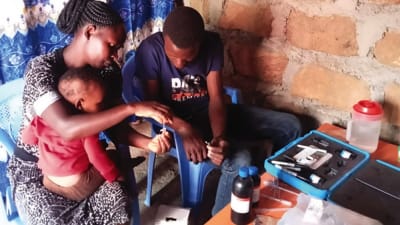
Researchers from Northwestern University have collaborated on the implementation of an accurate, low-cost, and easy-to-use test for detecting toxic levels of fluoride in water. The new biosensor device has been field tested in Kenya.
Briefs: Medical
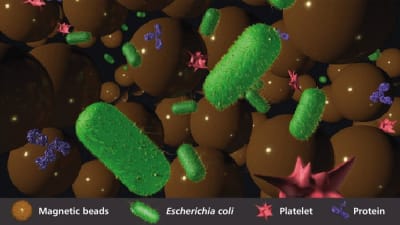
Researchers were able to successfully isolate bacteria from various fluids with a microparticle-based matrix filter. The filter trapped particles in small voids in the device, providing a larger concentration of bacteria for analysis.
Briefs: Test & Measurement
Enhancing At-Home COVID Tests with Glow-in-The-Dark Materials
Researchers at the University of Houston are using glow-in-the-dark materials to enhance and improve rapid COVID-19 home tests.
Briefs: Sensors/Data Acquisition
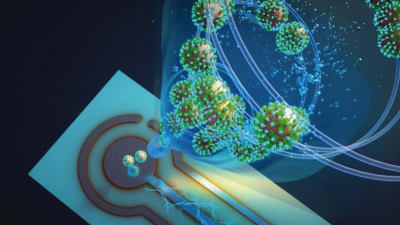
By combining recent advances in aerosol sampling technology and an ultrasensitive biosensing technique, researchers at Washington University in St. Louis have created a real-time monitor that can detect any of the SARS-CoV-2 virus variants in a room in about five minutes.
Briefs: Medical
The tool shows promise for imaging brain activity in 3D with high speed and contrast.
Briefs: Design
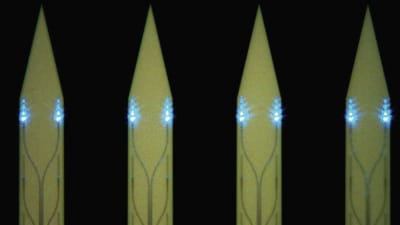
NASA researchers have developed a technology that yields 3D tissue-like assemblies of human broncho-epithelial cells for in vitro research on infection of humans by respiratory viruses.

Briefs: Materials
In Penn’s Clean Energy Conversions Lab, researchers are repurposing waste from industrial mines, storing carbon pulled from the atmosphere into newly formed rock. The team sees great environmental potential in mine tailings.

Briefs: RF & Microwave Electronics
In 1978, NASA scientist Donald J. Kessler theorized that an increasing amount of space pollution would lead to more collisions between objects in orbit, and thus more debris — the Kessler Syndrome. Multiple teams of researchers are working on solutions.
Briefs: Energy
Artificial Photosynthesis Produces Food without Sunshine
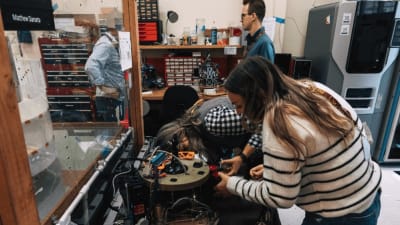
Scientists at UC Riverside and the University of Delaware have found a way to bypass the need for biological photosynthesis altogether and create food independent of sunlight by using artificial photosynthesis.
Briefs: Photonics/Optics
Innovators at NASA Johnson Space Center in collaboration with IRPI, LLC, have developed a compact inline filter that uses a multi-phase flow method to separate liquid from an incoming air charge. The filter also traps particulate matter and does so without significantly impinging upon flow velocity.

Briefs: Aerospace
A team has introduced a new method for taking high-res images of fast-moving and rotating objects in space, such as satellites or debris in low-Earth orbit.

Briefs: RF & Microwave Electronics
The Laser Communications Relay Demonstration (LCRD) will usher in a new era of laser communications.

Briefs: Imaging
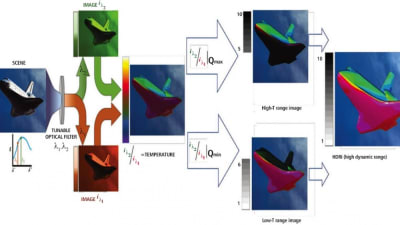
Innovators at NASA Langley Research Center have developed a multi-spectral imaging pyrometer utilizing tunable optics. The system uses a conventional infrared imaging camera as the basis.
Briefs: Materials
The future of wearable technology just got a big boost thanks to a team of University of Houston researchers who designed, developed, and delivered a successful prototype of a fully stretchable fabric-based lithium-ion (Li-ion) battery.
Briefs: Energy
A Calcium Rechargeable Battery with Long Cycle Life
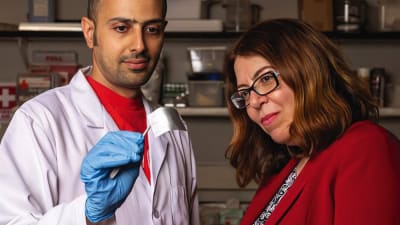
A research group has developed a prototype calcium (Ca) metal rechargeable battery capable of 500 cycles of repeated charge-discharge – the benchmark for practical use.
Briefs: Materials
A team Led by Worcester Polytechnic Institute (WPI) researcher Yan Wang has developed a solvent-free process to manufacture Li-ion battery electrodes that are greener, cheaper, and charge faster than electrodes currently on the market.
Top Stories
 Blog: Design

A Stretchable OLED that Can Maintain Most of Its Luminescence
 INSIDER: Design

Advancing All-Solid-State Batteries
 Blog: Power

My Opinion: We Need More Power Soon — Is Nuclear the Answer?
 Blog: Energy

Batteries that Can Withstand the Cold
 Quiz: Power

 Blog: Robotics, Automation & Control

Microscopic Swimming Machines that Can Sense, Respond to Surroundings
Webcasts
 On-Demand Webinars: Electronics & Computers

Advantages of Smart Power Distribution Unit Design for Automotive &...
 Upcoming Webinars: Unmanned Systems

Quiet, Please: NVH Improvement Opportunities in the Early Design...
 Upcoming Webinars: AR/AI

From Spreadsheets to Insights: Fast Data Analysis Without Complex...
 Upcoming Webinars: Defense

Cooling a New Generation of Aerospace and Defense Embedded...
 Upcoming Webinars: Software

Beyond AI-Copy-Paste Engineering: Advanced AI-Integration Success...
 Upcoming Webinars: Energy