-1
210
30
News: Manned Systems
In this video, we provide an overview of the Nancy Grace Roman Space Telescope’s mission, capabilities and timeline to launch.

Briefs: Photonics/Optics
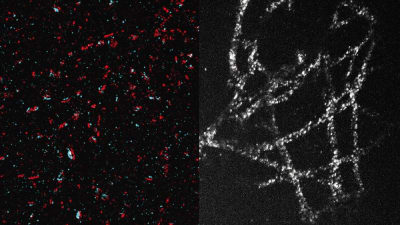
Researchers have made it possible to expand tissue twentyfold in a single step. This simple, inexpensive method could pave the way for nearly any biology lab to perform nanoscale imaging. Read on to learn more.
Briefs: AR/AI
Researchers have developed an optical design technology that dramatically reduces the volume of cameras with a folded lens system utilizing “metasurfaces,” a next-generation nano-optical device. Read on to learn more.

Briefs: Photonics/Optics
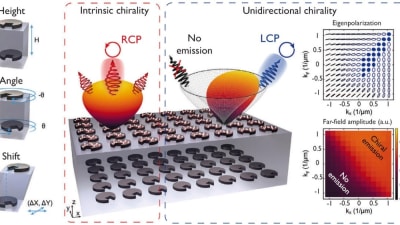
Researchers have designed a spiral ladder-inspired tool that allows precision control of light direction and polarization to control the direction of the emitted beam and the polarization of the light, while using a precisely engineered resonance of the structure. Read on to learn more.
Briefs: Imaging
A team from the University of Barcelona and the Universitat Oberta de Catalunya has designed a methodology that facilitates the recognition of QR codes in these physical environments, where reading is more complicated. Read on to learn more.

Briefs: Semiconductors & ICs
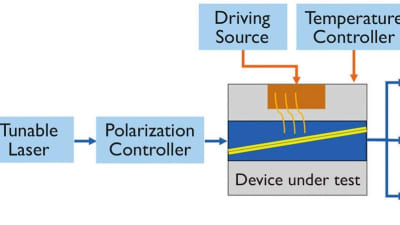
Researchers have successfully developed a wide-bandwidth, low-polarization semiconductor optical amplifier based on tensile-strained quantum wells. The study, published in the journal Sensors, presents a significant advancement in optical communication technology, addressing the growing demand for higher bandwidth and lower polarization sensitivity. Read on to learn more.
Briefs: Semiconductors & ICs
Researchers from MIT and elsewhere have developed a new technique to integrate 2D materials into devices in a single step while keeping the surfaces of the materials and the resulting interfaces pristine and free from defects. Read on to learn more.

Briefs: Energy
Researchers have fabricated the world’s highest-performing HTS wire segment while making the price-performance metric significantly more favorable. Read on to learn more.
Briefs: Electronics & Computers
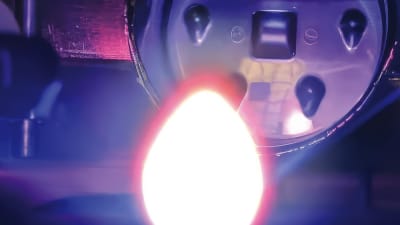
A team has created a prototype for what it calls “living bioelectronics” — a combination of living cells, gel, and electronics that can integrate with living tissue. The patches are made of sensors, bacterial cells, and a gel made from starch and gelatin. Tests in mice found that the devices could continuously monitor and improve psoriasis-like symptoms, without irritating skin. Read on to learn more.

Briefs: AR/AI
Growing Bio-Inspired Polymer Brains for Artificial Neural Networks
Read on to learn about a technique for growing conductive polymer wire connections between electrodes to realize artificial neural networks that overcome the limits of traditional computer hardware.
Briefs: Manned Systems
Want to create a zone of minimum radiation and magnetic/plasma effects for spacecraft? Then read on to find out how!

Briefs: RF & Microwave Electronics
Researchers at Texas A&M University are working on a new method of infrastructure monitoring using Synthetic Aperture Radar (SAR) remote sensing systems. SAR allows researchers to inspect and characterize pavements, retaining walls, and embankments from space and can help determine if there are flaws that should be further inspected for repair, saving valuable time. Read on to learn more.

Briefs: Mechanical & Fluid Systems
Owl-Wing Study Could Aid in Developing Low-Noise Fluid Machinery
The study could aid in understanding the role of TE fringes in the silent flight of owls and can inspire biomimetic designs that could lead to the development of low-noise fluid machinery. Read on to learn more.
Briefs: Aerospace
University of Virginia researchers showed for the first time that airflow in supersonic combusting jet engines can be controlled by an optical sensor. The finding could lead to more efficient stabilization of hypersonic jet aircraft. Read on to learn more.

Briefs: Manned Systems
Innovators at the NASA Johnson Space Center have developed a novel foot-pedal-operated system and device to control movement of an object in 3D space. The Foot Pedal Controller system enables operators to control movement of spacecraft, aircraft, and watercraft using only foot pedals. Read on to learn more.

Briefs: Imaging
A team led by University of Maryland computer scientists invented a camera mechanism that improves how robots see and react to the world around them. Inspired by how the human eye works, their innovative camera system mimics the tiny involuntary movements used by the eye to maintain clear and stable vision over time. Read on to learn more.

Briefs: Design
MIT engineers are designing a pair of wearable robotic limbs that can physically support an astronaut and lift them back on their feet after a fall. The system, which the researchers have dubbed Supernumerary Robotic Limbs or “SuperLimbs,” is designed to extend from a backpack. Read on to learn more.

Briefs: Green Design & Manufacturing
Inspired by a small and slow snail, scientists have developed a robot prototype that may one day scoop up microplastics from the surfaces of oceans, seas, and lakes.
Briefs: Electronics & Computers
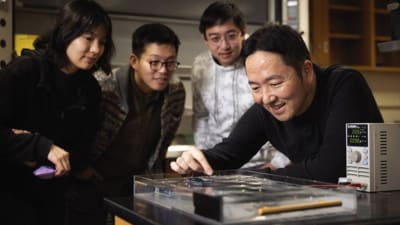
Researchers have developed a new soft robot design that engages in three simultaneous behaviors: rolling forward, spinning like a record, and following a path that orbits around a central point. The device, which operates without human or computer control, holds promise for developing soft robotic technologies that can be used to navigate and map unknown environments. The new soft robots are called twisted ringbots. Read on to learn more about them.

Briefs: Green Design & Manufacturing
A Dartmouth-led research team set out to determine if managing green roof soil microbes could boost healthy urban soil development, a methodology that could be applied to support climate resilience in cities. The team created an experimental green roof in Chicago to test how enhancing soil with native prairie microbes would change the soil microbial community over time. Read on to learn more.

Briefs: Power
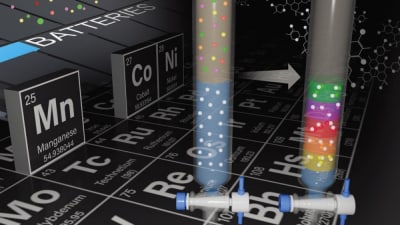
A PNNL research team used a simple mixed-salt water-based solution and their knowledge of metal properties to separate valuable minerals in continuously flowing reaction chambers. Read on to learn more.
Briefs: Aerospace
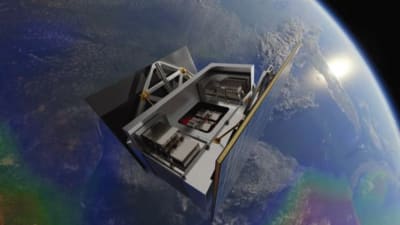
NASA has selected a team of University of Florida aerospace engineers to pursue a groundbreaking $12 million mission aimed at improving the way we track changes in Earth’s structures, such as tectonic plates and oceans. The mission, titled “GRATTIS” (Gravitational Reference Advanced Technology Test in Space), was the sole proposal selected in a national competition. Read on to learn more about it.
Briefs: Energy
In a study published in Joule, researchers at the SLAC-Stanford Battery Center report that giving batteries a first charge at unusually high currents increased their average lifespan by 50 percent while decreasing the initial charging time from 10 hours to just 20 minutes. Read on to learn more.

Briefs: Energy
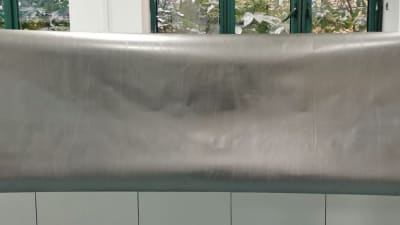
Researchers have developed a pioneering technique for producing large-scale graphene current collectors. This breakthrough promises to significantly enhance the safety and performance of lithium-ion batteries (LIBs), addressing a critical challenge in energy storage technology. Read on to learn more.
Briefs: Energy
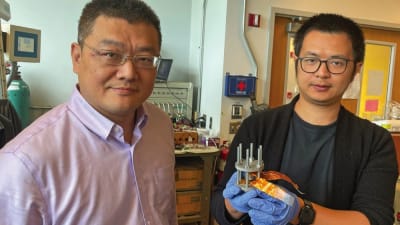
A multi-institutional research team led by Hailong Chen has developed a new, low-cost cathode that could radically improve lithium-ion batteries (LIBs) — potentially transforming the electric vehicle (EV) market and large-scale energy storage systems. Read on to learn more.
Briefs: Energy
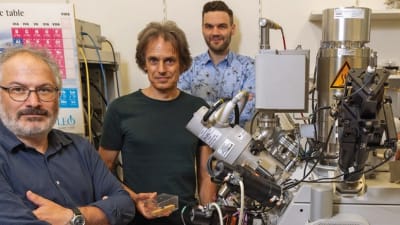
Using transmission electron microscopes, Researchers at Graz University of Technology were able to systematically track lithium ions as they traveled through battery material, map their arrangement in the crystal lattice of an iron phosphate cathode with unprecedented resolution, and precisely quantify their distribution in the crystal. Read on to learn more.
Briefs: Energy
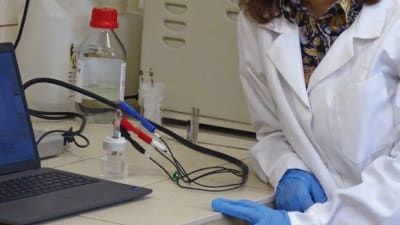
The global use of lithium-ion batteries has doubled in just the past four years, generating alarming amounts of battery waste containing many hazardous substances. The need for effective recycling methods for spent lithium-ion batteries is becoming increasingly critical. Scientists from various Polish research institutions presented a promising solution to this issue. Read on to learn more about it.
Briefs: Design
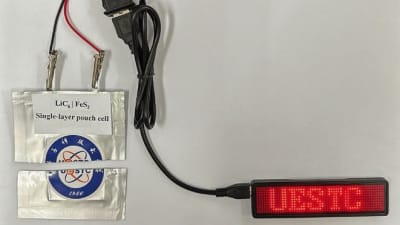
To address stability and safety issues, researchers have designed a lithium-sulfur battery that features an improved iron sulfide cathode. One prototype remains highly stable over 300 charge-discharge cycles, and another provides power even after being folded or cut. Read on to learn more.
Briefs: Design
Researchers led by Professor Young Min Song from the Gwangju Institute of Science and Technology have unveiled a vision system inspired by feline eyes to enhance object detection in various lighting conditions. Featuring a unique shape and reflective surface, the system reduces glare in bright environments and boosts sensitivity in low-light scenarios. Read on to learn more.

Top Stories
 Blog: Design

A Stretchable OLED that Can Maintain Most of Its Luminescence
 INSIDER: Design

Advancing All-Solid-State Batteries
 Blog: Power

My Opinion: We Need More Power Soon — Is Nuclear the Answer?
 Blog: Energy

Batteries that Can Withstand the Cold
 Quiz: Power

 Blog: Robotics, Automation & Control

Microscopic Swimming Machines that Can Sense, Respond to Surroundings
Webcasts
 On-Demand Webinars: Electronics & Computers

Advantages of Smart Power Distribution Unit Design for Automotive &...
 Upcoming Webinars: Unmanned Systems

Quiet, Please: NVH Improvement Opportunities in the Early Design...
 Upcoming Webinars: AR/AI

From Spreadsheets to Insights: Fast Data Analysis Without Complex...
 Upcoming Webinars: Defense

Cooling a New Generation of Aerospace and Defense Embedded...
 Upcoming Webinars: Software

Beyond AI-Copy-Paste Engineering: Advanced AI-Integration Success...
 Upcoming Webinars: Energy