-1
600
30
Briefs: Energy
A team of researchers is using aluminum foil to create batteries with higher energy density and greater stability. The team’s new battery system could enable EVs to run longer on a single charge and would be cheaper to manufacture – all while having a positive impact on the environment.
Briefs: Materials
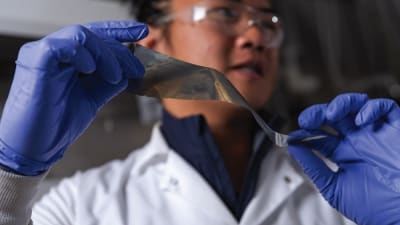
Scientists at Rice University’s George R. Brown School of Engineering have developed a readily scalable method to optimize prelithiation, a process that helps mitigate lithium loss and improves battery life cycles by coating silicon anodes with stabilized lithium metal particles.

Briefs: Motion Control
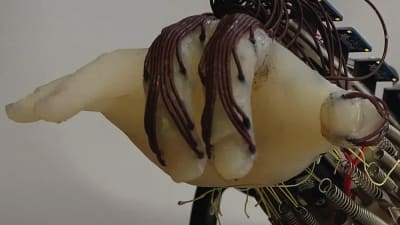
Grasping objects is a problem that is easy for a human, but challenging for a robot. Researchers designed a soft, 3D-printed robotic hand that cannot independently move its fingers but can still carry out a range of complex movements.
Briefs: Green Design & Manufacturing
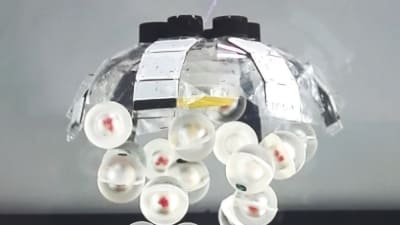
One of the strategies to combat the mounds of waste found in oceans — especially around coral reefs — is to employ robots to master the cleanup. However, existing underwater robots are mostly bulky with rigid bodies, unable to explore and sample in complex and unstructured environments, and are noisy due to electrical motors or hydraulic pumps.
Briefs: Robotics, Automation & Control
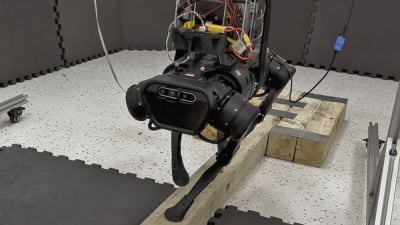
Researchers in Carnegie Mellon University’s Robotics Institute have designed a system that makes an off-the-shelf quadruped robot nimble enough to walk a narrow balance beam — a feat that is likely the first of its kind.
Briefs: Design
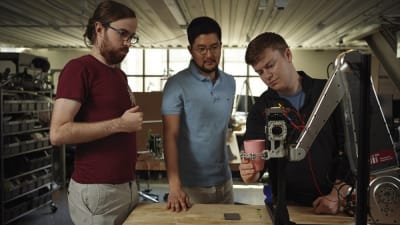
Looking to give robots a more nimble, human-like touch, MIT engineers have now developed a gripper that grasps by reflex. Rather than start from scratch after a failed attempt, the robot adapts in the moment.
Briefs: Robotics, Automation & Control
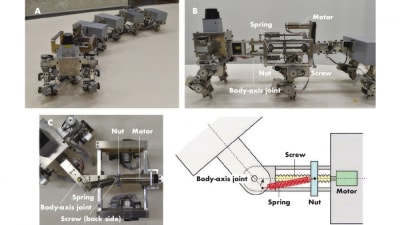
Researchers have invented a new kind of walking robot that takes advantage of dynamic instability to navigate. By changing the flexibility of the couplings, the robot can be made to turn without the need for complex computational control systems.
Briefs: Manned Systems
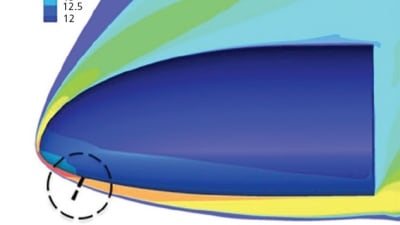
Researchers have designed an electrode-based system for guidance, navigation, and control of aircraft or spacecraft moving at hypersonic speeds in ionizing atmospheres.
Briefs: Information Technology
Armed with 5G network technology, AI, and edge computing resources, a pilot project under development at Naval Air Station Whidbey Island aims to create an optimized refueling system designed to boost readiness for military aircraft.

Briefs: AR/AI
Researchers from MIT’s Computer Science and Artificial Intelligence Laboratory (CSAIL) have introduced a method for robust flight navigation agents to master vision-based fly-to-target tasks in intricate, unfamiliar environments.

Briefs: Energy
Researchers at Chalmers University of Technology have developed a propeller design optimization method that paves the way for quiet, efficient electric aviation.

Briefs: Imaging
Advanced technology plays a vital role in search and rescue operations after natural disasters such as earthquakes. Thermal imaging equipment and sensitive listening devices are deployed to seek out signs of life.

Briefs: Wearables
A brain-machine interface coupled with robot offers increased benefits for stroke survivors.

Briefs: Wearables
The patch uses ultrasound to monitor blood flow to organs.

Briefs: Medical
Engineers have developed a stretchable ultrasonic array capable of serial, non-invasive, three-dimensional imaging of tissues as deep as four centimeters below the surface of human skin, at a spatial resolution of 0.5 mm.

Briefs: Medical
Next-generation sutures can deliver drugs, prevent infections, and monitor wounds.

Briefs: Materials
A new smart material is activated by both heat and electricity, making it the first ever to respond to two different stimuli. The work paves the way for a wide variety of potential applications, including clothing that warms up while you walk.

Briefs: Nanotechnology
Bending 2D Nanomaterial Could Benefit Future Technologies
Rice University’s Boris Yakobson and collaborators uncovered a property of ferroelectric 2D materials that could be exploited as a feature in future devices.
Briefs: Materials
There’s still more to explore with REFLEX, but this process could open new possibilities for new materials and microstructures across fields from electronics to optics to biomedical engineering.

Briefs: Manufacturing & Prototyping
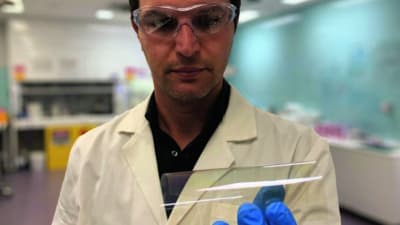
An international team of scientists is developing an inkable nanomaterial that they say could one day become a spray-on electronic component for ultra-thin, lightweight, and bendable displays and devices.
Briefs: Robotics, Automation & Control
Portable Laser-Guided Robotic Metrology
Innovators at the NASA Glenn Research Center have developed the PLGRM system, which allows an installed antenna to be characterized in an aircraft hangar. All PLGRM components can be packed onto pallets, shipped, and easily operated.
Briefs: Robotics, Automation & Control
Researchers from the University of Technology Sydney (UTS) have developed biosensor technology that will allow you to operate devices, such as robots and machines, solely through thought-control.

Briefs: Materials
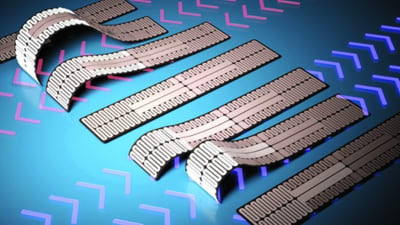
Researchers have demonstrated a caterpillar-like soft robot that can move forward, backward, and even dip under narrow spaces. Its movement is driven by a novel pattern of silver nanowires.
Briefs: AR/AI
Researchers at Columbia Engineering have demonstrated a highly dexterous robot hand, one that combines an advanced sense of touch with motor learning algorithms in order to achieve a high level of dexterity.


Briefs: Imaging
A wavelength of visible light is about 1,000 times larger than an electron, so the way the two affect each other is limited by that disparity. Now, researchers have come up with a way to make...

Briefs: Nanotechnology
3D nanometer-scale metamaterial structures hold promise for advanced optical isolators.

Briefs: Energy
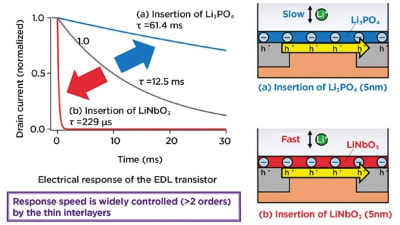
Researchers have employed a novel technique to investigate and modulate electric double layer dynamics at the solid/solid electrolyte interface.
Briefs: Energy
Researchers at Texas A&M University have discovered a 1,000 percent difference in the storage capacity of metal-free, water-based battery electrodes.

Top Stories
 Blog: Design

A Stretchable OLED that Can Maintain Most of Its Luminescence
 INSIDER: Design

Advancing All-Solid-State Batteries
 Blog: Power

My Opinion: We Need More Power Soon — Is Nuclear the Answer?
 Blog: Energy

Batteries that Can Withstand the Cold
 Quiz: Power

 Blog: Robotics, Automation & Control

Microscopic Swimming Machines that Can Sense, Respond to Surroundings
Webcasts
 On-Demand Webinars: Transportation

Advantages of Smart Power Distribution Unit Design for Automotive &...
 Upcoming Webinars: Unmanned Systems

Quiet, Please: NVH Improvement Opportunities in the Early Design...
 Upcoming Webinars: AR/AI

From Spreadsheets to Insights: Fast Data Analysis Without Complex...
 Upcoming Webinars: Electronics & Computers

Cooling a New Generation of Aerospace and Defense Embedded...
 Upcoming Webinars: AR/AI

Beyond AI-Copy-Paste Engineering: Advanced AI-Integration Success...
 Upcoming Webinars: Energy