-1
270
30
Briefs: Energy
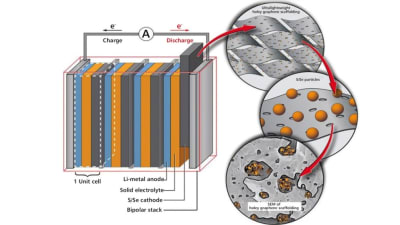
Whether for large electric vehicle systems or small electronic devices, SABERS can potentially set new benchmarks in energy density and power, all while offering the utmost in safety and reliability. Read on to learn more.
Briefs: Electronics & Computers
As industrial automation technologies continue to advance, the balance between traditional and open solutions will likely evolve. The emphasis will be on providing versatile platforms that meet varied user needs. Read on to learn more.

Briefs: Data Acquisition
A Centralized Data Management Platform
Many organizations have data stored in differing formats and various locations throughout the organization and often outside the organization. It is often difficult to access such data. Developed at NASA Ames Research Center is a novel data management platform for managing interconnected data and its derivatives. Read on to learn more about it.
Briefs: Robotics, Automation & Control
Yen-Ling Kuo at the University of Virginia School of Engineering and Applied Science is collaborating with a team at the Toyota Research Institute to build language representations of driving behavior that enable a robot to associate the meaning of words with what it sees by watching how humans interact with the environment or by its own interactions with the environment. Read on to learn more.

Briefs: Energy
Leveraging Machine Learning and AI to Automate Wearable Tech Design
Defying engineering challenges in record time, researchers at the University of Maryland developed a machine learning model that eliminates hassles in materials design to yield green technologies used in wearable heaters. Read on to learn more.
Briefs: Energy
The novel solar concentrators can be applied to textile fibers without the textile becoming brittle and susceptible to cracking or accumulating water vapor in the form of sweat. Read on to learn more.

Briefs: Manufacturing & Prototyping
Applications include vehicle and aircraft tires, sports helmets, military equipment, and seals and couplings. Read on to learn more.

Briefs: Imaging
If the outside of clothing or a vehicle were covered with the coating, an infrared camera would have a harder time distinguishing what is underneath. Read on to learn what this means.

Briefs: Materials
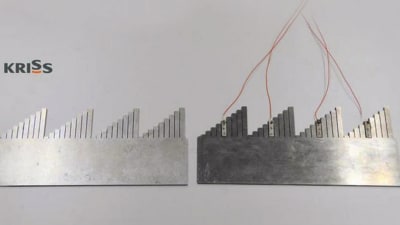
The Korea Research Institute of Standards and Science has developed a metamaterial that traps and amplifies micro-vibrations in small areas. This innovation is expected to increase the power output of energy harvesting, which converts wasted vibration energy into electricity, and accelerate its commercialization. Read on to learn more.
Briefs: Mechanical & Fluid Systems
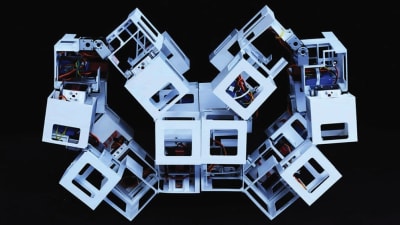
Inspired by the paper-folding art of origami, North Carolina State University engineers have discovered a way to make a single plastic cubed structure transform into more than 1,000 configurations using only three active motors. The findings could pave the way for shape-shifting artificial systems that can take on multiple functions and even carry a load. Read on to learn more.
Briefs: Medical
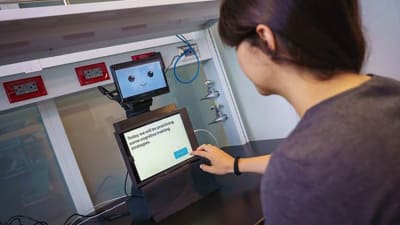
Read on to learn about CARMEN — Cognitively Assistive Robot for Motivation and Neurorehabilitation — a small, tabletop robot designed to help people with mild cognitive impairment learn skills to improve memory, attention, and executive functioning at home.
Briefs: Robotics, Automation & Control
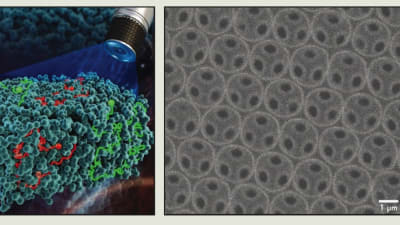
The “nanoswimmers” could be used to remediate contaminated soil, improve water filtration, or even deliver drugs to targeted areas of the body.
Briefs: Software
A new paper explores pick-and-place solutions with more precision. In precise pick-and-place, also known as kitting, the robot transforms an unstructured arrangement of objects into an organized arrangement. The approach, dubbed SimPLE (Simulation to Pick Localize and placE), learns to pick, regrasp and place objects using the object’s computer-aided design model. Read on to learn more.

Briefs: Robotics, Automation & Control
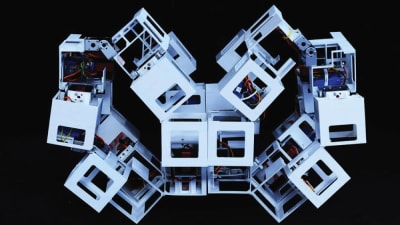
Inspired by the paper-folding art of origami, North Carolina State University engineers have discovered a way to make a single plastic cubed structure transform into more than 1,000 configurations using only three active motors. Read on to learn more.
Briefs: Medical
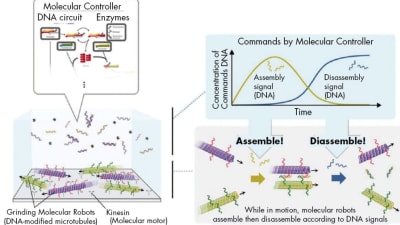
Researchers have successfully developed a DNA-based molecular controller that autonomously directs the assembly and disassembly of molecular robots. This pioneering technology marks a significant step toward advanced autonomous molecular systems with potential applications in medicine and nanotechnology.
Briefs: Test & Measurement
A new algorithm may make robots safer by making them more aware of human inattentiveness. In simulations, it improved safety by about a maximum of 80 percent and efficiency by about a maximum of 38 percent compared to existing methods. Read on to learn more about it.

Briefs: Materials
Engineers have developed an ultra-sensitive sensor made with graphene that can detect extraordinarily low concentrations of lead ions in water. The device achieves a record limit of detection of lead down to the femtomolar range, which is one million times more sensitive than previous sensing technologies. Read on to learn more.
Briefs: Sensors/Data Acquisition
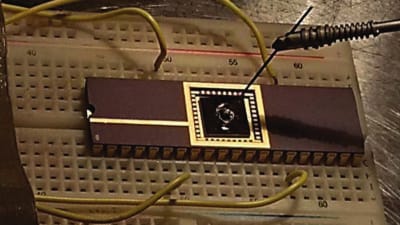
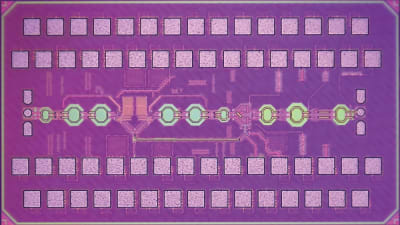
Researchers at the University of California, Davis, have developed a proof-of-concept sensor that may usher in a new era for millimeter wave radars. They call its design a “mission impossible” made possible. Read on to learn more.
Briefs: Energy
The data collected from cameras and vibration sensors continue to inform next steps in research. The goal is to make this technology commercially available for land-based and offshore wind turbines to ensure a harmonic relationship between wind energy and surrounding wildlife. Read on to learn more.

Briefs: Medical
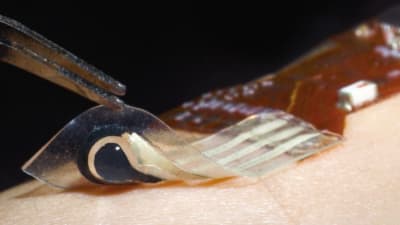
Detecting diseases early requires the rapid, continuous, and convenient monitoring of vital biomarkers. Researchers have developed a novel sensor that enables the continuous, real-time detection of solid-state epidermal biomarkers. Read on to learn more.
Briefs: Green Design & Manufacturing
The researchers are currently refining their approach with an eye toward applications where data is limited but high fidelity is required, such as target detection. Read on to learn more.

Briefs: Software
High-performance servo motion is now more affordable and accessible than ever due to integrated controllers, making the technology viable even for applications, which could not formerly support the cost or complexity of traditional implementations. Read on to learn more.

Briefs: Sensors/Data Acquisition
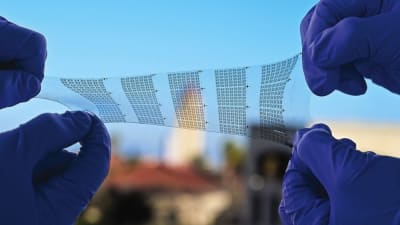
Researchers at Stanford have been working on skin-like, stretchable electronic devices for over a decade. Recently, they presented a new design and fabrication process for skin-like integrated circuits that are five times smaller and operate at one thousand times higher speeds than earlier versions. Read on to learn more about it.
Briefs: Manufacturing & Prototyping
A research team has created an innovative microelectronic device that can potentially function as a sustainable, high-performance “bit-switch.” This paves the way for future computing technologies to process data much faster while using significantly less energy. Read on to learn more.

Briefs: Materials
Now, a team from the Max Planck Institute for Polymer Research has developed a new material concept that could allow efficient blue OLEDs with a strongly simplified structure. Read on to learn more.

Briefs: Physical Sciences
For the first time, researchers at The University of Texas at Austin’s Applied Research Laboratories and NASA’s Goddard Space Flight Center have formed a radio interferometer between a GPS antenna and receiver and a large radio telescope. Read on to learn more about the new technique.

Briefs: RF & Microwave Electronics
Southwest Research Institute has developed off-road autonomous driving tools with a focus on stealth for the military and agility for space and agriculture clients. The vision-based system pairs stereo cameras with novel algorithms, eliminating the need for LiDAR and active sensors. Read on to learn more.

Briefs: Medical
In a newly published paper in the journal Science, researcher Qiushi Guo demonstrated a novel approach for creating high-performance, ultrafast lasers on nanophotonic chips. His work centers on miniaturizing mode-lock lasers. Read on to learn more.

Briefs: Medical
McGill University researchers have made a breakthrough in diagnostic technology, inventing a ‘lab on a chip’ that can be 3D-printed in just 30 minutes. The chip has the potential to make on-the-spot testing widely accessible. Read on to learn more.

Top Stories
 Blog: Design

A Stretchable OLED that Can Maintain Most of Its Luminescence
 INSIDER: Design

Advancing All-Solid-State Batteries
 Blog: Power

My Opinion: We Need More Power Soon — Is Nuclear the Answer?
 Blog: Energy

Batteries that Can Withstand the Cold
 Quiz: Power

 Blog: Robotics, Automation & Control

Microscopic Swimming Machines that Can Sense, Respond to Surroundings
Webcasts
 On-Demand Webinars: Electronics & Computers

Advantages of Smart Power Distribution Unit Design for Automotive &...
 Upcoming Webinars: Unmanned Systems

Quiet, Please: NVH Improvement Opportunities in the Early Design...
 Upcoming Webinars: AR/AI

From Spreadsheets to Insights: Fast Data Analysis Without Complex...
 Upcoming Webinars: Defense

Cooling a New Generation of Aerospace and Defense Embedded...
 Upcoming Webinars: Software

Beyond AI-Copy-Paste Engineering: Advanced AI-Integration Success...
 Upcoming Webinars: Energy