-1
6810
30
Briefs: Electronics & Computers
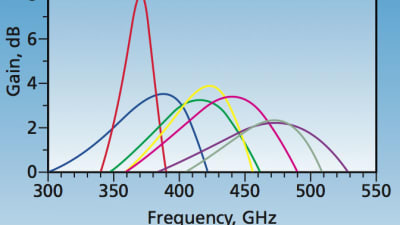
Several different experimental monolithic microwave integrated circuit (MMIC) amplifiers have been designed to operate in frequency bands ranging from 350 to 500 GHz and were undergoing...
Briefs: Software
Public Risk Assessment Program
The Public Entry Risk Assessment (PERA) program addresses risk to the public from shuttle or other spacecraft re-entry trajectories. Managing public risk to acceptable levels is a major component of safe spacecraft operation. PERA is given scenario inputs of vehicle trajectory, probability of failure along that...
Briefs: Software
Particle Swarm Optimization Toolbox
The Particle Swarm Optimization Toolbox is a library of evolutionary optimization tools developed in the MAT-LAB environment. The algorithms contained in the library include a genetic algorithm (GA), a single-objective particle swarm optimizer (SOPSO), and a multi-objective particle swarm optimizer (MOPSO)....
Briefs: Software
Telescience Support Center Data System Software
The Telescience Support Center (TSC) team has developed a database-driven, increment-specific Data Requirement Document (DRD) generation tool that automates much of the work required for generating and formatting the DRD. It creates a database to load the required changes to configure the TSC data...
Briefs: Software
Update on PISCES
An updated version of the Platform Independent Software Components for the Exploration of Space (PISCES) software library is available. A previous version was reported in “Library for Developing Spacecraft-Mission-Planning Software” (MSC-22983), NASA Tech Briefs, Vol. 25, No. 7 (July 2001), page 52. To recapitulate: This...
Briefs: Software
Ground and Space Radar Volume Matching and Comparison Software
This software enables easy comparison of ground- and space-based radar observations. The software was initially designed to compare ground radar reflectivity from operational, ground based S- and C-band meteorological radars with comparable measurements from the Tropical Rainfall...
Briefs: Software
Web-Based Interface for Command and Control of Network Sensors
This software allows for the visualization and control of a network of sensors through a Web browser interface. It is currently being deployed for a network of sensors monitoring Mt. Saint Helen’s volcano; however, this innovation is generic enough that it can be deployed for any type...
Briefs: Software
Orbit Determination Toolbox
The Orbit Determination Toolbox is an orbit determination (OD) analysis tool based on MATLAB and Java that provides a flexible way to do early mission analysis. The toolbox is primarily intended for advanced mission analysis such as might be performed in concept exploration, proposal, early design phase, or rapid design...
Briefs: Software
Distributed Observer Network
The Distributed Observer network (DON) is a NASA-collaborative environment that leverages game technology to bring three-dimensional simulations to conventional desktop and laptop computers in order to allow teams of engi-
neers working on design and operations, either individually or in groups, to view and collaborate...
Briefs: Software
Computer-Automated Evolution of Spacecraft X-Band Antennas
A document discusses the use of computer-aided evolution in arriving at a design for X-band communication antennas for NASA’s three Space Technology 5 (ST5) satellites, which were launched on March 22, 2006. Two evolutionary algorithms, incorporating different representations of the...
Briefs: Manufacturing & Prototyping
Practical Loop-Shaping Design of Feedback Control Systems
An improved methodology for designing feedback control systems has been developed based on systematically shaping the loop gain of the system to meet performance requirements such as stability margins, disturbance attenuation, and transient response, while taking into account the actuation...
Briefs: Manufacturing & Prototyping
Fully Printed High-Frequency Phased-Array Antenna on Flexible Substrate
To address the issues of flexible electronics needed for surface-to-surface, surface-to-orbit, and back-to-Earth communications necessary for manned exploration of the Moon, Mars, and beyond, a room-temperature printing process has been developed to create active, phased-array...
Briefs: Materials
Modeling of Failure for Analysis of Triaxial Braided Carbon Fiber Composites
In the development of advanced aircraft-engine fan cases and containment systems, composite materials are beginning to be used due to their low weight and high strength. The design of these structures must include the capability of withstanding impact loads from a released...
Briefs: Materials
An alternative method of low-temperature plasma functionalization of carbon nanotubes provides for the simultaneous attachment of molecular groups of multiple (typically two or three)...

Briefs: Materials
Catalyst for Carbon Monoxide Oxidation
In many applications, it is highly desirable to operate a CO2 laser in a sealed condition, for in an open system the laser requires a continuous flow of laser gas to remove the dissociation products that occur in the discharge zone of the laser, in order to maintain a stable power output. This adds to the...
Briefs: Materials
Titanium Hydroxide — a Volatile Species at High Temperature
Titanium hydroxide, TiO(OH)2 (g), has been identified as the primary reaction product of TiO2 (s) + H2O (g) at high temperatures (1,200–1,400 °C) through the use of the transpiration technique. This technique is a well-established method used to measure equilibrium pressures at 1 atm....
Briefs: Mechanical & Fluid Systems
Hybrid Heat Exchangers
A hybrid light-weight heat exchanger concept has been developed that uses high-conductivity carbon-carbon (C–C) composites as the heat-transfer fins and uses conventional high-temperature metals, such as Inconel, nickel, and titanium as the parting sheets to meet leakage and structural requirements.
Briefs: Mechanical & Fluid Systems
Orbital Winch for High-Strength, Space-Survivable Tethers
An Orbital Winch mechanism enables high-load, multi-line tethers to be deployed and retracted without rotating the spool on which the tether is wound. To minimize damage to the tether and the wound package during retraction or deployment under load, it can incorporate a Tension Management...
Briefs: Mechanical & Fluid Systems
The figure depicts selected aspects of a six-legged robot that moves by hopping and that can be steered in the sense that it can be launched into a hop in a controllable direction. This is a prototype of...

Briefs: Mechanical & Fluid Systems
A proposed robotic system for scientific exploration of rough terrain would include a stationary or infrequently moving larger base robot, to which would be tethered a smaller hopping robot of the type...

Briefs: Information Technology
Physics of Life: A Model for Non-Newtonian Properties of Living Systems
This innovation proposes the reconciliation of the evolution of life with the second law of thermodynamics via the introduction of the First Principle for modeling behavior of living systems. The structure of the model is quantum-inspired: it acquires the topology of the...
Briefs: Information Technology
Parameterized Linear Longitudinal Airship Model
A parameterized linear mathematical model of the longitudinal dynamics of an airship is undergoing development. This model is intended to be used in designing control systems for future airships that would operate in the atmospheres of Earth and remote planets.


Briefs: Electronics & Computers
Previous microstrip-to-waveguide transitions either required a hermetically sealed waveguide configuration, or a balun that needed to be tuned according to the frequency band of...

Briefs: Electronics & Computers
Thin-Film Ferroelectric-Coupled Microstripline Phase Shifters With Reduced Device Hysteresis
This work deals with the performance of coupled microstripline phase shifters (CMPS) fabricated using BaxSr1-xTiO3 (BST) ferroelectric thin films. The CMPS were fabricated using commercially available pulsed laser deposition BST films with Ba:Sr ratios of...
Briefs: Electronics & Computers
Two-Stage, 90-GHz, Low-Noise Amplifier
A device has been developed for coherent detection of the polarization of the cosmic microwave background (CMB). A two-stage amplifier has been designed that covers 75–110 GHz. The device uses the emerging 35-nm InP HEMT technology recently developed at Northrop Grumman Corporation primarily for use at...
Briefs: Imaging
A 311-GHz Fundamental Oscillator Using InP HBT Technology
This oscillator uses a single-emitter 0.3-μm InP heterojunction bipolar transistor (HBT) device with maximum frequency of oscillation (fmax) greater than 500 GHz. Due to high conductor and substrate losses at submillimeter-wave frequencies, a primary challenge is to efficiently use the...
Briefs: Electronics & Computers
FPGA Coprocessor Design for an Onboard Multi-angle Spectro-Polarimetric Imager
A multi-angle spectro-polarimetric imager (MSPI) is an advanced camera system currently under development at JPL for possible future consideration on a satellite-based Aerosol-Cloud-Environment (ACE) interaction study. The light in the optical system is subjected to a...
Top Stories
 Blog: Lighting

A Stretchable OLED that Can Maintain Most of Its Luminescence
 INSIDER: Energy

Advancing All-Solid-State Batteries
 Blog: Energy

Batteries that Can Withstand the Cold
 Blog: AR/AI

My Opinion: We Need More Power Soon — Is Nuclear the Answer?
 Quiz: Power

 Blog: Design

Webcasts
 On-Demand Webinars: Transportation

Quiet, Please: NVH Improvement Opportunities in the Early Design Cycle
 Upcoming Webinars: Test & Measurement

From Spreadsheets to Insights: Fast Data Analysis Without Complex...
 Upcoming Webinars: Aerospace

Cooling a New Generation of Aerospace and Defense Embedded...
 Upcoming Webinars: AR/AI

Beyond AI-Copy-Paste Engineering: Advanced AI-Integration Success...
 Upcoming Webinars: Energy

Battery Abuse Testing: Pushing to Failure
 Upcoming Webinars: Power