
Stories
42
39
0
0
30
Quiz: Software
How much do you know about CAD? Find out with this quiz.

Blog: Software
International research collaboration has unlocked a new approach that performs complex tensor computations using a single propagation of light. The result is single-shot tensor computing, achieved at the speed of light itself.

Special Reports: Software

ADAS/Connected & Automated Vehicles - December 2025
How the NVIDIA‐Magna collaboration is redefining autonomy…ultra‐realistic simulation speeds AV development…the 'autonomy underdogs' driving ADAS forward. Read about these and other new...Products: Robotics, Automation & Control
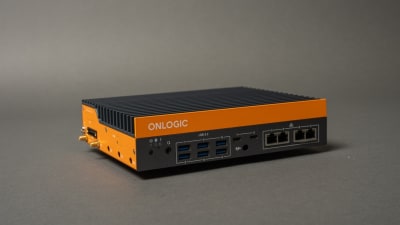
See the product of the month: OnLogic's new edge computer series, the Karbon 520.
Articles: AR/AI
Without integrated vision, robots can only perform tasks in precisely the same way every time. If a part is even slightly out of position or rotated differently, the robot may fail to complete its task, or worse, cause an error in the process. Read on to learn more.

Articles: AR/AI
The future of industrial autonomy will not be defined by systems that operate as opaque black boxes, but by approaches that deliberately embed the expertise of the people who know the processes best. Machine teaching makes this possible by making the skills and strategies of expert operators the foundation of AI system design. Read on to learn more.

Products: Software
See what's new on the market, including the new ImageIR® 9800 from infraTec; Instron's new 100 kN table model for the 6800 and 3400 Series universal testing systems; Sumida Corporation's CIUH10D46 and CIUH10D47 pulse transformers; and much more.

Briefs: AR/AI
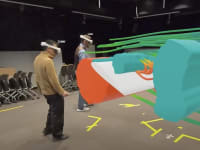
Robots may soon have a new way to communicate with people. Not through words or screens, but with light and images projected directly onto the world around them. University of South Florida's Zhao Han is developing technology that could transform how people interact with robots in both emergencies and everyday life. Read on to learn more.

Briefs: Software
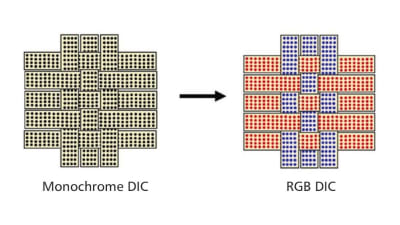
Innovators at NASA Johnson Space Center have developed a technology that can isolate a single direction of tensile strain in biaxially woven material. This is accomplished using traditional digital image correlation (DIC) techniques in combination with custom red-green-blue (RGB) color filtering software. Read on to learn more.
Blog: Energy
It's crucial at this point in time to think about the direction of AI development. If it's not done right, there will be serious global consequences.

Special Reports: Photonics/Optics
Optics & Photonics Innovations - November 2025
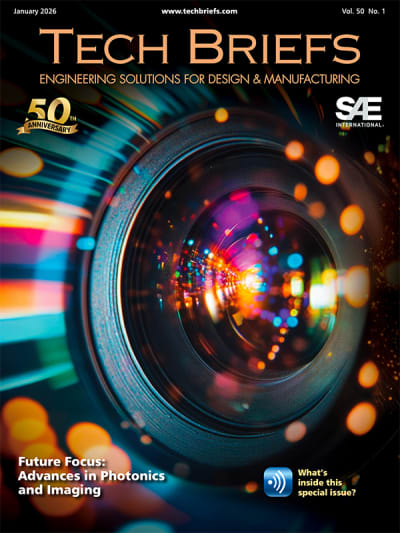
Photonic processor enables ultrafast AI computations…how new polishing technique could revolutionize optical manufacturing…facial mapping technology is a leap forward in augmented reality. Read...Articles: Design
Multi-Path is a new audio digital-to-analog conversion (DAC) architecture that improves today’s best DAC performance by 100X (40dB) or more. Noise, linearity, and dynamic range are so advanced that today’s finest test equipment cannot fully measure it (40nVrms broadband noise floor). Read on to learn more about the 2025 Create the Future Design Contest Electronics finalist.

INSIDER: Robotics, Automation & Control
Introducing X1: The world's first multirobot system that integrates a humanoid robot with a transforming drone that can launch off the humanoid's back and, later, drive away. The versatile team can...

Blog: Design
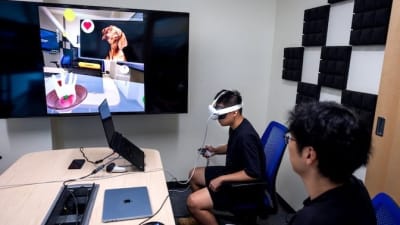
A digital, voice-controlled hand could improve the convenience and accessibility of virtual and augmented reality by enabling hands-free use of games and apps. The prototype software was developed by computer scientists at the University of Michigan.
Blog: Software
With increasing demands and requirements for building complex embedded systems that involve complex machines, the demand for resilient embedded systems is even higher today. Building safe and secure embedded systems is paramount in the context of pervasive embedded systems across multiple domains and industries. Read on to learn more.
Products: Software
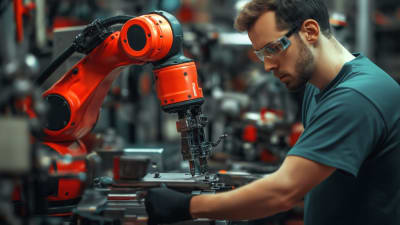
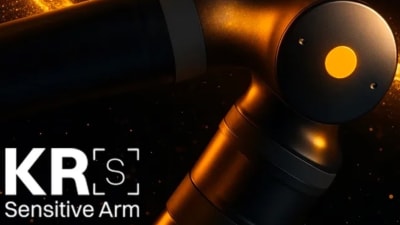
See the new products, including Kassow Robots' Sensitive Arm technology across its complete range of 7-axis collaborative robots; igus' first humanoid robot, Iggy Rob, designed to support industrial production, service environments, and transport tasks; Weidmuller USA's unmanaged Single Pair Ethernet Switch that enables a seamless networking experience for users in a wide array of industrial environments; BizLink's careDP, an AI-powered condition monitoring system designed to revolutionize maintenance in robotic production lines; and more.
Articles: Software
It is no exaggeration to say that AI will be the next big leap across all of industry, reimagining the way people work, products are designed, and factories are operated. But AI doesn’t mean a fully autonomous future but rather a harmony, uniting people and technology in a way that plays to the strength of both to achieve a result greater than what either could achieve alone. Read on to learn more.

Articles: Electronics & Computers
MIT researchers have developed a method that anyone can use to design an energy management interface between the harvester and the sensor load to minimize the drain on the harvester and maximize the amount of data that can be transmitted by the sensor. Read on to learn more via this Q&A with Daniel Monagle and Steven B. Leeb.

Articles: Software
Samantha Shumberger, Senior Design Engineer, Molex, from Wellsville, PA, is the 2025 Rising Star Award Winner for Electronics.

Articles: Software
A new technology closes the gap and combines PCB production into a single process, leveraging the capabilities of SMT. The resulting through-hole reflow (THR) process allows for components to be mounted through those pre-drilled holes — but secured during the same soldering process as the SMT-designed components. Read on to learn more.

Products: Information Technology
See the product of the month: Phoenix Contact's NearFi, a contactless real-time transmission technology.

Products: Sensors/Data Acquisition
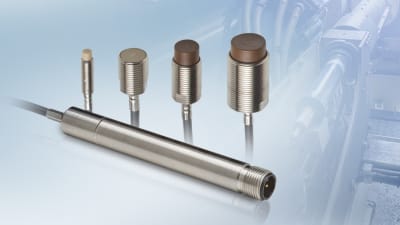
See what's new on the market, including the eddyNCDT 3005 from Micro-Epsilon; Instron's new iteration of its Bluehill® Central software platform; Novotechnik U.S.'s TE1 Series of absolute linear position sensors; Specialised Imaging's new high-intensity short duration flash designed to freeze motion in aeroballistic applications; and more.
Application Briefs: Software
In an office in Bordeaux, the Pollen Robotics teams are working on an ambitious mission: to imagine and advance useful robotics for humans. Their flagship creation, Reachy, combines accessibility, innovation, and open-source collaboration. Read on to learn more and see where it all started.

Briefs: Motion Control
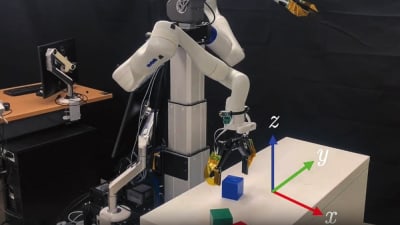
Researchers from MIT and NVIDIA Research have developed a novel algorithm that dramatically speeds up a robot’s planning process. Their approach enables a robot to “think ahead” by evaluating thousands of possible solutions in parallel and then refining the best ones to meet the constraints of the robot and its environment. Read on to learn more.
Briefs: Imaging
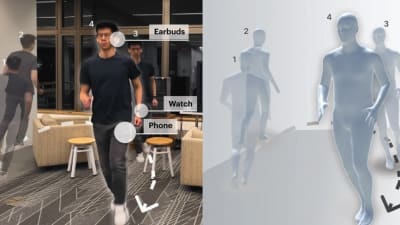
Northwestern engineers have developed a new system for full-body motion capture — and it doesn’t require specialized rooms, expensive equipment, bulky cameras, or an array of sensors. Instead, it requires a simple mobile device. Read on to learn more.
Briefs: Imaging
Researchers have provided a new open-source algorithm called Conditional Variational Diffusion Model (CVDM). Based on generative AI, this model improves the quality of images by reconstructing them from randomness. In addition, the CVDM is computationally less expensive than established diffusion models — and it can be easily adapted for a variety of applications. Read on to learn more.
Briefs: Internet of Things
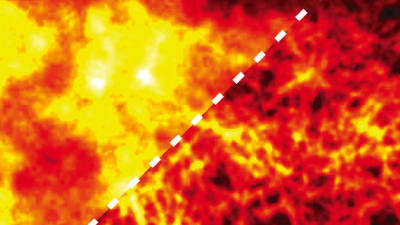
A research team from Japan has fabricated a flexible multimodal wearable sensor patch and developed edge computing software that is capable of detecting arrhythmia, coughs, and falls in volunteers. Read on to learn more about the sensor, which uses a smartphone as the edge computing device.

Application Briefs: Software
Why should you know the right trigger strategy? Read on to find out.

Products: Software
See the product of the month: STMicroelectronics' LEOPOL1 point-of-load step-down converter for low-Earth orbit deployments targeting the needs of equipment developers in the space market.

Top Stories
 Blog: Robotics, Automation & Control
Aerial Microrobots That Can Match a Bumblebee's Speed
 Blog: Electronics & Computers

Turning Edible Fungi into Organic Memristors
 Blog: Manufacturing & Prototyping

Revolutionizing the Production of Semiconductor Chips
 News: Energy

 INSIDER: Electronics & Computers
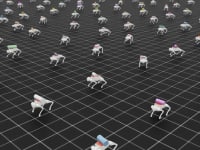
World’s Smallest Programmable, Autonomous Robots
 INSIDER: Manufacturing & Prototyping
Webcasts
 On-Demand Webinars: Power

E/E Architecture Redefined: Building Smarter, Safer, and Scalable Vehicles
 Upcoming Webinars: Energy

Hydrogen Engines Are Heating Up for Heavy Duty
 Upcoming Webinars: Electronics & Computers

Advantages of Smart Power Distribution Unit Design for Automotive...
 Upcoming Webinars: Automotive

Quiet, Please: NVH Improvement Opportunities in the Early Design...
 Upcoming Webinars: Power

A FREE Two-Day Event Dedicated to Connected Mobility
 Podcasts: Defense

How Sift's Unified Observability Platform Accelerates Drone Innovation