Stories
34,35
0
90
30
Briefs: Medical
New technology developed by researchers at the University of Houston could revolutionize medical imaging and lead to faster, more precise and more cost-effective alternatives to traditional diagnostic methods. Read on to learn more.
Briefs: RF & Microwave Electronics
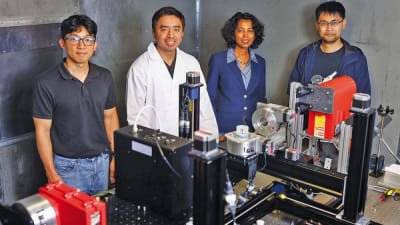
Researchers have developed a photonic chip-based traveling wave parametric amplifier that achieves ultra-broadband signal amplification in an unprecedentedly compact form. Read on to learn more about it.
Briefs: Photonics/Optics
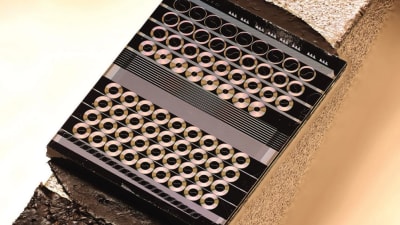
Augmented reality has become a hot topic in the entertainment, fashion, and makeup industries. Though a few different technologies exist in these fields, dynamic facial projection mapping is among the most sophisticated and visually stunning ones. Read on to learn more about it.

Briefs: Software
Artificial intelligence systems promise transformative advancements, yet their growth has been limited by energy inefficiencies and bottlenecks in data transfer. Researchers at Columbia Engineering have unveiled a groundbreaking solution: a 3D photonic-electronic platform that achieves unprecedented energy efficiency and bandwidth density, paving the way for next-generation AI hardware. Read on to learn more.

Briefs: Imaging
Metabolic imaging is a noninvasive method that enables clinicians and scientists to study living cells using laser light, which can help them assess disease progression and treatment responses. But light scatters when it shines into biological tissue, limiting how deeply it can penetrate and hampering the resolution of captured images. Now, MIT researchers have developed a new technique that more than doubles the usual depth limit of metabolic imaging. Read on to learn more.

Application Briefs: Photonics/Optics
Machining metal has its challenges as many shops will attest, but machining glass is another matter – one that Dan Bukaty Jr., President of Precision Glass & Optics (PG&O) is well schooled in. Mr. Bukaty and his 35-person shop manufacture high-end precision glass optics for customers such as IMAX, Intuitive Surgical, Boeing and NASA, to name a few. Read on to learn about PG&O's use of a vision system.
Application Briefs: Photonics/Optics
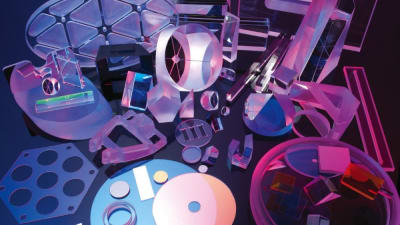
Exploiting the “spatial” degree of freedom of light can mean many things. Read on to learn what they are and what the process can lead to.

INSIDER: Photonics/Optics
Physicists in the Harvard John A. Paulson School of Engineering and Applied Sciences (SEAS) have created a compact laser that emits extremely bright, short pulses of light in a useful but...

INSIDER: Photonics/Optics
In the field of technical imaging, the term “trigger” is often used synonymously with the term frame-synchronization (or f-sync) signal. In the...
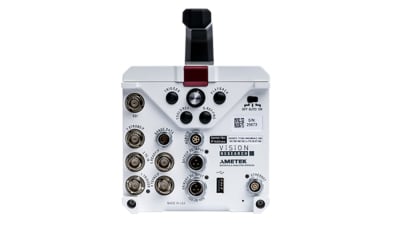
INSIDER: Imaging
A beam of light doesn’t sound like a material that can create a knot. Until now.

White Papers: Defense
Destroy the Target, Not Everything Else: Beam Management in High-Power Directed Energy Laser Projects
Using high power lasers to neutralize threats is a significant advance in weapons systems. Lasers are not affected by gravity, travel without...Blog: Design
The work addresses the outfielder problem, which refers to the baseball player who stands in the outfield to catch the ball after it is hit. It is a classic challenge in physics and the neuroscience of movement, used to explore how humans and animals predict movements in a dynamic environment and how automated systems can be designed to mimic them.

Briefs: Photonics/Optics
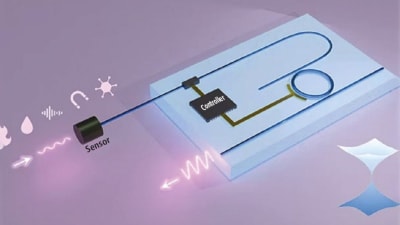
New research unlocks the power of exceptional points (EPs) for advanced optical sensing. In a study published in Science Advances , a team showed that these unique EPs — specific conditions in systems where extraordinary optical phenomena can occur — can be deployed on conventional sensors to achieve a striking sensitivity to environmental perturbations. Read on to learn more.
Briefs: Imaging
Daniel Gehrig and Davide Scaramuzza from the Department of Informatics at the University of Zurich have combined a novel bio-inspired camera with AI to develop a system that can detect obstacles around a car much quicker than current systems and using less computational power. Read on to learn more about the study, which is published in Nature.

Briefs: Photonics/Optics
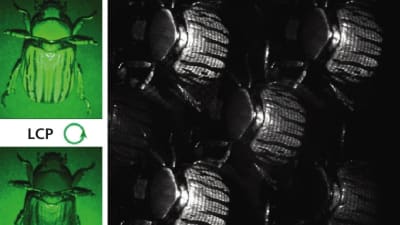
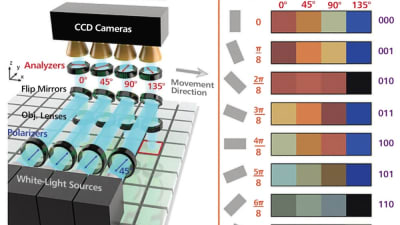
Researchers at the Harvard John A. Paulson School of Engineering and Applied Sciences have developed a compact, single-shot polarization imaging system that can provide a complete picture of polarization. Read on to learn more about it.
Briefs: Imaging
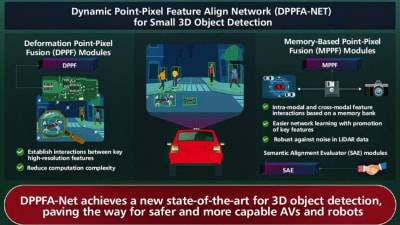
Scientists have developed multi-modal 3D object detection methods that combine 3D LiDAR data with 2D RGB images taken by standard cameras. While the fusion of 2D images and 3D LiDAR data leads to more accurate 3D detection results, it still faces its own set of challenges, with accurate detection of small objects remaining difficult. Read on to learn more about it.
Blog: Lighting Technology
A research team has recently developed a neuromorphic exposure control system that revolutionizes machine vision under extreme lighting variations.

Special Reports: Manufacturing & Prototyping

Robotics & Motion Control - March 2025
From the operating room to the family farm to your next hotel stay, advances in robotics and automation are impacting a wide range of industries. Read all about it in this compendium of articles from the...Special Reports: Sensors/Data Acquisition

Test & Measurement - March 2025
Testing the “eyes” of NASA's next space telescope…mass‐manufacturing photonic sensors at the quantum limit…driving zero defects in today's intelligent vehicles. Read about these and other applications...Blog: AR/AI
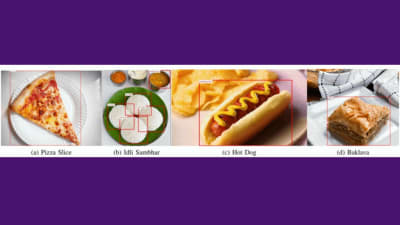
An AI system developed by NYU Tandon School of Engineering researchers promises a new tool for the millions of people who want to manage their weight, diabetes, and other diet-related health conditions.
Special Reports: Materials

Medical Manufacturing & Outsourcing - March 2025
Researchers achieve near‐void‐free 3D printing…how new laser joining technology is improving implantable device reliability…tips and techniques for adhesive bonding of plastics. Read...Articles: Photonics/Optics
See the products of tomorrow, including paper-thin optical lenses simple enough to mass produce like microchips; a compact cooling technology that can pump away heat continuously using layers of flexing thin films; and a multilayered chip design that doesn’t require any silicon wafer substrates and works at temperatures low enough to preserve the underlying layer’s circuitry.

Products: Electronics & Computers
See what's new on the market, including electronic control products from NORD DRIVESYSTEMS; the new F-141 photonics alignment system from PI; InnoPhase IoT's expansion of its Talaria platform; Aerotech, Inc.'s HexGen® HEX150-125HL Miniature Hexapod; and more.

Products: Software
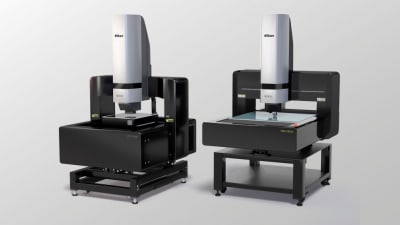
See what's new on the market, including Nikon Corporation's NEXIV VMF-K Series, a next-generation video measuring system; the surfaceCONTROL 3D snapshot sensors from Micro-Epsilon; InfraTec's INDU-SCAN base, a flexible and cost-effective thermography solution for use in industrial applications 24/7; Curtiss-Wright Actuation Division's Exlar® electric actuator product offerings; and more.
Briefs: Sensors/Data Acquisition
A Bristol-led team of physicists has found a way to operate mass manufacturable photonic sensors at the quantum limit. This breakthrough paves the way for practical applications such as monitoring greenhouse gases and cancer detection. Read on to learn more.
Briefs: Photonics/Optics
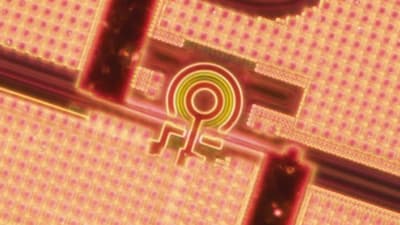
Researchers have created visible lasers of very pure colors from near-ultraviolet to near-infrared that fit on a fingertip. The colors of the lasers can be precisely tuned and extremely fast — up to 267 petahertz per second, which is critical for applications such as quantum optics. Read on to learn more.

Briefs: Nanotechnology
Researchers have designed a way to levitate and propel objects using only light by creating specific nanoscale patterning on the objects' surfaces. The work could be a step toward developing a spacecraft that could reach the nearest planet outside of our solar system in 20 years, powered and accelerated only by light. Read on to learn more.

Briefs: Data Acquisition
Purdue researchers have created technology aimed at replacing Morse code with colored “digital characters” to modernize optical storage. They are confident the advancement will help with the explosion of remote data storage during and after the COVID-19 pandemic. Read on to learn more.
Briefs: AR/AI
Researchers in the emerging field of spatial computing have developed a prototype augmented reality headset that uses holographic imaging to overlay full-color, 3D moving images on the lenses of what would appear to be an ordinary pair of glasses. Read on to learn more about it.

Top Stories
 Blog: Lighting

A Stretchable OLED that Can Maintain Most of Its Luminescence
 INSIDER: Energy

Advancing All-Solid-State Batteries
 Blog: Power

My Opinion: We Need More Power Soon — Is Nuclear the Answer?
 Quiz: Energy

 Blog: Lighting Technology

Microscopic Swimming Machines that Can Sense, Respond to Surroundings
 Blog: Data Acquisition

Webcasts
 On-Demand Webinars: Electronics & Computers

Advantages of Smart Power Distribution Unit Design for Automotive &...
 Upcoming Webinars: Automotive

Quiet, Please: NVH Improvement Opportunities in the Early Design...
 Upcoming Webinars: Test & Measurement

From Spreadsheets to Insights: Fast Data Analysis Without Complex...
 Upcoming Webinars: Defense

Cooling a New Generation of Aerospace and Defense Embedded...
 Upcoming Webinars: Sensors/Data Acquisition

Beyond AI-Copy-Paste Engineering: Advanced AI-Integration Success...
 Upcoming Webinars: Power