Access the latest developments used in sensor-related technologies. Learn more about essential applications for specialized sensors and durable designs for extreme conditions.
Achieving accurate representations of the interactions at play in MEMS devices requires multiphysics simulation. Check out the following ebook, MEMS Device R&D, for four stories on how organizations around the world are...
A new system that brings together real-world sensing and virtual reality would make it easier for building maintenance personnel to identify and fix issues in commercial buildings that are in operation. The system was developed by computer scientists at the University of California San Diego and Carnegie Mellon University. Read on to learn more.
Clean, safe water is vital for human health and well-being. However, detecting contamination quickly and accurately remains a major challenge in many parts of the world. A groundbreaking new device developed by researchers at the National University of Singapore has the potential to significantly advance water quality monitoring and management. Read on to learn more.
A new study from NC State University combines three-dimensional embroidery techniques with machine learning to create a fabric-based sensor that can control electronic devices through touch. Read on to learn more.
When it comes to haptic feedback, most technologies are limited to simple vibrations. But our skin is loaded with tiny sensors that detect pressure, vibration, stretching and more. Now, Northwestern University engineers have unveiled a new technology that creates precise movements to mimic these complex sensations. Read on to learn more.
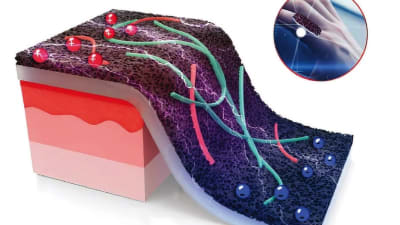
A major challenge in self-powered wearable sensors for health care monitoring is distinguishing different signals when they occur at the same time. Researchers from Penn State and China’s Hebei University of Technology addressed this issue by uncovering a new property of a sensor material, enabling the team to develop a new type of flexible sensor that can accurately measure both temperature and physical strain simultaneously but separately to more precisely pinpoint various signals.
Harvard research breakthrough could speed development of room‐temperature quantum computers…New generation of ultra‐lightweight, high‐res space cameras takes flight…NASA LiDAR advance gives...
Researchers at the University of Pennsylvania and University of Michigan have created the world’s smallest fully programmable, autonomous robots: microscopic swimming machines that can...
Sensors are expected to deliver accurate data reliably despite exposure to harsh environments including continued stress from thermal, chemical or mechanical factors. Epoxy compounds serve a critical role in...
For the broad array of industrial applications concerned with liquid flow control, extremely accurate, repeatable results are necessary to successful operation. To achieve such...
Founded by MIT alumni, the Pickle Robot Company has built machines that can autonomously load and unload trucks inside warehouses and logistic centers.
Endoscopic imaging system development requires coordination between various engineering disciplines, especially for optical illumination and imaging engines, particularly when adding fluorescence imaging capabilities. Read on to learn more about it.
If you’re wondering which of our videos from 2025 were the most popular, wonder no more! We’ve put together a list below of the top 5 Tech Briefs videos.
Miniaturization ranks as the driving force behind the semiconductor industry. The tremendous gains in computer performance since the 1950s are largely due to the fact that ever smaller...
Scientists have long sought to make semiconductors that are also superconducting, thereby enhancing their speed and energy efficiency and enabling new quantum technologies. However,...
As more devices get piled onto computer chips to increase processing power capacity, heat generation becomes increasingly concentrated. This heat must be removed to keep chip...
The phrase ‘liquid metal’ may bring to mind something hazardous, like mercury or molten steel. But in the Laboratory of Photonic Materials and Fiber Devices (FIMAP) in EPFL’s School of...
Mechanical engineering researchers in the Harvard John A. Paulson School of Engineering and Applied Sciences think there’s another way to design robots: Programming intended functions directly into a robot’s physical structure, allowing the robot to react to its surroundings without the need for extensive on-board electronics. Read on to learn more.
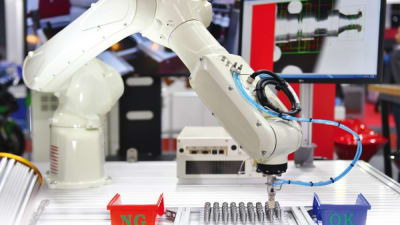
Without integrated vision, robots can only perform tasks in precisely the same way every time. If a part is even slightly out of position or rotated differently, the robot may fail to complete its task, or worse, cause an error in the process. Read on to learn more.
This compendium of articles from the editors of Tech Briefs and Aerospace & Defense Technology magazines looks at the latest advances in power electronics and energy storage for applications ranging from...
Photonic processor enables ultrafast AI computations…how new polishing technique could revolutionize optical manufacturing…facial mapping technology is a leap forward in augmented reality. Read...
The battlefield is changing and so is mission computing. In this interview, Mercury System’s Brad Bruce explains how open architectures like SOSA and MOSA are driving...
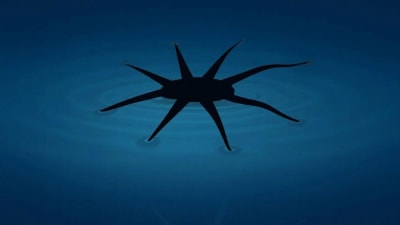
Imagine a tiny robot, no bigger than a leaf, gliding across a pond’s surface like a water strider. One day, devices like this could track pollutants, collect water samples or scout...
Researchers have developed a soft robotic skin that enables vine robots a few millimeters wide to navigate convoluted paths and fragile environments. To accomplish...
Selecting the right sensor solution is a strategic challenge. The wrong choice can compromise system performance, data reliability, and long-term scalability, making informed selection critical to...
As electrification accelerates and magnetic wire applications evolve, manufacturers are under growing pressure to deliver zero-defect quality, higher...