36,38
-1
120
30
Briefs: Energy
Researchers are hoping to spark a green battery revolution by showing that iron instead of cobalt and nickel can be used as a cathode material in lithium-ion batteries. Read on to learn more.

Briefs: Photonics/Optics
The palm-sized light field camera could improve autonomous driving, classification of recycled materials, and remote sensing. Read on to learn more about it.

Briefs: Wearables
Engineers have developed a new technique for making wearable sensors that enables medical researchers to prototype and test new designs much faster and at a far lower cost than existing methods. Read on to learn more.
Briefs: Materials
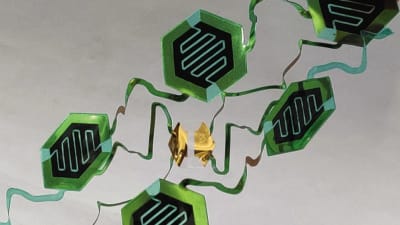
After announcing a ferroelectric semiconductor at the nanoscale thinness required for modern computing components, a University of Michigan team has demonstrated a reconfigurable transistor using that material. Read on to learn more.

Briefs: Materials
The RTV sealing method may benefit terrestrial applications that may demand cure-in-place internal seals. The method could also innovate manufacturing processes for components by enhancing the speed of assembly while increasing seal integrity. Read on to learn more.

Briefs: Manufacturing & Prototyping
This research could help to reduce the environmental impact of additive manufacturing, which typically relies on nonrecyclable polymers and resins derived from fossil fuels. Read on to learn more.

Briefs: Medical
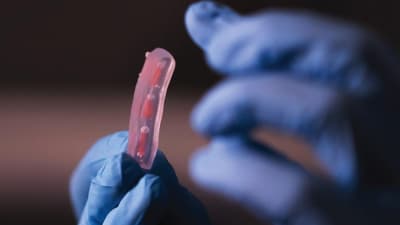
Eva Baur, a Ph.D. student, used 3D-printed double network granular elastomers (DNGEs) to print a prototype ‘finger,’ complete with rigid ‘bones’ surrounded by flexible ‘flesh.’ The finger was printed to deform in a pre-defined way, demonstrating the technology’s potential to manufacture devices that are sufficiently supple to bend and stretch, while remaining firm enough to manipulate objects. Read on to learn more.
Briefs: Photonics/Optics
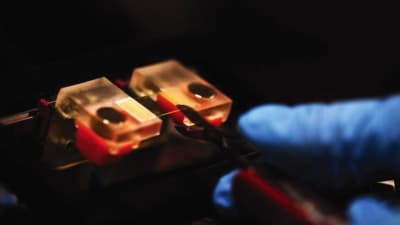
Researchers have developed standards and calibrations for optical microscopes that allow quantum dots to be aligned with the center of a photonic component to within an error of 10 to 20 nanometers (about one-thousandth the thickness of a sheet of paper). Such alignment is critical for chip-scale devices that employ the radiation emitted by quantum dots to store and transmit quantum information. Read on to learn more.

Briefs: Materials
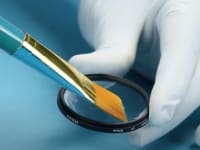
Researchers have developed a new way to produce and shape large, high-quality mirrors that are much thinner than conventional space-telescope mirrors. The final product is even flexible enough to be rolled up and stored compactly inside a launch vehicle. Read on to learn more.

Briefs: Physical Sciences
John Kolinski and his team at the Laboratory of Engineering Mechanics of Soft Interfaces aim to understand how cracks propagate in brittle solids, which is essential for developing and testing safe and cost-effective composite materials for use in construction, sports, and aerospace engineering.
Briefs: Materials
Electrodynamic dust shields (EDSs) are a key method to actively clean surfaces by running high voltages (but low currents) through electrodes on the surface. The forces generated by the voltage efficiently remove built-up, electrically charged dust particles. Innovators have developed a new transparent EDS for removing dust from space and lunar solar cells among other transparent surfaces.

Briefs: Nanotechnology
Researchers of Karlsruhe Institute of Technology and partners carried out steroid hormone adsorption experiments to study the interplay of forces in the small pores. They found that vertically aligned carbon nanotubes (VaCNT) of specific pore geometry and pore surface structure are suited for use as highly selective membranes.

Briefs: Manufacturing & Prototyping
Engineers are poised to clean things up with an oxygen-free chemical vapor deposition (OF-CVD) method that can create high-quality graphene samples at scale. Their work directly demonstrates how trace oxygen affects the growth rate of graphene and identifies the link between oxygen and graphene quality for the first time.
Briefs: Materials
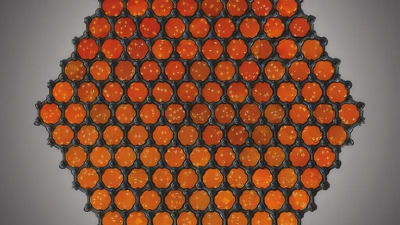
Innovators at NASA’s Glenn Research Center have made several breakthroughs in treating hexagonal boron nitride (hBN) nanomaterials, improving their properties to supplant carbon nanotubes in many applications.

Briefs: Materials
The team plans to integrate such CO2-capturing materials with its earlier porous sponge platform, which has been developed to remove environmental toxins including oil, phosphates, and microplastics.

Briefs: Energy
According to the researchers, this proof-of-concept system could be adapted to help produce precursors for plastics or other chemical feedstocks, as well as scaled up to produce larger amounts of sustainable biofuels.

Briefs: Physical Sciences
Advancing Chemical Recycling of Waste Plastics
New research from the lab of Giannis Mpoumpakis, Associate Professor of Chemical and Petroleum Engineering at the University of Pittsburgh, focuses on optimizing a promising technology called pyrolysis, which can chemically recycle waste plastics into more valuable chemicals.
Briefs: Materials
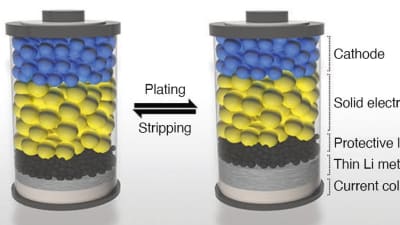
A research team from Pohang University has successfully enhanced the performance and durability of all-solid-state batteries. This breakthrough was made possible through the implementation of a novel approach known as bottom electrodeposition. Read on to learn more.
Briefs: Physical Sciences
Examining lithium metal batteries using nuclear magnetic resonance spectroscopy may help in the design of new electrolytes and anode surfaces for high-performance batteries. Read on to learn more.
Briefs: Design
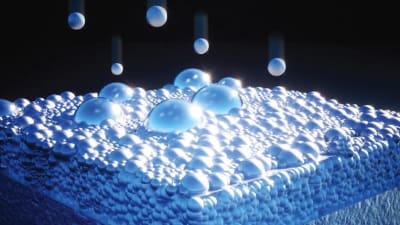
A new synthesis process for solid electrolytes marks a crucial stride toward the commercialization of all-solid-state batteries free from the risks of explosion and fire. Read on to learn more.

Briefs: Physical Sciences
A research team has developed a high-energy, high-power hybrid sodium-ion battery capable of rapid charging. The innovative hybrid energy storage system integrates anode materials typically used in batteries with cathodes suitable for supercapacitors. Read on to learn more.

Briefs: Robotics, Automation & Control
Researchers from NC State University have demonstrated mini soft hydraulic actuators that can be used to control the deformation and motion of soft robots that are less than a millimeter thick. The researchers also demonstrated that this technique works with shape memory materials.
Briefs: Robotics, Automation & Control
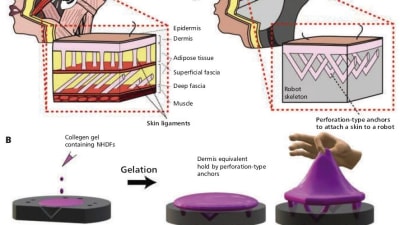
Researchers have found a way to bind engineered skin tissue to the complex forms of humanoid robots. This brings with it potential benefits to robotic platforms such as increased mobility, self-healing abilities, embedded sensing capabilities and an increasingly lifelike appearance.
Briefs: Materials
Perovskites are among the most researched topics in materials science. Recently, a research team solved an age-old challenge to synthesize all-organic two-dimensional perovskites, extending the field into the exciting realm of 2D materials. This breakthrough opens up a new field of 2D all-organic perovskites, which holds promise for both fundamental science and potential applications.

Briefs: Physical Sciences
Innovators at NASA Johnson Space Center have designed a science enclosure system for science experiments conducted aboard the International Space Station (ISS). It allows users the ability to safely manipulate objects of study within the transparent enclosure by utilizing protective boundary layer innovations whose designs may be transferable to other containment systems.

Briefs: Energy
In a recent study published in the journal ACS Applied Energy Materials, researchers have utilized poly(vinylphosphonic acid) (PVPA) as a binder for a micro-SiO electrodes, achieving superior performance compared to conventional cells. Read on to learn more.

Briefs: Physical Sciences
A global team of researchers and industry collaborators led by RMIT University has invented recyclable ’water batteries’ that won’t catch fire or explode. Read on to learn more.
Briefs: Energy
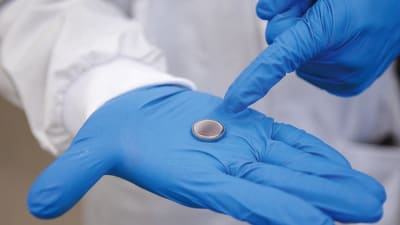
A team of researchers from Japanese and French universities has developed a practical nickel-based electrode material that opens new avenues to cobalt-free batteries for electric vehicles. Read on to learn more.

Briefs: Materials
In bringing bio-inspired robots to life, scientists must first create soft matter counterparts that match the softness and functionality of biological tissue. University of Nebraska–Lincoln engineer Eric Markvicka is at the forefront of these efforts. Read on to learn more.

Top Stories
 Blog: Lighting

A Stretchable OLED that Can Maintain Most of Its Luminescence
 Blog: Energy

Batteries that Can Withstand the Cold
 INSIDER: Energy

Advancing All-Solid-State Batteries
 Quiz: Energy

 Blog: Physical Sciences

 Blog: Materials

Webcasts
 Upcoming Webinars: Sensors/Data Acquisition

From Spreadsheets to Insights: Fast Data Analysis Without Complex...
 Upcoming Webinars: Electronics & Computers

Cooling a New Generation of Aerospace and Defense Embedded...
 Upcoming Webinars: Sensors/Data Acquisition

Beyond AI-Copy-Paste Engineering: Advanced AI-Integration Success...
 Upcoming Webinars: Power

Battery Abuse Testing: Pushing to Failure
 Upcoming Webinars: Connectivity

A FREE Two-Day Event Dedicated to Connected Mobility
 Upcoming Webinars: Test & Measurement

Choosing the Right N-Port Strategy: Multiport VNAs vs. Switch...