Stories
54
0
0
30
INSIDER: Lighting
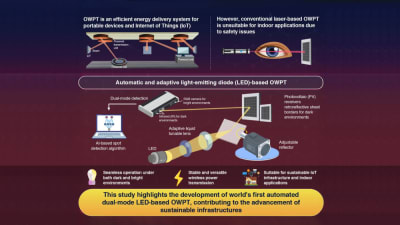
The world’s first automatic and adaptive, dual-mode light-emitting diode (LED)-based optical wireless power transmission system, that operates seamlessly under both dark and bright...
On-Demand Webinars: Transportation

Engineers face increasing pressure to design power distribution units (PDU) that can support higher complexity, greater electrification, and stricter safety...
Blog: Energy
Global energy demands are surging, pushed by energy-intensive data centers powering artificial intelligence and increased manufacturing. How will the world meet these rising energy needs? Read on to find out about one way!

White Papers: Sensors/Data Acquisition
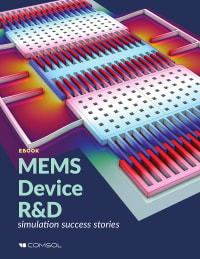
MEMS Device R&D
Achieving accurate representations of the interactions at play in MEMS devices requires multiphysics simulation. Check out the following ebook, MEMS Device R&D, for four stories on how organizations around the world are...Quiz: Electronics & Computers
It basically runs everything from laptops to smartphones, so it must be common knowledge. How much do you know about digital logic?

Briefs: Semiconductors & ICs
In two papers, one released in Nature Materials and a second in ACS Nano, researchers describe a new methodology for fabricating targeted 3D nanoscale structures via self-assembly that can find use in a variety of applications, and they provide a design algorithm for others to follow suit. And it’s all based on the most basic biomolecular building blocks: DNA. Read on to learn more.

Articles: Semiconductors & ICs
To address the staggering power and energy demands of AI, engineers have developed a revolutionary new thin-film material that promises to make AI devices significantly faster while dramatically cutting energy consumption. In this interview, Alamgir Karim, who is leading the research, discusses the new approach, its benefits, and how Nobel Prize-winning chemistry enabled this discovery.

Briefs: Semiconductors & ICs
A new study from NC State University combines three-dimensional embroidery techniques with machine learning to create a fabric-based sensor that can control electronic devices through touch. Read on to learn more.

Special Reports: Photonics/Optics

Photonics, Optics & Imaging - January 2026
Harvard research breakthrough could speed development of room‐temperature quantum computers…New generation of ultra‐lightweight, high‐res space cameras takes flight…NASA LiDAR advance gives...White Papers: Semiconductors & ICs

Use of Adhesives and Sealants for Hermetic Wire Feedthroughs
The hermetic sealing of electrical and optical feedthroughs is a critical area for assuring the longevity and reliability of devices such as optical assemblies, thermocouples, EV...White Papers: Aerospace

Adhesives for Automotive Electronics
The rise of electric vehicles and driver aids along with the proliferation of electronic sensors and safety features point towards continued growth in automotive electronics. Due to their lightweight,...INSIDER: Electronics & Computers
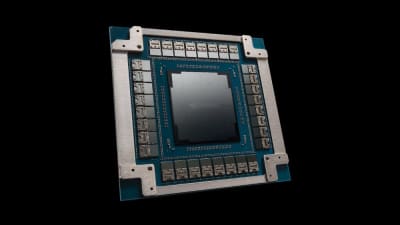
NVIDIA is bringing Ethernet networking with co-packaged optics to artificial intelligence (AI) factories, enabling scale-out and scale-across on the NVIDIA Rubin platform...
INSIDER: Electronics & Computers
Scientists have long sought to make semiconductors that are also superconducting, thereby enhancing their speed and energy efficiency and enabling new quantum technologies. However,...
INSIDER: Design
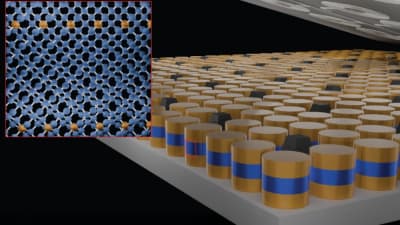
As more devices get piled onto computer chips to increase processing power capacity, heat generation becomes increasingly concentrated. This heat must be removed to keep chip...

Blog: Manufacturing & Prototyping
Engineers at The University of Texas at Austin are leading an academic and industry all-star team that aims to revolutionize the production of semiconductor chips with a new 3D printing method.
Special Reports: Transportation

ADAS/Connected & Automated Vehicles - December 2025
How the NVIDIA‐Magna collaboration is redefining autonomy…ultra‐realistic simulation speeds AV development…the 'autonomy underdogs' driving ADAS forward. Read about these and other new...Products: Information Technology
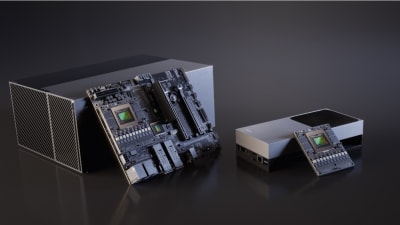
See the new products, including NVIDIA's IGX Thor, an industrial-grade platform built to bring real-time physical AI directly to the edge; Teknic's precision planetary gearboxes; PI's L-220 series linear actuators; Compact Click dev tool from MIKROE; and more.
Briefs: Photonics/Optics
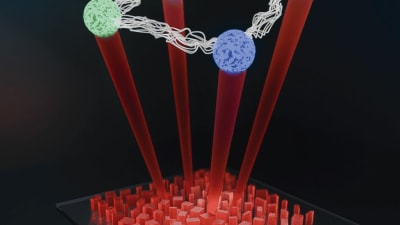
Optics researchers in the Harvard John A. Paulson School of Engineering and Applied Sciences created specially designed metasurfaces — flat devices etched with nanoscale light-manipulating patterns — to act as ultra-thin upgrades for quantum-optical chips and setups. Read on to learn more.
Briefs: Semiconductors & ICs
Cornell researchers have developed a low-power microchip they call a “microwave brain,” the first processor to compute on both ultrafast data signals and wireless communication signals by harnessing the physics of microwaves. Read on to learn more about it.

Special Reports: AR/AI
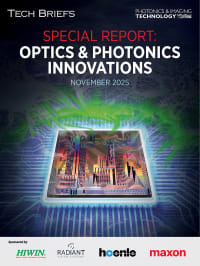
Optics & Photonics Innovations - November 2025
Photonic processor enables ultrafast AI computations…how new polishing technique could revolutionize optical manufacturing…facial mapping technology is a leap forward in augmented reality. Read...White Papers: Electronics & Computers

Transient Suppression at Different Interfaces
This White Paper presents real-world examples of filtering and suppression techniques across asymmetrical, symmetrical, and power interfaces. Using Würth Elektronik components such as ferrites,...INSIDER: Sensors/Data Acquisition
Imagine a tiny robot, no bigger than a leaf, gliding across a pond’s surface like a water strider. One day, devices like this could track pollutants, collect water samples or scout...

INSIDER: Photonics/Optics
A few years ago, researchers in Michal Lipson’s Columbia Engineering lab noticed something remarkable. They were working on a project to design high-power chips that could...

INSIDER: Physical Sciences
University of Houston researchers have made a groundbreaking discovery in thermal conductivity, overturning an existing theory that boron arsenide (BAs) couldn’t compete with...

Briefs: Sensors/Data Acquisition
Researchers at Fuzhou University in China created a machine vision sensor that uses quantum dots to adapt to extreme changes in light far faster than the human eye can — in about 40 seconds — by mimicking eyes’ key behaviors. Their results could be a game changer for robotic vision and autonomous vehicle safety. Read on to learn more.

INSIDER: Power
For more than 30 years, researchers have been trying to create small gears in order to construct micro-engines. But progress stalled at 0.1 millimeters, as it was not possible to build the...

Blog: Electronics & Computers
MIT researchers have replaced silicon with a magnetic semiconductor, creating a magnetic transistor that could enable smaller, faster, and more energy-efficient circuits.

INSIDER: Semiconductors & ICs
Transistors, the building blocks of modern electronics, are typically made of silicon. Because it’s a semiconductor, this material can control the flow of electricity in a...

Products: Energy
See the new products, including Nexperia's ESD diodes designed to protect 48V automotive data communications networks against the destructive effects of electrostatic discharge events; Comau's collaboration with Intecells to optimize the use of cold plasma within industrial cell manufacturing processes; Carlo Gavazzi Automation's UWP-DLB Series, an advanced solution delivering intelligent dynamic load balancing for EV charging systems; and more.

Top Stories
 Blog: Lighting

A Stretchable OLED that Can Maintain Most of Its Luminescence
 Blog: Energy

Batteries that Can Withstand the Cold
 INSIDER: Energy

Advancing All-Solid-State Batteries
 Blog: Power

My Opinion: We Need More Power Soon — Is Nuclear the Answer?
 Quiz: Power

 Blog: Data Acquisition

Webcasts
 Upcoming Webinars: Test & Measurement

From Spreadsheets to Insights: Fast Data Analysis Without Complex...
 Upcoming Webinars: Aerospace

Cooling a New Generation of Aerospace and Defense Embedded...
 Upcoming Webinars: Test & Measurement

Beyond AI-Copy-Paste Engineering: Advanced AI-Integration Success...
 Upcoming Webinars: Power

Battery Abuse Testing: Pushing to Failure
 Upcoming Webinars: AR/AI

A FREE Two-Day Event Dedicated to Connected Mobility
 Upcoming Webinars: RF & Microwave Electronics

Choosing the Right N-Port Strategy: Multiport VNAs vs. Switch...