
Stories
38
53
0
0
30
Articles: Manufacturing & Prototyping
As electric vehicle designs change and production targets grow even more aggressive, advanced laser welding technologies have continued to evolve to help manufacturers be more efficient and stay competitive. Read on to learn more about it.

Blog: Manned Systems
A new material might contribute to a reduction of the fossil fuels consumed by aircraft engines and gas turbines in the future.
Products: Materials
See the new products, including Plasmatreat's HydroPlasma, a solution for the removal of stubborn contaminants from glass and metal surfaces; TDK Corporation's 3000-watt TDK-Lambda brand HWS3000G programmable AC-DC power supplies; Zircotec's new range of proprietary ceramic coatings; Thermo Fisher Scientific's expanded solutions for battery manufacturers; and more.

Application Briefs: Manufacturing & Prototyping
Finland-based Metos Oy, a manufacturer of professional stainless steel kitchen equipment, needed a welding solution that could deliver flawless, pressure-rated welds for small batches of high-spec products, which feature tubular structures and circular shafts that required continuous, precision welding. Read on to find out what they did.

Podcasts: Materials
New materials are enabling the production of medical devices that are stronger, more flexible, and more sustainable.

Blog: Manufacturing & Prototyping
MIT engineers have developed a printable aluminum alloy that can withstand high temperatures and is five times stronger than traditionally manufactured aluminum.

Briefs: Materials
Researchers at the U.S. Department of Energy (DOE)’s Oak Ridge National Laboratory (ORNL) have developed an innovative new technique using carbon nanofibers to enhance binding in carbon fiber and other fiber-reinforced polymer composites — an advance likely to improve structural materials for automobiles, airplanes and other applications that require lightweight and strong materials.
Blog: Electronics & Computers
EPFL researchers have pioneered a 3D printing method that grows metals and ceramics inside a water-based gel, resulting in constructions for next-gen energy, biomedical, and sensing technologies.
Briefs: Energy
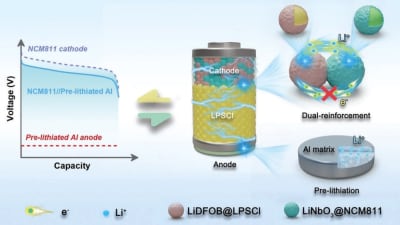
Researchers from Nanjing University, led by Professor Ping He and Professor Shaochun Tang, have published a comprehensive study in Nano-Micro Letters on the development of high-energy, stable all-solid-state lithium batteries using aluminum-based anodes and high-nickel cathodes. Read on to learn more about it.
Briefs: Power
In a major step forward for sustainable energy technology, researchers at Worcester Polytechnic Institute, led by Professor Yan Wang, William B. Smith Professor of Mechanical and Materials Engineering, have developed a new, scalable method to recycle lithium-ion batteries in a way that is both efficient and environmentally friendly. Read on to learn more.

Briefs: Materials
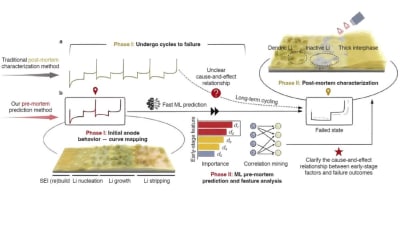
In a groundbreaking study, researchers at Tsinghua Shenzhen International Graduate School and the Shenzhen Institute of Advanced Technology, Chinese Academy of Sciences, have developed a predictive model that uses electrochemical data from the initial cycles of LMBs to forecast potential failures. Read on to learn more.
Briefs: Materials
A team of Rice University researchers led by materials scientist Ming Tang showed that even if the materials used in thick battery electrodes have nearly identical structures, their internal chemistry impacts energy flow — and, hence, performance — differently. This finding goes against conventional wisdom in the field. Read on to learn more.

Articles: Medical
See the products of tomorrow, including a new type of 3D-printed titanium that’s about a third cheaper than commonly used titanium alloys; specially designed metasurfaces — flat devices etched with nanoscale light-manipulating patterns — to act as ultra-thin upgrades for quantum-optical chips and setups; and a handheld slide staining system designed to support medical, research, or environmental monitoring.

Briefs: Manufacturing & Prototyping
Researchers at the Department of Energy’s Oak Ridge National Laboratory are using advanced manufacturing techniques to revitalize the domestic production of very large metal parts that weigh at least 10,000 pounds each and are necessary for a variety of industries, including clean energy. Read on to learn more.

Q&A: Manufacturing & Prototyping
Professor Ashif Iquebal together with Professor Aviral Shrivastava and their team at Arizona State University are developing methods for improving the quality of highly critical metal parts manufactured using 3D printing.

Briefs: Materials
Researchers at the U.S. Department of Energy (DOE)’s Oak Ridge National Laboratory (ORNL) have developed an innovative new technique using carbon nanofibers to enhance binding in carbon fiber and other fiber-reinforced polymer composites — an advance likely to improve structural materials for automobiles, airplanes and other applications that require lightweight and strong materials.

Special Reports: Manufacturing & Prototyping

Medical Manufacturing & Outsourcing - July 2025
The promise of additive manufacturing has always been clear – to rapidly create intricate geometries, structures, and implants. But its real power lies in the ability to rethink how medical...Podcasts: Materials
John Mark, Space & Defense Business Manager, Omniseal Solutions, is the guest on this sponsored interview episode of the Aerospace & Defense Technology podcast to explain the role that advanced materials and sealing technologies provide in space vehicles.

Articles: Power
Lightweight aluminum is a top choice for designing and manufacturing battery pack enclosures due to its durability and ability to enhance vehicle performance. While welding 6000-series aluminum alloys can be challenging, advanced methods like laser welding with filler wire effectively create strong, airtight joints while addressing issues like porosity and cracking. Read on to learn more.

Briefs: Power
This research has far-reaching implications, offering a path to safer, more efficient batteries that can support the growing demand for electric vehicles. As the world moves towards cleaner energy solutions, these advancements are crucial for making EVs more viable and attractive for consumers. Read on to learn more.

Briefs: Energy
To create the new batteries needed for EVs, mobile devices, and renewable energy storage, researchers have explored new materials, new designs, new configurations, and new chemistry. But one aspect — the texture of the metals used — has been historically overlooked. Read on to learn more.

Briefs: Materials
In a new study, researchers from the University of Illinois Urbana-Champaign reported that automated high-resolution electron imaging can capture the nanoscale deformation events that lead to metal failure and breakage at the origin of metal failure. Read on to learn more.

Q&A: Design
Guhaprasanna “Guha” Manogharan and his team at Penn State College of Engineering and the Center for Innovative Materials Processing through Direct Digital Deposition (CIMP-3D) have developed a method to 3D print complex parts with different materials to achieve multiple design and engineering goals.

Blog: Materials
MIT engineers have found a way to fabricate a metamaterial that is both strong and stretchy. The base material is typically highly rigid and brittle, but it is printed in precise, intricate patterns that form a structure that is both strong and flexible.

Briefs: Materials
Researchers have developed a groundbreaking near-infrared fluorescent nanosensor capable of simultaneously detecting and differentiating between iron forms — Fe(II) and Fe(III) — in living plants. Read on to learn more about it.

Briefs: Energy
The triple-layer solid electrolyte features a robust middle layer that boosts the battery’s mechanical strength, while its soft outer surface ensures an excellent electrode contact, facilitating an easy movement of lithium ions. Read on to learn more.

Briefs: Manufacturing & Prototyping
An innovator at NASA Langley Research Center has developed a novel method for making thin, lightweight radiation shielding that can be sprayed or melted onto common textiles used in clothing such as cotton, nylon, polyester, Nomex, and Kevlar. Read on to learn more about it.

Briefs: Materials
Purdue University material engineers have created a patent-pending process to develop ultrahigh-strength aluminum alloys that are suitable for additive manufacturing because of their plastic deformability. Read on to learn more.
Top Stories
 Blog: Robotics, Automation & Control

Aerial Microrobots That Can Match a Bumblebee's Speed
 Blog: Electronics & Computers

Turning Edible Fungi into Organic Memristors
 Blog: Manufacturing & Prototyping

Revolutionizing the Production of Semiconductor Chips
 News: Energy

 INSIDER: Electronics & Computers

World’s Smallest Programmable, Autonomous Robots
 INSIDER: Manufacturing & Prototyping

Webcasts
 On-Demand Webinars: Power

E/E Architecture Redefined: Building Smarter, Safer, and Scalable Vehicles
 Upcoming Webinars: Energy

Hydrogen Engines Are Heating Up for Heavy Duty
 Upcoming Webinars: Electronics & Computers

Advantages of Smart Power Distribution Unit Design for Automotive...
 Upcoming Webinars: Automotive

Quiet, Please: NVH Improvement Opportunities in the Early Design...
 Upcoming Webinars: Power

A FREE Two-Day Event Dedicated to Connected Mobility
 Podcasts: Defense

How Sift's Unified Observability Platform Accelerates Drone Innovation