-1
0
30
Blog: Semiconductors & ICs
Global energy demands are surging, pushed by energy-intensive data centers powering artificial intelligence and increased manufacturing. How will the world meet these rising energy needs? Read on to find out about one way!

Blog: Materials
Physicists have uncovered a link between magnetism and a mysterious phase of matter called the pseudogap, which appears in certain quantum materials just above the temperature at which they become superconducting.
Blog: Energy
Researchers at Texas A&M University have developed a battery design that continues operating through the coldest conditions.

Blog: Materials
Marc Porosoff, Associate Professor, University of Rochester, Department of Chemical and Sustainability Engineering, and his collaborators recently achieved several key advancements to make tungsten carbide a more viable alternative to platinum in chemical reactions.

Blog: Aerospace
The new tracking method generates more detailed information in near real-time than authorities have today about the reentry of space debris from falling satellites — information that will help to quickly locate and retrieve the charred and sometimes toxic remains.

Blog: Lighting
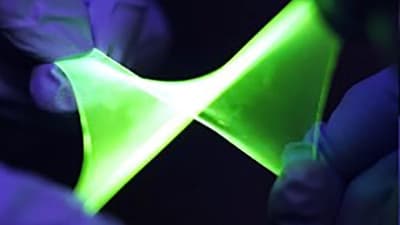
An international collaboration has developed a flexible and stretchable OLED that could put the technology on track for new applications.
Blog: AR/AI
Electrical demand, moved largely by AI, is skyrocketing, but is nuclear energy the best solution?

Blog: Robotics, Automation & Control
Researchers have created the world’s smallest programmable, autonomous robots: microscopic swimming machines that can independently sense and respond to their surroundings, operate for months, and cost just a penny each.

Blog: Materials
Researchers detail how an existing sodium-based material, sodium vanadium oxide, can perform significantly better when the water it naturally contains is not removed.
Blog: Medical
An AI system that can predict what a patient’s knee X-ray will look like a year in the future could transform how millions of people with osteoarthritis understand and manage their condition, according to research by the University of Surrey.

News: Green Design & Manufacturing
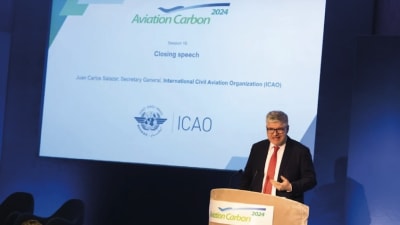
SAE Media Group®, an SAE International company and a leading global provider of conferences and publications for aerospace, defense, and other critical industries, has announced its acquisition of Aviation Carbon, the specialist event platform dedicated to carbon reduction, sustainability, and decarbonization across the aviation industry.
Blog: Electronics & Computers
Researchers from The Ohio State University recently discovered that common edible fungi, such as shiitake mushrooms, can be grown and trained to act as organic memristors, a type of data processor that can remember past electrical states.

Blog: Aerospace
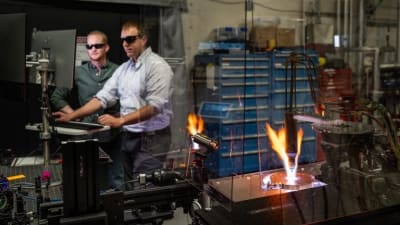
A team of engineers at Sandia National Laboratories has developed ways to rapidly evaluate new thermal protection (heat shield) materials for hypersonic vehicles.
Blog: Robotics, Automation & Control
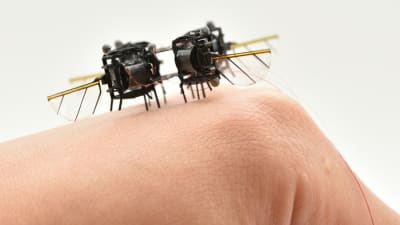
MIT researchers have demonstrated aerial microrobots that can fly with speed and agility that is comparable to their biological counterparts.
Blog: Manufacturing & Prototyping
Engineers at Carnegie Mellon University have created a fast, highly accurate simulator for spray-based concrete 3D printing that could enable stronger, more complex, and less wasteful construction by predicting how concrete behaves and solidifies, even around rebar.

Blog: Robotics, Automation & Control
As engineering continues to shape society and drive innovation, here are the year’s top 10 engineering stories that resonated most with Tech Briefs' audience.

Blog: Aerospace
If you’re wondering which of our videos from 2025 were the most popular, wonder no more! We’ve put together a list below of the top 5 Tech Briefs videos.

Blog: Energy
Learn which of our little tests were the most popular this year. Find out which five quizzes topped our 2025 list. Thanks for yet another year of loyal readership; we appreciate your devotion to Tech Briefs. Happy Holidays!

Blog: Wearables
By combining high spatial resolution with a comfortable, wearable form factor, VoxeLite recreates touch sensations, which could transform how people interact with digital environments, including more immersive virtual reality systems, assistive technologies for people with vision impairments, human-robot interfaces, and enhanced touchscreens.

Blog: Medical
It’s a mistake to focus on AI without thinking about how it is used by the people working with it.

Blog: Design
We here at Tech Briefs want to remedy that toxic part of the holidays. So, we put together a list of terrific gift ideas for anyone — but especially the engineer — in your life.

Blog: Semiconductors & ICs
Engineers at The University of Texas at Austin are leading an academic and industry all-star team that aims to revolutionize the production of semiconductor chips with a new 3D printing method.
Blog: Materials
A new material might contribute to a reduction of the fossil fuels consumed by aircraft engines and gas turbines in the future.
Blog: Design
International research collaboration has unlocked a new approach that performs complex tensor computations using a single propagation of light. The result is single-shot tensor computing, achieved at the speed of light itself.

Blog: Materials
Researchers at the University of Sydney and start-up Dewpoint Innovations have developed a nanoengineered polymer paint-like coating that can passively cool buildings and capture water directly from the air — all without energy input.

Blog: Mechanical & Fluid Systems
Researchers have built a self-powered device that detects toxic amines in water using electrochemiluminescence (ECL).

Blog: Energy
It's crucial at this point in time to think about the direction of AI development. If it's not done right, there will be serious global consequences.

Blog: Electronics & Computers
The 23rd annual Create the Future Design Contest was held November 7 in New York City. Read on to find out who took home the $25,000 grand prize!

Blog: Design
MIT engineers have developed a printable aluminum alloy that can withstand high temperatures and is five times stronger than traditionally manufactured aluminum.

Top Stories
 Blog: Design

A Stretchable OLED that Can Maintain Most of Its Luminescence
 INSIDER: Energy

Advancing All-Solid-State Batteries
 Blog: Design

Batteries that Can Withstand the Cold
 Blog: AR/AI

My Opinion: We Need More Power Soon — Is Nuclear the Answer?
 Quiz: Power

 Blog: Physical Sciences

Webcasts
 Upcoming Webinars: Test & Measurement

From Spreadsheets to Insights: Fast Data Analysis Without Complex...
 Upcoming Webinars: Electronics & Computers

Cooling a New Generation of Aerospace and Defense Embedded...
 Upcoming Webinars: Test & Measurement

Beyond AI-Copy-Paste Engineering: Advanced AI-Integration Success...
 Upcoming Webinars: Energy

Battery Abuse Testing: Pushing to Failure
 Upcoming Webinars: Power

A FREE Two-Day Event Dedicated to Connected Mobility
 Upcoming Webinars: Test & Measurement

Choosing the Right N-Port Strategy: Multiport VNAs vs. Switch...